Int J Gynecol Cancer. 2018 Mar;28(3):479-485. doi: 10.1097/IGC.0000000000001190.
The objectives of this study were to assess if targeted investigation for tumor-specific mutations by ultradeep DNA sequencing of peritoneal washes of ovarian cancer patients after primary surgical debulking and chemotherapy, and clinically diagnosed as disease free, provides a more sensitive and specific method to assess actual treatment response and tailor future therapy and to compare this "molecular second look" with conventional cytology and histopathology-based findings.
METHODS/MATERIALS: We identified 10 patients with advanced-stage, high-grade serous ovarian cancer who had undergone second-look laparoscopy and for whom DNA could be isolated from biobanked paired blood, primary and recurrent tumor, and second-look peritoneal washes. A targeted 56 gene cancer-relevant panel was used for next-generation sequencing (average coverage, >6500×). Mutations were validated using either digital droplet polymerase chain reaction (ddPCR) or Sanger sequencing.
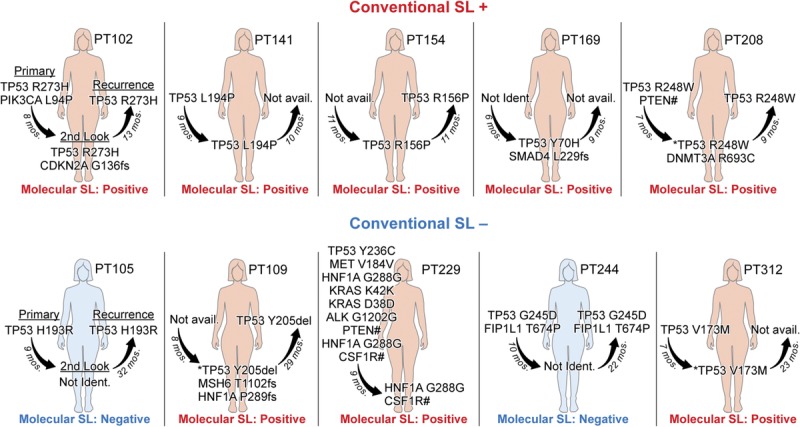
A total of 25 tumor-specific mutations were identified (median, 2/patient; range, 1-8). TP53 mutations were identified in at least 1 sample from all patients. All 5 pathology-based second-look positive patients were confirmed positive by molecular second look. Genetic analysis revealed that 3 of the 5 pathology-based negative second looks were actually positive. In the 2 patients, the second-look mutations were present in either the original primary or recurrent tumors. In the third, 2 high-frequency, novel frameshift mutations in MSH6 and HNF1A were identified.
The molecular second look detects tumor-specific evidence of residual disease and provides genetic insight into tumor evolution and future recurrences beyond standard pathology. In the precision medicine era, detecting and genetically characterizing residual disease after standard treatment will be invaluable for improving patient outcomes.
本研究旨在评估对经初次手术减瘤和化疗后且临床诊断无疾病残留的卵巢癌患者的腹腔冲洗液进行靶向肿瘤特异性基因突变的超高深度 DNA 测序,是否比传统细胞学和基于组织病理学的检查方法更敏感、更特异,从而更准确地评估实际治疗反应并为未来的治疗提供指导。
方法/材料:我们选择了 10 名经二次腹腔镜检查且可从配对的血、原发和复发性肿瘤以及二次腹腔镜检查的腹腔冲洗液中提取 DNA 的晚期、高级别浆液性卵巢癌患者。使用靶向 56 个基因的癌症相关panel 进行下一代测序(平均覆盖度>6500×)。采用数字液滴聚合酶链反应(ddPCR)或 Sanger 测序对突变进行验证。
共鉴定出 25 个肿瘤特异性突变(中位数为 2/例;范围 1-8)。所有患者均至少在 1 个样本中发现 TP53 突变。所有 5 例基于组织病理学的二次检查阳性患者均通过分子二次检查得到确认。遗传分析显示,5 例基于组织病理学的二次检查阴性患者中有 3 例实际上为阳性。在这 2 例患者中,二次检查的突变存在于原始原发肿瘤或复发性肿瘤中。在第 3 例患者中,鉴定出 MSH6 和 HNF1A 中 2 个高频、新型移码突变。
分子二次检查可检测到残留疾病的肿瘤特异性证据,并提供有关肿瘤进化和未来复发的遗传信息,超出了标准病理学的范围。在精准医学时代,检测和遗传特征分析标准治疗后的残留疾病对于改善患者预后将具有重要价值。