Skrzat-Klapaczyńska Agata, Matłosz Bartłomiej, Bednarska Agnieszka, Paciorek Marcin, Firląg-Burkacka Ewa, Horban Andrzej, Kowalska Justyna D
Medical University of Warsaw, Department for Adult's Infectious Diseases, Warsaw, Poland.
Hospital for Infectious Diseases, HIV Out-Patient Clinic, Warsaw, Poland.
PLoS One. 2018 Jan 11;13(1):e0190564. doi: 10.1371/journal.pone.0190564. eCollection 2018.
Urinary tract infections remain an important yet underinvestigated clinical problem among HIV infected patients. Here we analyze factors associated with its occurrence and the spectrum of bacterial pathogens identified in the group of patients followed at the HIV Out-Patient Clinic in Warsaw.
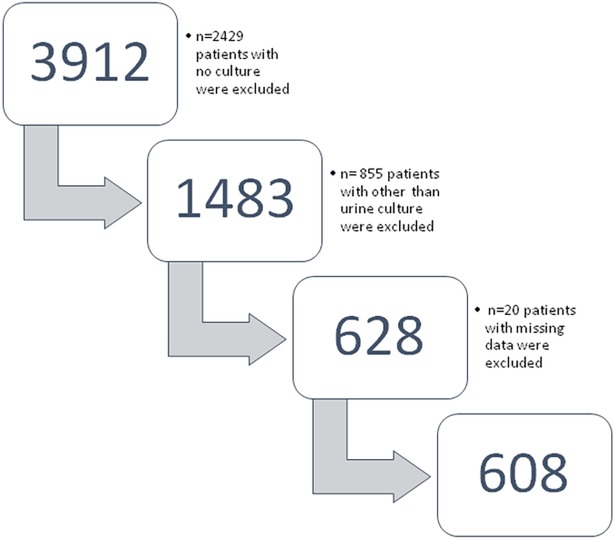
Clinic database collected all medical information on patients routinely followed since 1994 to 2015. All patients with available urine culture were included into analyses, only the first culture was included. In statistical analyses logistic regression models were used to identify factors associated with positive culture.
In total 608 patients had urine culture performed, 176 (28.9%) were females and 432 (71,1%) were males, 378 (62.2%) registered in care before/in 2007, 258 (42.4%) infected through homosexual contact. Median baseline lymphocyte CD4+ count was 385 (IQR:204-565) cells/μl and median nadir lymphocyte CD4+ count 197 (86-306) cells/μl. One hundred and eighteen patients were actively infected with HCV, as defined by positive real-time PCR. In total 141 (23.2%) patients had positive urine culture, the most common bacterial pathogen was E.coli (58.2%) and E. faecalis (12.8%). Patients with urinary tract infection were more likely to be female (51.8% vs. 22.1%, p<0.0001), infected through other than homosexual mode (80.1% vs. 50.7%, p<0.0001), with lower nadir CD4 count (139 vs. 221 cells/μl, p<0.0001) and lower baseline HIV RNA (4.02 vs. 4.35 log copies/ml, p = 0.01) and less likely to be HCV RNA positive (26.9% vs. 49.2%, p = 0.01). In multivariate regression model being registered before/in 2007 (OR = 2.10; [95%CI: 1.24-3.56]), infected through other than homosexual mode (2.05;[1.18-3.56]) and female gender (2.14;[1.33-3.44]) were increasing and higher nadir CD4+ count decreasing (0.92;[0.85-0.99]) the odds of urinary tract infection.
We have identified that almost one third of patients had urinary tract infections with non-typical bacterial pathogens. Population with increased odds of urinary tract infections are women, patients infected through other than homosexual contacts and those registered before 2007.
尿路感染在HIV感染患者中仍然是一个重要但研究不足的临床问题。在此,我们分析了华沙HIV门诊随访患者中与尿路感染发生相关的因素以及所鉴定的细菌病原体谱。
临床数据库收集了自1994年至2015年常规随访患者的所有医疗信息。所有有可用尿培养结果的患者均纳入分析,仅纳入首次培养结果。在统计分析中,使用逻辑回归模型来确定与培养阳性相关的因素。
共有608例患者进行了尿培养,其中176例(28.9%)为女性,432例(71.1%)为男性,378例(62.2%)于2007年及以前登记接受治疗,258例(42.4%)通过同性恋接触感染。基线淋巴细胞CD4 +计数中位数为385(四分位间距:204 - 565)个细胞/μl,最低点淋巴细胞CD4 +计数中位数为197(86 - 306)个细胞/μl。118例患者经实时PCR检测确诊为HCV现症感染。共有141例(23.2%)患者尿培养阳性,最常见的细菌病原体是大肠埃希菌(58.2%)和粪肠球菌(12.8%)。尿路感染患者更可能为女性(51.8%对22.1%,p<0.0001),通过非同性恋方式感染(80.1%对50.7%,p<0.0001),最低点CD4计数较低(139对221个细胞/μl,p<0.0001),基线HIV RNA较低(4.02对4.35 log拷贝/ml,p = 0.01),且HCV RNA阳性的可能性较小(26.9%对49.2%,p = 0.01)。在多变量回归模型中,2007年及以前登记接受治疗(比值比 = 2.10;[95%置信区间:1.24 - 3.56])、通过非同性恋方式感染(2.05;[1.18 - 3.56])和女性性别(2.14;[1.33 - 3.44])会增加尿路感染的几率,而最低点CD4 +计数较高则会降低(0.92;[0.85 - 0.99])尿路感染的几率。
我们发现近三分之一的患者患有由非典型细菌病原体引起的尿路感染。尿路感染几率增加的人群包括女性、通过非同性恋接触感染的患者以及2007年以前登记接受治疗的患者。