Iyer Janaki Kannan, Dickey Alexia, Rouhani Parvaneh, Kaul Anil, Govindaraju Nirmal, Singh Raj Narain, Kaul Rashmi
Department of Biochemistry and Microbiology, Oklahoma State University-Center for Health Sciences, Tulsa, Oklahoma, United States of America.
School of Materials Science and Engineering, Oklahoma State University-Tulsa, Tulsa, Oklahoma, United States of America.
PLoS One. 2018 Jan 11;13(1):e0191020. doi: 10.1371/journal.pone.0191020. eCollection 2018.
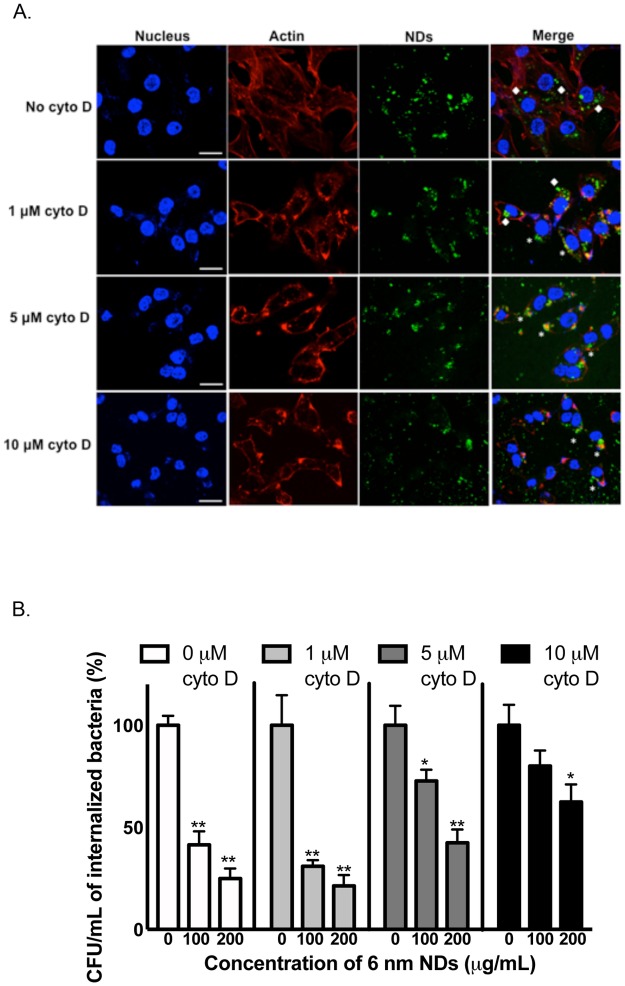
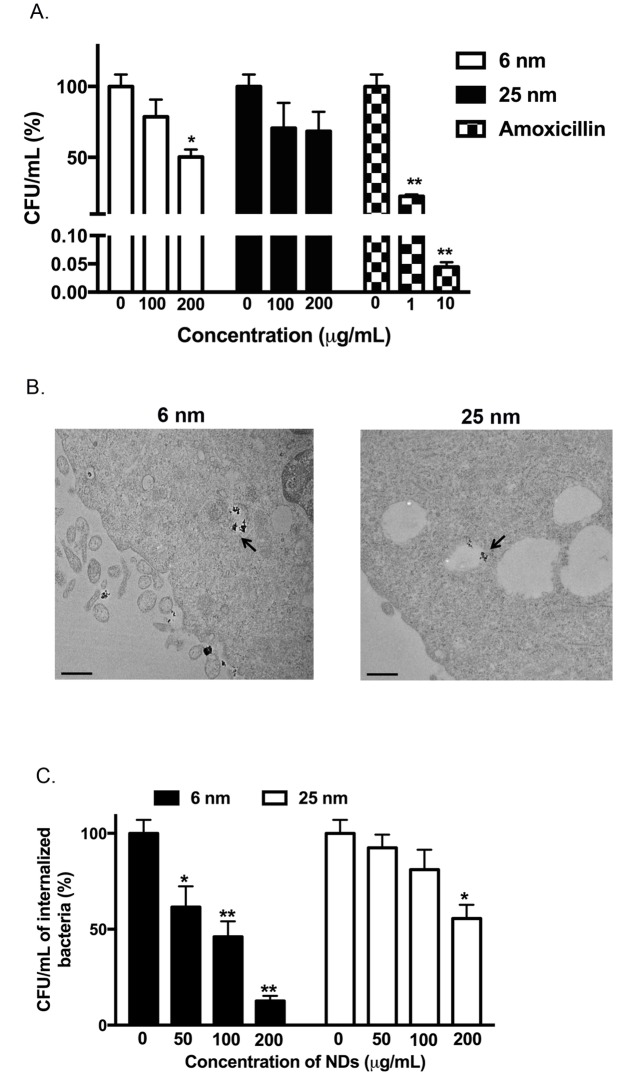
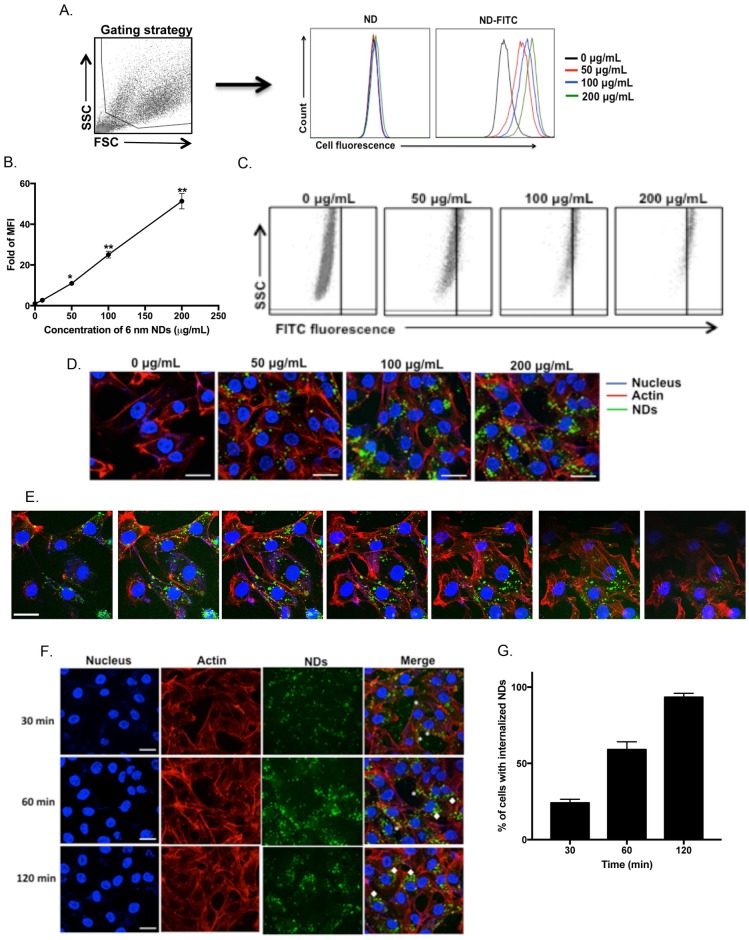
About 25-44% of women will experience at least one episode of recurrent UTI and the causative agent in over 70% of UTI cases is uropathogenic Escherichia coli (UPEC). UPEC cause recurrent UTI by evading the bladder's innate immune system through internalization into the bladder epithelium where antibiotics cannot reach or be effective. Thus, it is important to develop novel therapeutics to eliminate these intracellular pathogens. Nanodiamonds (NDs) are biocompatible nanomaterials that serve as promising candidates for targeted therapeutic applications. The objective of the current study was to investigate if 6 or 25 nm NDs can kill extracellular and intracellular UPEC in infected bladder cells. We utilized the human bladder epithelial cell line, T24, and an invasive strain of UPEC that causes recurrent UTI. We found that acid-purified 6 nm NDs displayed greater antibacterial properties towards UPEC than 25 nm NDs (11.5% vs 94.2% CFU/mL at 100 μg/mL of 6 and 25 nm, respectively; P<0.001). Furthermore, 6 nm NDs were better than 25 nm NDs in reducing the number of UPEC internalized in T24 bladder cells (46.1% vs 81.1% CFU/mL at 100 μg/mL of 6 and 25 nm, respectively; P<0.01). Our studies demonstrate that 6 nm NDs interacted with T24 bladder cells in a dose-dependent manner and were internalized in 2 hours through an actin-dependent mechanism. Finally, internalization of NDs was required for reducing the number of intracellular UPEC in T24 bladder cells. These findings suggest that 6 nm NDs are promising candidates to treat recurrent UTIs.
约25%-44%的女性会经历至少一次复发性尿路感染,超过70%的尿路感染病例的病原体是尿路致病性大肠杆菌(UPEC)。UPEC通过内化进入膀胱上皮细胞,从而逃避膀胱的固有免疫系统,而抗生素无法到达此处或发挥作用,进而导致复发性尿路感染。因此,开发新型疗法以消除这些细胞内病原体很重要。纳米金刚石(NDs)是具有生物相容性的纳米材料,有望用于靶向治疗应用。本研究的目的是调查6纳米或25纳米的纳米金刚石是否能杀死受感染膀胱细胞中的细胞外和细胞内UPEC。我们使用了人膀胱上皮细胞系T24和一种导致复发性尿路感染的侵袭性UPEC菌株。我们发现,酸纯化的6纳米纳米金刚石对UPEC的抗菌性能比25纳米的纳米金刚石更强(在6纳米和25纳米分别为100μg/mL时,CFU/mL分别为11.5%和94.2%;P<0.001)。此外,在减少T24膀胱细胞内化的UPEC数量方面,6纳米的纳米金刚石比25纳米的纳米金刚石更有效(在6纳米和25纳米分别为100μg/mL时,CFU/mL分别为46.1%和81.1%;P<0.01)。我们的研究表明,6纳米的纳米金刚石与T24膀胱细胞以剂量依赖的方式相互作用,并在2小时内通过肌动蛋白依赖机制内化。最后,纳米金刚石的内化是减少T24膀胱细胞内细胞内UPEC数量所必需的。这些发现表明,6纳米的纳米金刚石有望用于治疗复发性尿路感染。