Mwau Matilu, Syeunda Catherine Akinyi, Adhiambo Maureen, Bwana Priska, Kithinji Lucy, Mwende Joy, Oyiengo Laura, Sirengo Martin, Boeke Caroline E
Kenya Medical Research Institute, Nairobi, Kenya.
National AIDS and STIs Control Program, Ministry of Health, Kenya, Nairobi, Kenya.
PLoS One. 2018 Jan 11;13(1):e0190659. doi: 10.1371/journal.pone.0190659. eCollection 2018.
Kenya is one of the first African countries to scale up a national HIV viral load monitoring program. We sought to assess program scale up using the national database and identify areas for systems strengthening.
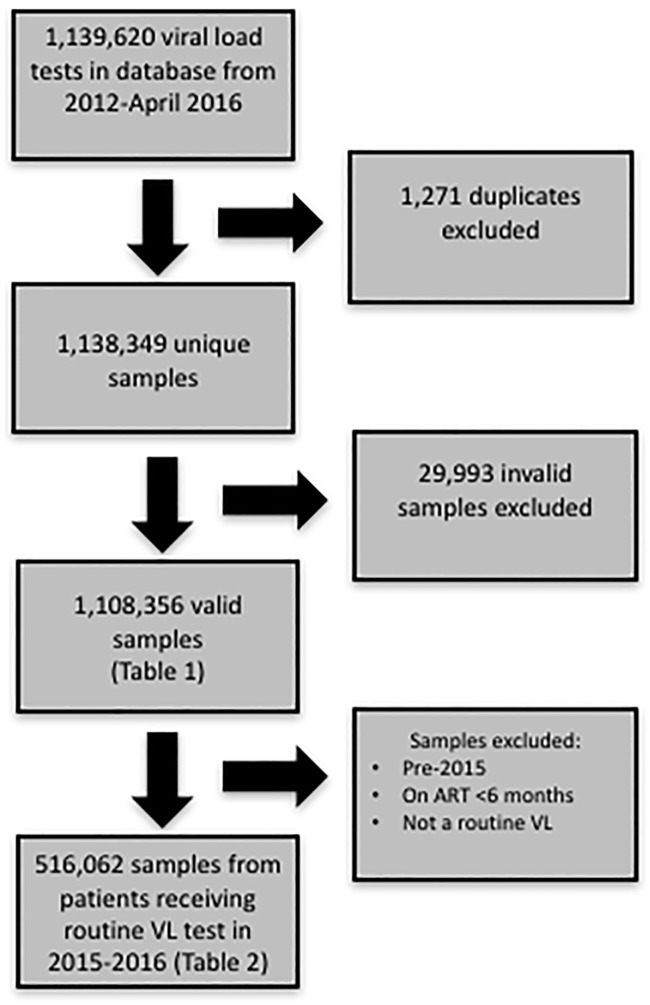
Data from January 2012 to March 2016 were extracted from Kenya's national viral load database. Characteristics of 1,108,356 tests were assessed over time, including reason for testing, turnaround times, test results, treatment regimens, and socio-demographic information.
The number of facilities offering viral load testing increased to ~2,000 with >40,000 tests being conducted per month by 2016. By March 2016, most (84.2%) tests were conducted for routine monitoring purposes and the turnaround time from facility-level sample collection to result dispatch from the lab was 21(24) [median (IQR)] days. Although the proportions of repeat viral load tests increased over time, the volumes were lower than expected. Elevated viral load was much more common in pediatric and adolescent patients (0-<3 years: 43.1%, 3-<10 years: 34.5%, 10-<20 years: 36.6%) than in adults (30-<60 years: 13.3%; p<0.001).
Coverage of viral load testing dramatically increased in Kenya to >50% of patients on antiretroviral therapy (ART) by early 2016 and represents a relatively efficient laboratory system. However, strengthening of patient tracking mechanisms and viral load result utilization may be necessary to further improve the system. Additional focus is needed on paediatric/adolescent patients to improve viral suppression in these groups. Kenya's national viral load database has demonstrated its usefulness in assessing laboratory programs, tracking trends in patient characteristics, monitoring scale-up of new policies and programs, and identifying problem areas for further investigation.
肯尼亚是最早扩大国家艾滋病毒病毒载量监测项目规模的非洲国家之一。我们试图利用国家数据库评估项目的扩大规模情况,并确定加强系统的领域。
从肯尼亚国家病毒载量数据库中提取2012年1月至2016年3月的数据。对1,108,356次检测的特征进行了长期评估,包括检测原因、周转时间、检测结果、治疗方案和社会人口统计学信息。
到2016年,提供病毒载量检测的机构数量增加到约2000个,每月进行超过40,000次检测。到2016年3月,大多数(84.2%)检测是为了常规监测目的进行的,从机构层面样本采集到实验室结果发送的周转时间为21(24) [中位数(四分位间距)]天。尽管重复病毒载量检测的比例随时间增加,但数量低于预期。病毒载量升高在儿科和青少年患者(0至<3岁:43.1%,3至<10岁:34.5%,10至<20岁:36.6%)中比在成人(30至<60岁:13.3%;p<0.001)中更为常见。
到2016年初,肯尼亚病毒载量检测的覆盖率大幅提高,接受抗逆转录病毒治疗(ART)的患者中超过50%接受了检测,这代表了一个相对高效的实验室系统。然而,可能需要加强患者追踪机制和病毒载量结果的利用,以进一步改进该系统。需要额外关注儿科/青少年患者,以提高这些群体的病毒抑制率。肯尼亚国家病毒载量数据库已证明其在评估实验室项目、追踪患者特征趋势、监测新政策和项目的扩大规模以及确定需要进一步调查的问题领域方面的有用性。