Nguyen Thang, Nguyen Hoa Q, Widyakusuma Niken N, Nguyen Thao H, Pham Tam T, Taxis Katja
Department of Pharmacology and Clinical Pharmacy, Faculty of Pharmacy, Can Tho University of Medicine and Pharmacy, Can Tho, Vietnam.
Groningen Research Institute of Pharmacy, Unit of PharmacoTherapy, Epidemiology & Economics, University of Groningen, Groningen, The Netherlands.
BMJ Open. 2018 Jan 10;8(1):e018271. doi: 10.1136/bmjopen-2017-018271.
Ischaemic heart diseases (IHDs) are a leading cause of death worldwide. Although prescribing according to guidelines improves health outcomes, it remains suboptimal. We determined whether interventions targeted at healthcare professionals are effective to enhance prescribing and health outcomes in patients with IHDs.
We systematically searched PubMed and EMBASE for studies published between 1 January 2000 and 31 August 2017. We included original studies of interventions targeted at healthcare professionals to enhance prescribing guideline-recommended medications for IHDs. We only included randomised controlled trials (RCTs). Main outcomes were the proportion of eligible patients receiving guideline-recommended medications, the proportion of patients achieving target blood pressure and target low-density lipoprotein-cholesterol (LDL-C)/cholesterol level and mortality rate. Meta-analyses were performed using the inverse-variance method and the random effects model. The quality of evidence was assessed using the Grading of Recommendations, Assessment, Development, and Evaluation approach.
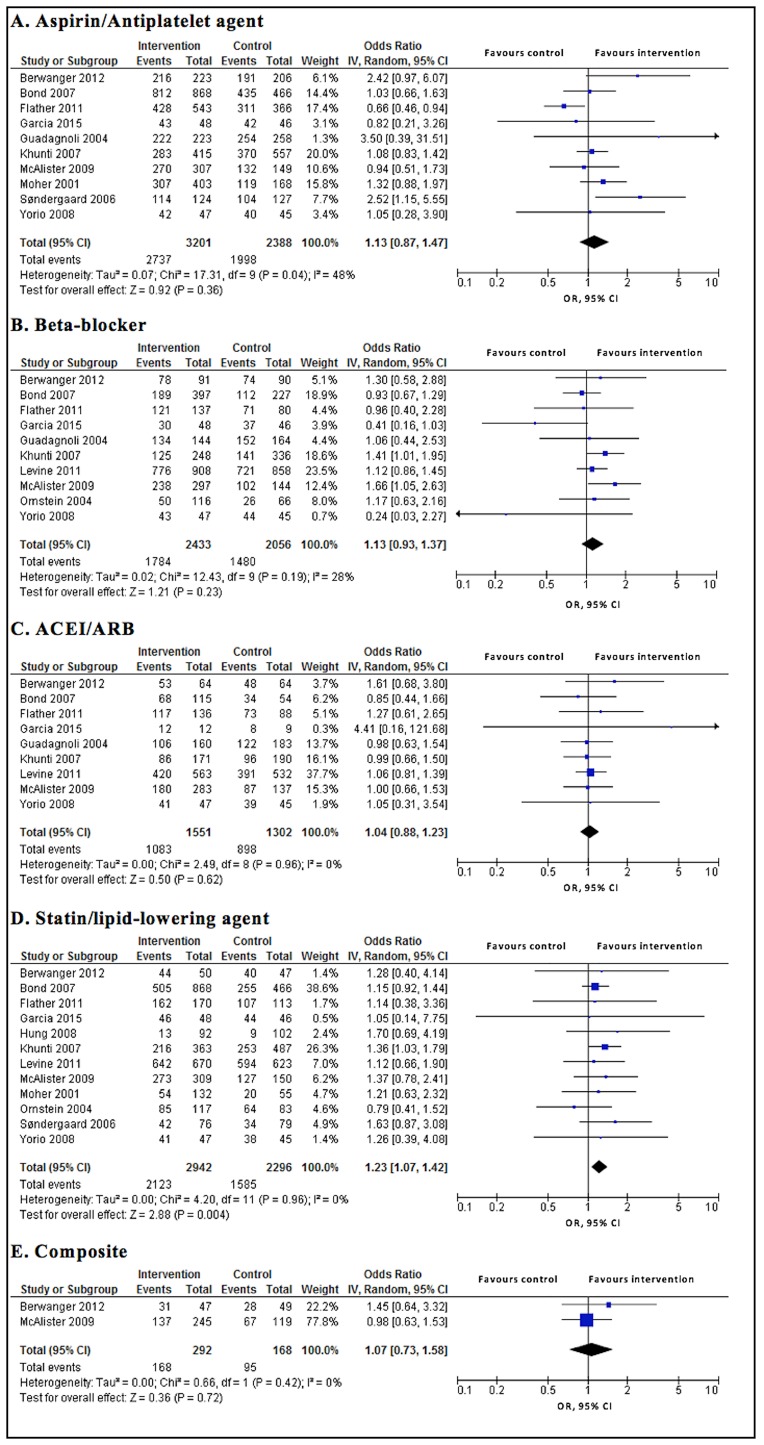
We included 13 studies, 4 RCTs (1869 patients) and 9 cluster RCTs (15 224 patients). 11 out of 13 studies were performed in North America and Europe. Interventions were of organisational or professional nature. The interventions significantly enhanced prescribing of statins/lipid-lowering agents (OR 1.23; 95% CI 1.07 to 1.42, P=0.004), but not other medications (aspirin/antiplatelet agents, beta-blockers, ACE inhibitors/angiotensin II receptor blockers and the composite of medications). There was no significant association between the interventions and improved health outcomes (target LDL-C and mortality) except for target blood pressure (OR 1.46; 95% CI 1.11 to 1.93; P=0.008). The evidence was of moderate or high quality for all outcomes.
Organisational and professional interventions improved prescribing of statins/lipid-lowering agents and target blood pressure in patients with IHDs but there was little evidence of change in other outcomes.
CRD42016039188.
缺血性心脏病(IHD)是全球主要死因。尽管遵循指南开药可改善健康结局,但仍未达到最佳效果。我们确定针对医疗保健专业人员的干预措施是否能有效提高IHD患者的用药依从性和健康结局。
我们系统检索了PubMed和EMBASE数据库中2000年1月1日至2017年8月31日发表的研究。纳入针对医疗保健专业人员的干预措施的原始研究,以增加IHD指南推荐药物的处方量。我们仅纳入随机对照试验(RCT)。主要结局包括接受指南推荐药物的合格患者比例、达到目标血压和目标低密度脂蛋白胆固醇(LDL-C)/胆固醇水平的患者比例以及死亡率。采用逆方差法和随机效应模型进行荟萃分析。使用推荐分级、评估、制定和评价方法评估证据质量。
我们纳入了13项研究,4项RCT(1869例患者)和9项整群RCT(15224例患者)。13项研究中有11项在北美和欧洲进行。干预措施具有组织或专业性质。干预措施显著增加了他汀类药物/降脂药物的处方量(OR 1.23;95%CI 1.07至1.42,P = 0.004),但对其他药物(阿司匹林/抗血小板药物、β受体阻滞剂、ACE抑制剂/血管紧张素II受体阻滞剂以及药物组合)没有影响。除目标血压外,干预措施与改善健康结局(目标LDL-C和死亡率)之间无显著关联(OR 1.