From the Division of Cardiovascular Medicine, Addenbrooke's Hospital (H.Y., A.F., K.F., N.F., M.B.) and Department of Biochemistry (T.L.), University of Cambridge, United Kingdom; and Institute of Medical Biology, Peking Union Medical College, Chinese Academy of Medical Sciences, Kunming, Yunnan Province, China (Z.Y.).
Arterioscler Thromb Vasc Biol. 2018 Mar;38(3):555-565. doi: 10.1161/ATVBAHA.117.310502. Epub 2018 Jan 11.
Vascular smooth muscle cell (VSMC) apoptosis accelerates atherosclerosis and promotes breakdown of the extracellular matrix, but the mechanistic links between these 2 processes are unknown. The forkhead protein FOXO3a (forkhead transcription factor O subfamily member 3a) is activated in human atherosclerosis and induces a range of proapoptotic and other transcriptional targets. We, therefore, determined the mechanisms and consequences of FOXO3a activation in atherosclerosis and arterial remodeling after injury.
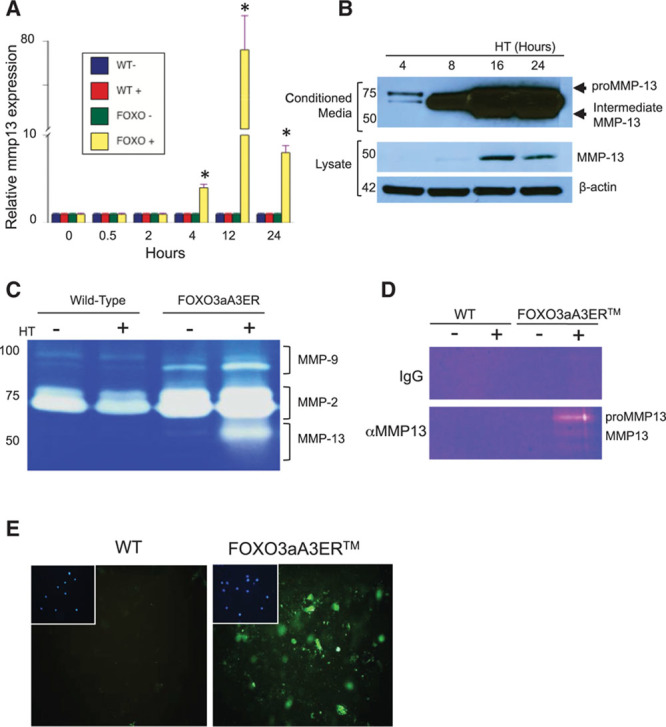
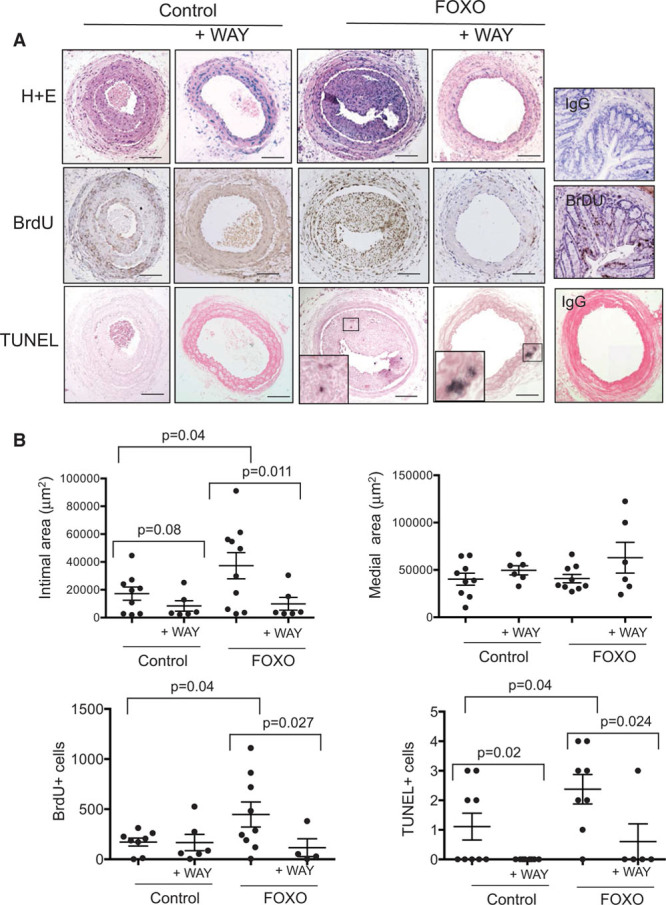
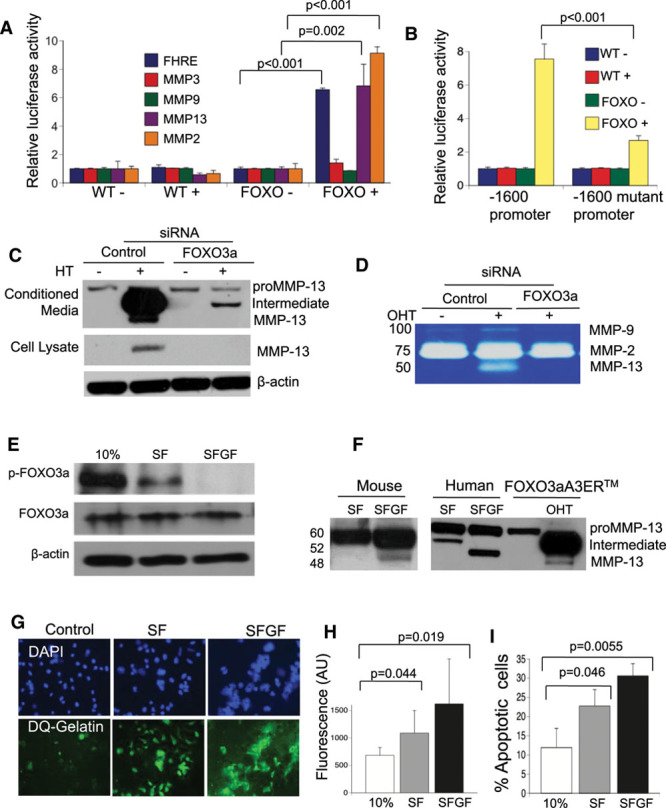
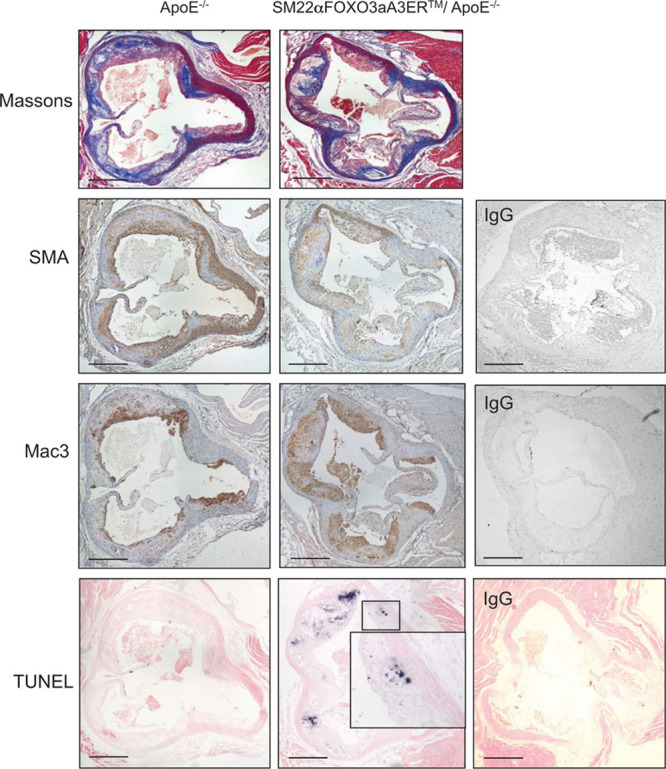
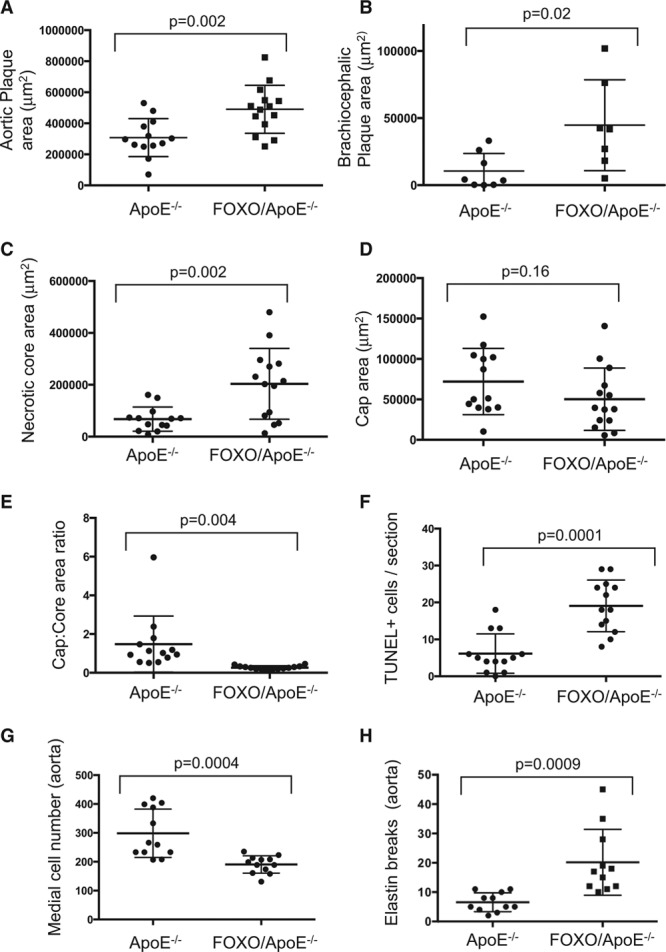
Expression of a conditional FOXO3a allele (FOXO3aA3ER) potently induced VSMC apoptosis, expression and activation of MMP13 (matrix metalloproteinase 13), and downregulation of endogenous TIMPs (tissue inhibitors of MMPs). and were direct FOXO3a transcriptional targets in VSMCs. Activation of endogenous FOXO3a also induced MMP13, extracellular matrix degradation, and apoptosis, and MMP13-specific inhibitors and fibronectin reduced FOXO3a-mediated apoptosis. FOXO3a activation in mice with VSMC-restricted FOXO3aA3ER induced MMP13 expression and activity and medial VSMC apoptosis. FOXO3a activation in FOXO3aA3ER/ApoE (apolipoprotein E deficient) mice increased atherosclerosis, increased necrotic core and reduced fibrous cap areas, and induced features of medial degeneration. After carotid artery ligation, FOXO3a activation increased VSMC apoptosis, VSMC proliferation, and neointima formation, all of which were reduced by MMP13 inhibition.
FOXO3a activation induces VSMC apoptosis and extracellular matrix breakdown, in part, because of transcriptional activation of MMP13. FOXO3a activation promotes atherosclerosis and medial degeneration and increases neointima after injury that is partly dependent on MMP13. FOXO3a-induced MMP activation represents a direct mechanistic link between VSMC apoptosis and matrix breakdown in vascular disease.
血管平滑肌细胞(VSMC)凋亡加速动脉粥样硬化并促进细胞外基质的分解,但这两个过程之间的机制联系尚不清楚。叉头蛋白 FOXO3a(叉头转录因子 O 亚家族成员 3a)在人类动脉粥样硬化中被激活,并诱导一系列促凋亡和其他转录靶标。因此,我们确定了 FOXO3a 在动脉粥样硬化和损伤后动脉重塑中的激活机制和后果。
条件性 FOXO3a 等位基因(FOXO3aA3ER)的表达强力诱导 VSMC 凋亡、MMP13(基质金属蛋白酶 13)的表达和激活以及内源性 TIMPs(基质金属蛋白酶抑制剂)的下调。 和 是 VSMCs 中 FOXO3a 的直接转录靶标。内源性 FOXO3a 的激活也诱导了 MMP13、细胞外基质降解和凋亡,而 MMP13 特异性抑制剂和纤维连接蛋白减少了 FOXO3a 介导的凋亡。FOXO3a 在 VSMC 特异性 FOXO3aA3ER 小鼠中的激活诱导了 MMP13 的表达和活性以及中膜 VSMC 的凋亡。FOXO3a 在 FOXO3aA3ER/ApoE(载脂蛋白 E 缺乏)小鼠中的激活增加了动脉粥样硬化,增加了坏死核心和减少了纤维帽区域,并诱导了中膜退化的特征。在颈动脉结扎后,FOXO3a 的激活增加了 VSMC 凋亡、VSMC 增殖和新生内膜形成,所有这些都可以通过 MMP13 抑制来减少。
FOXO3a 的激活诱导 VSMC 凋亡和细胞外基质降解,部分原因是 MMP13 的转录激活。FOXO3a 的激活促进了动脉粥样硬化和中膜退化,并增加了损伤后的新生内膜形成,这在一定程度上依赖于 MMP13。FOXO3a 诱导的 MMP 激活代表了血管疾病中 VSMC 凋亡和基质分解之间的直接机制联系。