Zhang Juanjuan, Collins Steven H
Department of Mechanical Engineering, Carnegie Mellon University, Pittsburgh, PA, United States.
School of Electric and Electronic Engineering, Nanyang Technological University, Singapore, Singapore.
Front Neurorobot. 2017 Dec 20;11:68. doi: 10.3389/fnbot.2017.00068. eCollection 2017.
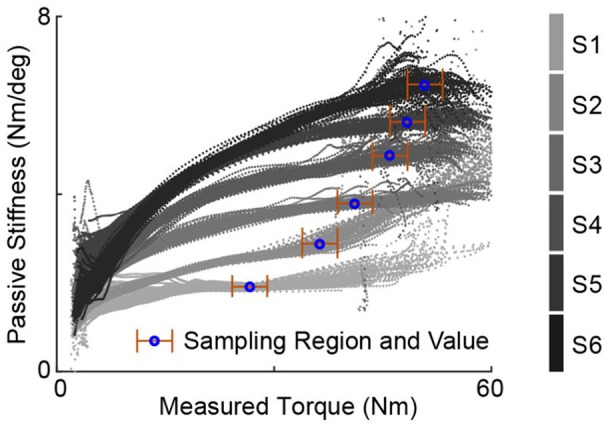
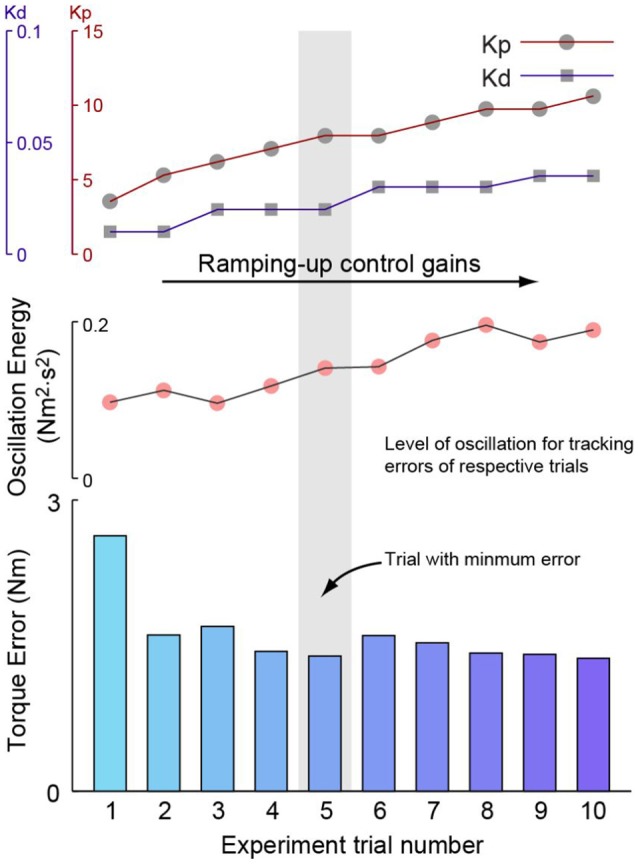
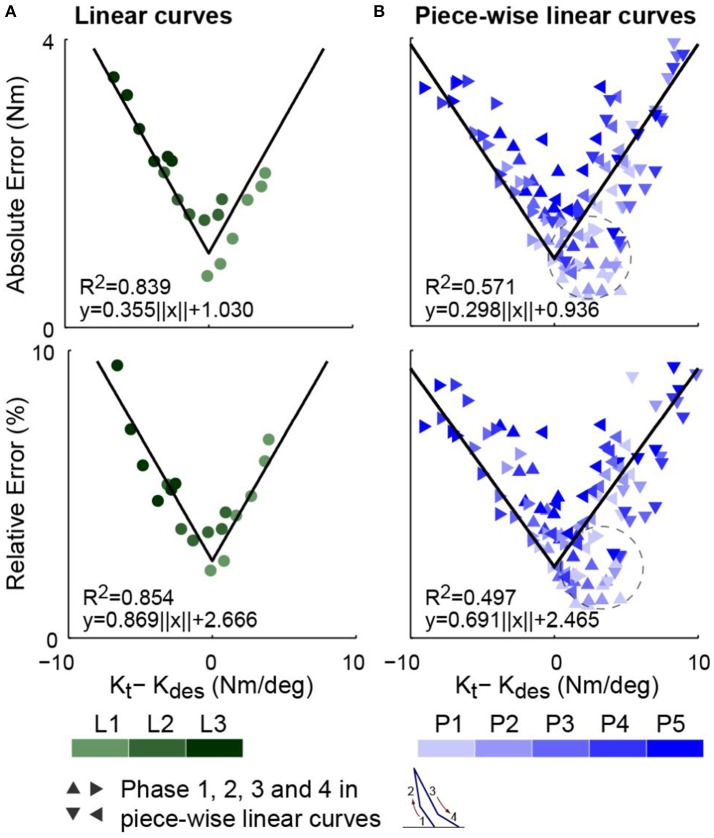
This study uses theory and experiments to investigate the relationship between the passive stiffness of series elastic actuators and torque tracking performance in lower-limb exoskeletons during human walking. Through theoretical analysis with our simplified system model, we found that the optimal passive stiffness matches the slope of the desired torque-angle relationship. We also conjectured that a bandwidth limit resulted in a maximum rate of change in torque error that can be commanded through control input, which is fixed across desired and passive stiffness conditions. This led to hypotheses about the interactions among optimal control gains, passive stiffness and desired quasi-stiffness. Walking experiments were conducted with multiple angle-based desired torque curves. The observed lowest torque tracking errors identified for each combination of desired and passive stiffnesses were shown to be linearly proportional to the magnitude of the difference between the two stiffnesses. The proportional gains corresponding to the lowest observed errors were seen inversely proportional to passive stiffness values and to desired stiffness. These findings supported our hypotheses, and provide guidance to application-specific hardware customization as well as controller design for torque-controlled robotic legged locomotion.
本研究运用理论和实验方法,探究了下肢外骨骼在人体行走过程中,串联弹性驱动器的被动刚度与扭矩跟踪性能之间的关系。通过对简化系统模型进行理论分析,我们发现最优被动刚度与期望扭矩 - 角度关系的斜率相匹配。我们还推测,带宽限制导致了通过控制输入可指令的扭矩误差的最大变化率,该变化率在期望刚度和被动刚度条件下是固定的。这引发了关于最优控制增益、被动刚度和期望准刚度之间相互作用的假设。我们针对多个基于角度的期望扭矩曲线进行了行走实验。结果表明,针对每种期望刚度和被动刚度组合所观察到的最低扭矩跟踪误差,与两种刚度之间差值的大小呈线性比例关系。对应于最低观察误差的比例增益与被动刚度值以及期望刚度成反比。这些发现支持了我们的假设,并为特定应用的硬件定制以及扭矩控制的机器人腿部运动的控制器设计提供了指导。