Zhang Xuemei, Wei Lingyu, Wang Jing, Qin Zailong, Wang Jia, Lu Yuanjun, Zheng Xiang, Peng Qiu, Ye Qiurong, Ai Feiyan, Liu Peishan, Wang Siwen, Li Guiyuan, Shen Shourong, Ma Jian
Hunan Cancer Hospital and the Affiliated Cancer Hospital of Xiangya School of Medicine, Central South University, Changsha, China.
Cancer Research Institute, Central South University, Changsha, China.
Front Immunol. 2017 Dec 13;8:1774. doi: 10.3389/fimmu.2017.01774. eCollection 2017.
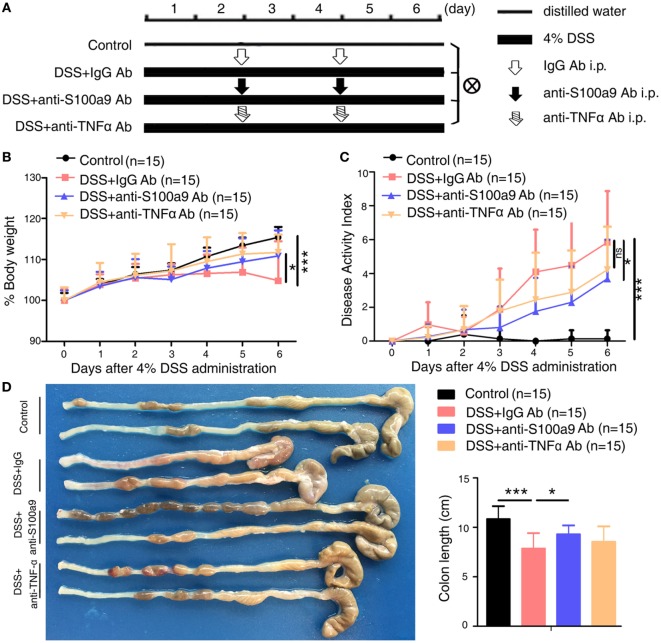
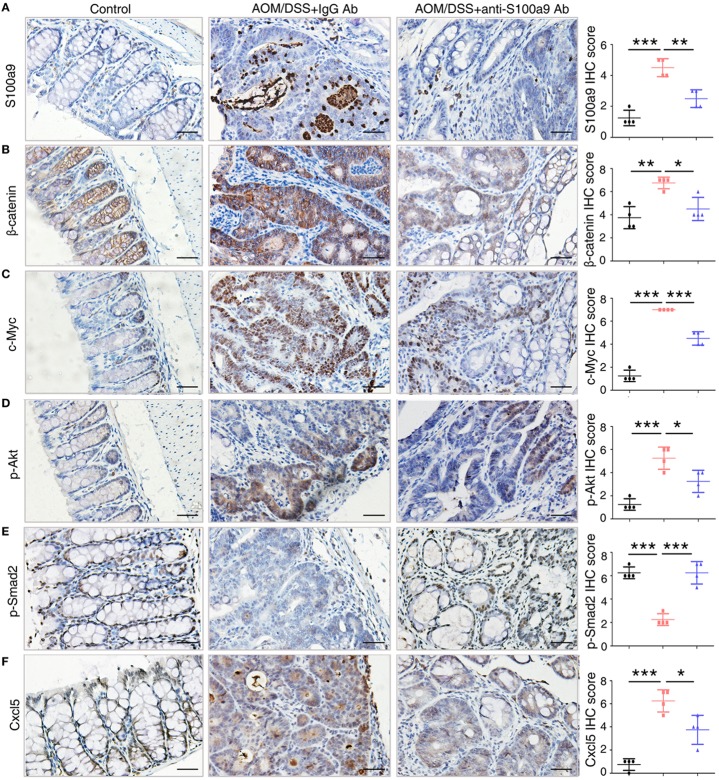
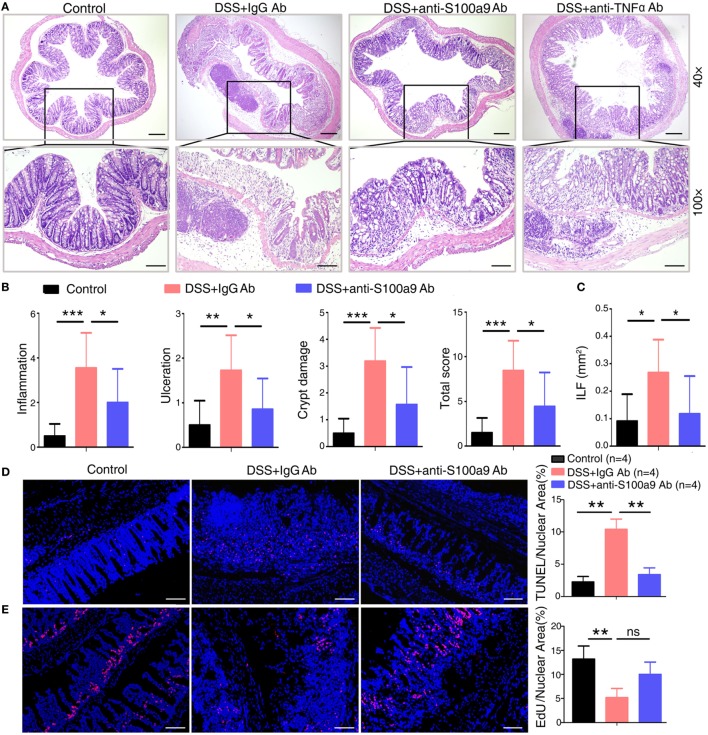
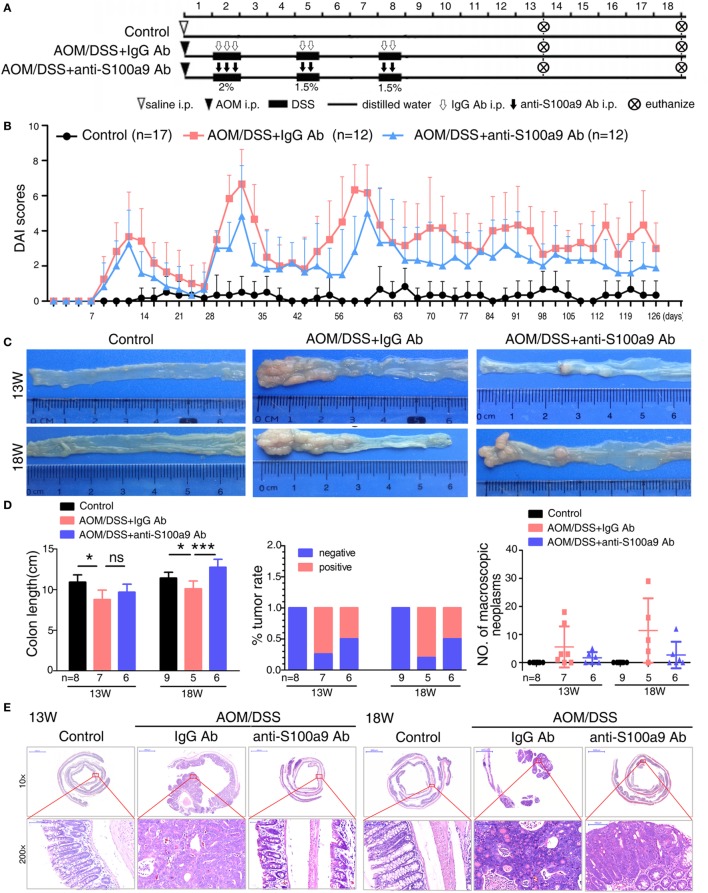
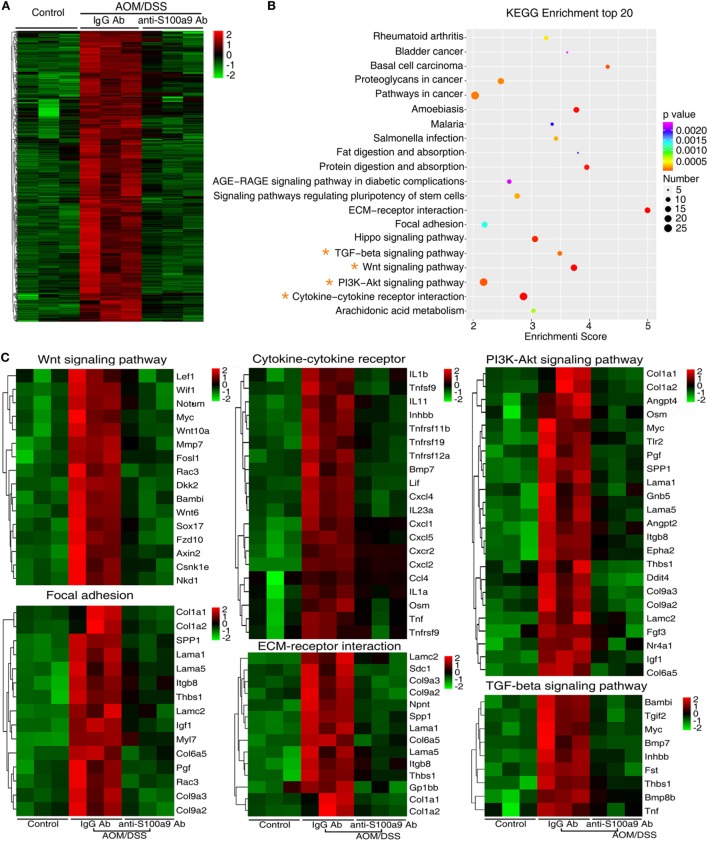
The association between chronic inflammation and cancer has long been recognized. The inflammatory bowel disease ulcerative colitis frequently progresses to colon cancer; however, the underlying mechanism is still unclear. S100a9 has been emerged as an important pro-inflammatory mediator in acute and chronic inflammation, and the aberrant expression of S100a9 also contributes to tumorigenic processes such as cell proliferation, angiogenesis, metastasis, and immune evasion. We previously revealed that S100a8 and S100a9 are highly activated and play an important role in the process of colitis-associated carcinogenesis, which suggests an attractive therapeutic target for ulcerative colitis and related colon cancer. Here, we report that administration of a neutralizing anti-S100a9 antibody significantly ameliorated dextran sulfate sodium (DSS)-induced colitis and accompanied by diminished cellular infiltrate of innate immunity cells (macrophages, neutrophils, and dendritic cells) and production of pro-inflammatory cytokines (, and ). The protective effect of anti-S100a9 antibody treatment was also observed in azoxymethane (AOM)/DSS-induced colitis-associated cancer (CAC) mouse model. The inflammatory response, tumor cell proliferation, and immune cells infiltration in the colon tissues were suppressed by anti-S100a9 antibody. Gene expression profiling showed that key pathways known to be involved in CAC development, such as Wnt signaling pathway, PI3K-Akt signaling pathway, cytokine-cytokine receptor interaction, and ECM-receptor interaction pathway, were suppressed after treatment with anti-S100a9 antibody in CAC mice. In view of the protective effect of neutralizing anti-S100a9 antibody against DSS-induced colitis and AOM/DSS-induced CAC in mouse model, this study suggests that anti-S100a9 antibody may provide a novel therapeutic approach to treat ulcerative colitis and may decrease the risk for developing CAC.
慢性炎症与癌症之间的关联早已为人所知。炎症性肠病溃疡性结肠炎常进展为结肠癌;然而,其潜在机制仍不清楚。S100a9已成为急性和慢性炎症中一种重要的促炎介质,S100a9的异常表达也有助于细胞增殖、血管生成、转移和免疫逃逸等致癌过程。我们之前发现S100a8和S100a9高度活化,并在结肠炎相关致癌过程中发挥重要作用,这提示其可能是溃疡性结肠炎及相关结肠癌的一个有吸引力的治疗靶点。在此,我们报告给予中和性抗S100a9抗体可显著改善葡聚糖硫酸钠(DSS)诱导的结肠炎,并伴有固有免疫细胞(巨噬细胞、中性粒细胞和树突状细胞)的细胞浸润减少以及促炎细胞因子( 、 和 )的产生减少。在氧化偶氮甲烷(AOM)/DSS诱导的结肠炎相关癌症(CAC)小鼠模型中也观察到了抗S100a9抗体治疗的保护作用。抗S100a9抗体抑制了结肠组织中的炎症反应、肿瘤细胞增殖和免疫细胞浸润。基因表达谱分析表明,在用抗S100a9抗体处理CAC小鼠后,已知参与CAC发展的关键通路,如Wnt信号通路、PI3K-Akt信号通路、细胞因子-细胞因子受体相互作用以及ECM-受体相互作用通路均受到抑制。鉴于中和性抗S100a9抗体对小鼠模型中DSS诱导的结肠炎和AOM/DSS诱导的CAC具有保护作用,本研究提示抗S100a9抗体可能为治疗溃疡性结肠炎提供一种新的治疗方法,并可能降低发生CAC的风险。