Marchiori Paulo E R, Machado Eduardo C, Sales Cristina R G, Espinoza-Núñez Erick, Magalhães Filho José R, Souza Gustavo M, Pires Regina C M, Ribeiro Rafael V
Department of Biology, Federal University of Lavras, Lavras, Brazil.
Laboratory of Plant Physiology 'Coaracy M. Franco', Center for Research and Development in Ecophysiology and Biophysics, Agronomic Institute (IAC), Campinas, Brazil.
Front Plant Sci. 2017 Dec 20;8:2148. doi: 10.3389/fpls.2017.02148. eCollection 2017.
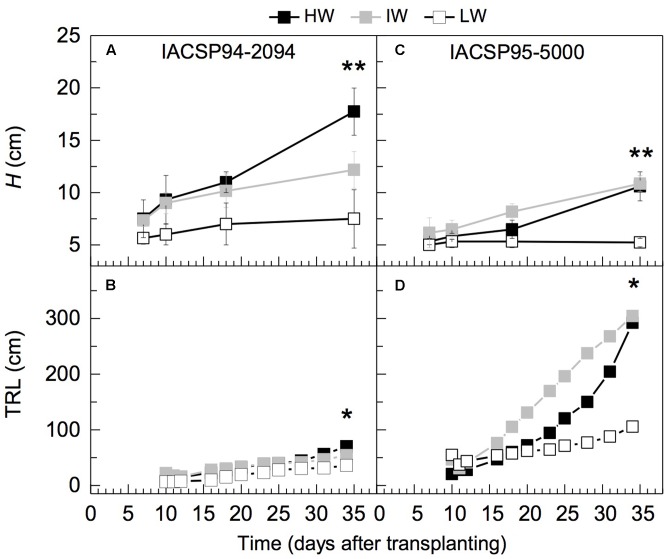
The water availability at early phenological stages is critical for crop establishment and sugarcane varieties show differential performance under drought. Herein, we evaluated the relative importance of morphological and physiological plasticity of young sugarcane plants grown under water deficit, testing the hypothesis that high phenotypic plasticity is associated with drought tolerance. IACSP95-5000 is a high yielding genotype and IACSP94-2094 has good performance under water limiting environments. Plants were grown in rhizotrons for 35 days under three water availabilities: high (soil water matric potential [Ψ] higher than -20 kPa); intermediate (Ψ reached -65 and -90 kPa at the end of experimental period) and low (Ψ reached values lower than -150 kPa). Our data revealed that morphological and physiological responses of sugarcane to drought are dependent on genotype and intensity of water deficit. In general, IACSP95-5000 showed higher physiological plasticity given by leaf gas exchange and photochemical traits, whereas IACSP94-2094 showed higher morphological plasticity determined by changes in leaf area (LA) and specific LA. As IACSP94-2094 accumulated less biomass than IACSP95-5000 under varying water availability, it is suggested that high morphological plasticity does not always represent an effective advantage to maintain plant growth under water deficit. In addition, our results revealed that sugarcane varieties face water deficit using distinct strategies based on physiological or morphological changes. When the effectiveness of those changes in maintaining plant growth under low water availability is taken into account, our results indicate that the physiological plasticity is more important than the morphological one in young sugarcane plants.
在物候期早期的水分供应对于作物定植至关重要,甘蔗品种在干旱条件下表现出不同的性能。在此,我们评估了水分亏缺条件下生长的甘蔗幼苗形态和生理可塑性的相对重要性,检验了高表型可塑性与耐旱性相关的假设。IACSP95 - 5000是一个高产基因型,IACSP94 - 2094在水分受限环境下表现良好。植株在根箱中生长35天,设置三种水分供应条件:高(土壤水基质势[Ψ]高于 - 20 kPa);中(实验期结束时Ψ达到 - 65和 - 90 kPa)和低(Ψ达到低于 - 150 kPa的值)。我们的数据表明,甘蔗对干旱的形态和生理反应取决于基因型和水分亏缺强度。总体而言,IACSP95 - 5000通过叶片气体交换和光化学特性表现出更高的生理可塑性,而IACSP94 - 2094通过叶面积(LA)和比叶面积的变化表现出更高的形态可塑性。由于在不同水分供应条件下IACSP94 - 2094积累的生物量比IACSP95 - 5000少,表明高形态可塑性在水分亏缺条件下并不总是代表维持植物生长的有效优势。此外,我们的结果表明,甘蔗品种基于生理或形态变化采用不同策略应对水分亏缺。当考虑这些变化在低水分供应条件下维持植物生长的有效性时,我们的结果表明,生理可塑性在甘蔗幼苗中比形态可塑性更重要。