Linnenbringer Erin, Gehlert Sarah, Geronimus Arline T
Division of Public Health Sciences, Department of Surgery, Washington University School of Medicine, St. Louis, MO 63110-1093, USA.
College of Social Work, University of South Carolina, Columbia, SC 29208, USA.
AIMS Public Health. 2017;4(5):526-556. doi: 10.3934/publichealth.2017.5.526. Epub 2017 Nov 24.
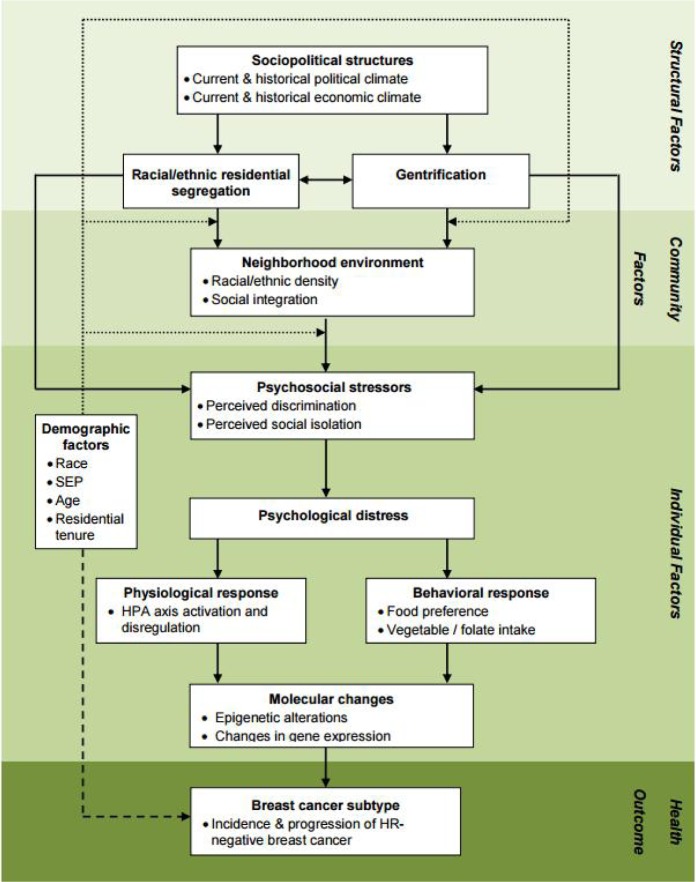
Hormone receptor negative (HR-) breast cancer subtypes are etiologically distinct from the more common, less aggressive, and more treatable form of estrogen receptor positive (ER+) breast cancer. Numerous population-based studies have found that, in the United States, Black women are 2 to 3 times more likely to develop HR- breast cancer than White women. Much of the existing research on racial disparities in breast cancer subtype has focused on identifying predisposing genetic factors associated with African ancestry. This approach fails to acknowledge that racial stratification shapes a wide range of environmental and social exposures over the life course. Human stress genomics considers the role of individual stress perceptions on gene expression. Yet, the role of structurally rooted biopsychosocial processes that may be activated by the social patterning of stressors in an historically unequal society, whether perceived by individual black women or not, could also impact cellular physiology and gene expression patterns relevant to HR- breast cancer etiology. Using the weathering hypothesis as our conceptual framework, we develop a structural perspective for examining racial disparities in breast cancer subtypes, integrating important findings from the stress biology, breast cancer epidemiology, and health disparities literatures. After integrating key findings from these largely independent literatures, we develop a theoretically and empirically guided framework for assessing potential multilevel factors relevant to the development of HR- breast cancer disproportionately among Black women in the US. We hypothesize that a dynamic interplay among socially patterned psychosocial stressors, physiological & behavioral responses, and genomic pathways contribute to the increased risk of HR- breast cancer among Black women. This work provides a basis for exploring potential alternative pathways linking the lived experience of race to the risk of HR- breast cancer, and suggests new avenues for research and public health action.
激素受体阴性(HR-)乳腺癌亚型在病因上与更常见、侵袭性较小且更易治疗的雌激素受体阳性(ER+)乳腺癌不同。大量基于人群的研究发现,在美国,黑人女性患HR-乳腺癌的可能性是白人女性的2至3倍。现有的许多关于乳腺癌亚型种族差异的研究都集中在识别与非洲血统相关的易感基因因素上。这种方法没有认识到种族分层在整个生命过程中塑造了广泛的环境和社会暴露。人类应激基因组学考虑个体应激感知对基因表达的作用。然而,在一个历史上不平等的社会中,可能由应激源的社会模式激活的、无论个体黑人女性是否感知到的、基于结构的生物心理社会过程,也可能影响与HR-乳腺癌病因相关的细胞生理学和基因表达模式。以衰老假说为我们的概念框架,我们构建了一个结构视角来审视乳腺癌亚型的种族差异,整合了应激生物学、乳腺癌流行病学和健康差异文献中的重要发现。在整合了这些基本独立的文献中的关键发现后,我们构建了一个理论和实证指导的框架,以评估与美国黑人女性中HR-乳腺癌不成比例发展相关的潜在多层次因素。我们假设社会模式化的心理社会应激源、生理和行为反应以及基因组途径之间的动态相互作用导致了黑人女性中HR-乳腺癌风险的增加。这项工作为探索将种族生活经历与HR-乳腺癌风险联系起来的潜在替代途径提供了基础,并为研究和公共卫生行动提出了新的途径。