Ekiti Martin E, Zambo Jean-Berthelot, Assah Felix K, Agbor Valirie N, Kekay Krystel, Ashuntantang Gloria
Faculty of Medicine and Biomedical Sciences, University of Yaoundé I, P.O. Box 1364, Yaounde, Cameroon.
Occupational Health Service, National Refining Company (SONARA), P.O. Box 365, Limbe, Cameroon.
BMC Nephrol. 2018 Jan 15;19(1):10. doi: 10.1186/s12882-017-0798-9.
Agricultural workers especially in sugarcane plantations have a high risk of chronic kidney disease (CKD). Little is known about CKD among sugarcane plantation workers in Cameroon. This study sought to evaluate the prevalence and identify factors associated with CKD in sugarcane plantation workers in Cameroon.
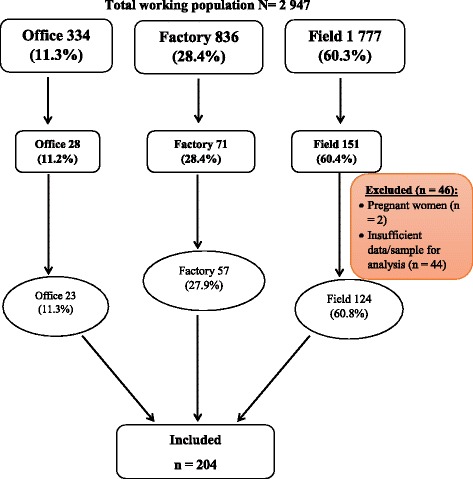
We conducted an analytic cross-sectional study including 204 adult workers at the sugarcane plantation complex in Mbandjock, Cameroon; over 500 m above sea level. Chronic kidney disease (proteinuria as estimated by urine dipstick analysis and/or estimated glomerular filtration rate < 60 ml/min/1.73 m persistent after 3 months) was the outcome of interest. Those with abnormal results were seen again after 3 months to confirm the diagnosis. We evaluated the association between CKD and participant age, sex, contract-type, duration of employment, socio-economic status, workspace, exposure to agrochemicals, heavy metals and heat, selected risk factors and co-morbid conditions.
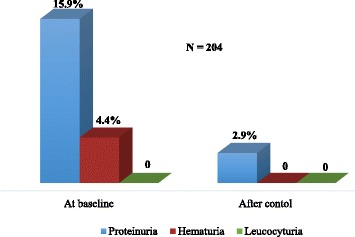
The overall prevalence of CKD was 3.4%. The factory workers were the most affected (7%), compared to the field (2.4%) and office workers (0%). 2.9% of the participants had persistent proteinuria, mild in every case, and 0.5% of them had an estimated glomerular filtration rate < 60 ml/min/1.73 m. Age ≥ 40 years was an independent predictor of CKD.
The prevalence of CKD among employees of the Mbandjock sugarcane plantation is low, probably reflecting the preventive measures against heat stress and dehydration in place.
农业工人,尤其是甘蔗种植园的工人,患慢性肾病(CKD)的风险很高。喀麦隆甘蔗种植园工人中慢性肾病的情况鲜为人知。本研究旨在评估喀麦隆甘蔗种植园工人慢性肾病的患病率,并确定与之相关的因素。
我们进行了一项分析性横断面研究,纳入了喀麦隆姆班乔克甘蔗种植园综合体的204名成年工人;海拔超过500米。慢性肾病(通过尿试纸分析估计蛋白尿和/或估计肾小球滤过率<60 ml/min/1.73 m²,持续3个月后)是研究的关注结果。结果异常者在3个月后再次检查以确诊。我们评估了慢性肾病与参与者的年龄、性别、合同类型、就业时长、社会经济地位、工作场所、接触农用化学品、重金属和高温、选定的风险因素以及合并症之间的关联。
慢性肾病的总体患病率为3.4%。工厂工人受影响最大(7%),相比之下,田间工人为2.4%,办公室工人为0%。2.9%的参与者有持续性蛋白尿,均为轻度,其中0.5%的人估计肾小球滤过率<60 ml/min/1.73 m²。年龄≥40岁是慢性肾病的独立预测因素。
姆班乔克甘蔗种植园员工中慢性肾病的患病率较低,这可能反映了现有的针对热应激和脱水的预防措施。