Stanford Institute for Immunity, Transplantation and Infection, Stanford University School of Medicine, Stanford, CA.
Biomedical Informatics Research, Stanford University School of Medicine, Stanford, CA.
Crit Care Med. 2018 Feb;46(2):244-251. doi: 10.1097/CCM.0000000000002839.
To identify a novel, generalizable diagnostic for acute respiratory distress syndrome using whole-blood gene expression arrays from multiple acute respiratory distress syndrome cohorts of varying etiologies.
We performed a systematic search for human whole-blood gene expression arrays of acute respiratory distress syndrome in National Institutes of Health Gene Expression Omnibus and ArrayExpress. We also included the Glue Grant gene expression cohorts.
We included investigator-defined acute respiratory distress syndrome within 48 hours of diagnosis and compared these with relevant critically ill controls.
We used multicohort analysis of gene expression to identify genes significantly associated with acute respiratory distress syndrome, both with and without adjustment for clinical severity score. We performed gene ontology enrichment using Database for Annotation, Visualization and Integrated Discovery and cell type enrichment tests for both immune cells and pneumocyte gene expression. Finally, we selected a gene set optimized for diagnostic power across the datasets and used leave-one-dataset-out cross validation to assess robustness of the model.
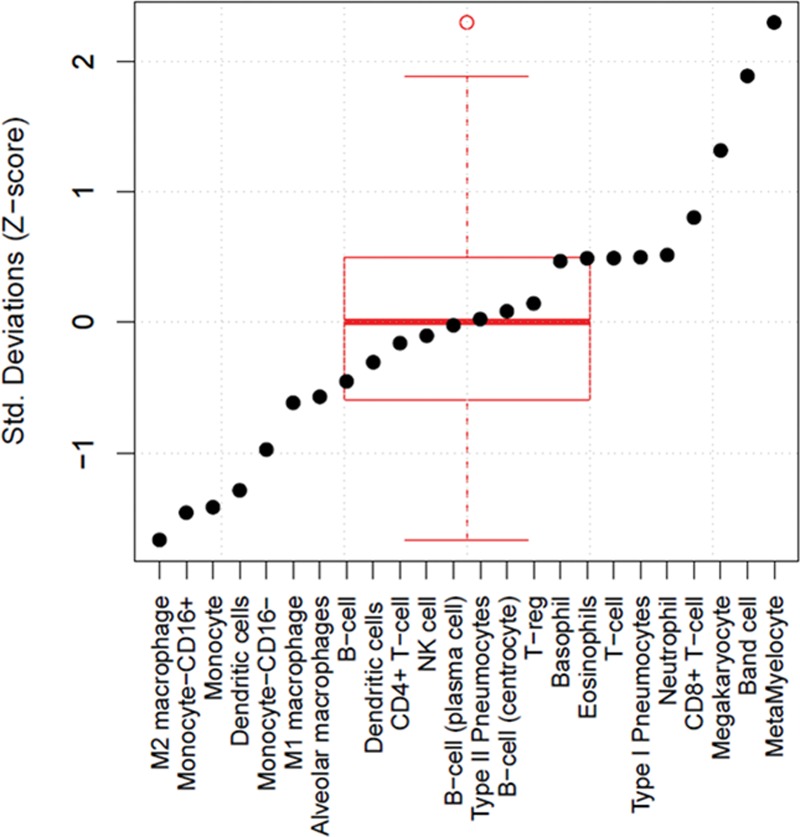
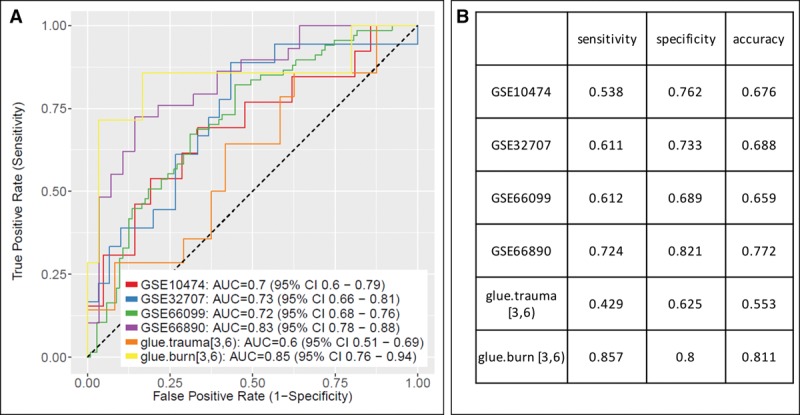
We identified datasets from three adult cohorts with sepsis, one pediatric cohort with acute respiratory failure, and two datasets of adult patients with trauma and burns, for a total of 148 acute respiratory distress syndrome cases and 268 critically ill controls. We identified 30 genes that were significantly associated with acute respiratory distress syndrome (false discovery rate < 20% and effect size >1.3), many of which had been previously associated with sepsis. When metaregression was used to adjust for clinical severity scores, none of these genes remained significant. Cell type enrichment was notable for bands and neutrophils, suggesting that the gene expression signature is one of acute inflammation rather than lung injury per se. Finally, an attempt to develop a generalizable diagnostic gene set for acute respiratory distress syndrome showed a mean area under the receiver-operating characteristic curve of only 0.63 on leave-one-dataset-out cross validation.
The whole-blood gene expression signature across a wide clinical spectrum of acute respiratory distress syndrome is likely confounded by systemic inflammation, limiting the utility of whole-blood gene expression studies for uncovering a generalizable diagnostic gene signature.
利用源自不同病因急性呼吸窘迫综合征(ARDS)多个队列的全血基因表达谱,确定一种新的、可普遍应用的急性呼吸窘迫综合征诊断方法。
我们在国家卫生研究院基因表达综合数据库和 ArrayExpress 中进行了系统性检索,查找人类全血 ARDS 基因表达谱。我们还纳入了 Glue Grant 基因表达队列。
我们纳入了研究者定义的诊断后 48 小时内的急性呼吸窘迫综合征,并将其与相关危重病对照进行比较。
我们使用多队列基因表达分析来确定与急性呼吸窘迫综合征显著相关的基因,同时调整临床严重程度评分和未调整临床严重程度评分。我们使用数据库进行基因本体富集分析、可视化和综合发现以及免疫细胞和肺泡细胞基因表达的细胞类型富集测试。最后,我们选择了一个在所有数据集上优化诊断能力的基因集,并使用留一数据集外交叉验证来评估模型的稳健性。
我们从三个成人脓毒症队列、一个儿科急性呼吸衰竭队列和两个成人创伤和烧伤队列中确定了数据集,共 148 例急性呼吸窘迫综合征病例和 268 例危重病对照。我们确定了 30 个与急性呼吸窘迫综合征显著相关的基因(错误发现率<20%,效应大小>1.3),其中许多基因以前与脓毒症有关。当使用荟萃回归来调整临床严重程度评分时,这些基因中没有一个仍然显著。细胞类型富集在带和中性粒细胞中很明显,这表明基因表达谱是急性炎症而不是肺损伤本身。最后,尝试开发一种普遍适用的急性呼吸窘迫综合征诊断基因集,在留一数据集外交叉验证中的平均接收者操作特征曲线下面积仅为 0.63。
在急性呼吸窘迫综合征广泛的临床谱中,全血基因表达谱可能受到全身炎症的影响,这限制了全血基因表达研究在发现普遍适用的诊断基因特征方面的应用。