European Society for Occupational and Environmental Medicine, EOM, Berlin, Germany.
Emeritus, Institute for Occupational and Maritime Medicine, University of Hamburg, D-20246 Hamburg, Germany.
Int J Environ Res Public Health. 2018 Jan 16;15(1):143. doi: 10.3390/ijerph15010143.
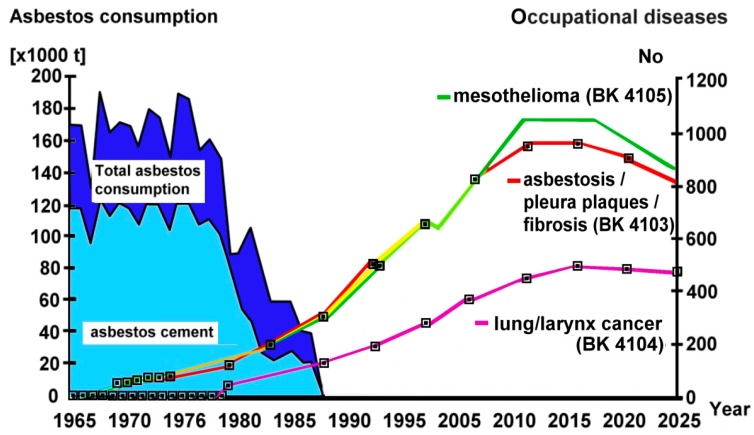
There was some limited use of asbestos at end of the 19th century in industrialized countries including Germany, but its consumption dramatically increased after World War II. The increase in use and exposure was followed by the discovery of high numbers of asbestos-related diseases with a mean latency period of about 38 years in Germany. The strong socio-political pressure from the asbestos industry, its affiliated scientists and physicians has successfully hindered regulatory measures and an asbestos ban for many years; a restrictive stance that is still being unravelled in compensation litigation. This national experience is compared with the situation in other industrialized countries and against the backdrop of the constant efforts of the WHO to eliminate asbestos-related diseases worldwide.
19 世纪末,包括德国在内的一些工业化国家有限度地使用了石棉,但自第二次世界大战后,其使用和接触量大幅增加。随着使用和接触的增加,德国发现了大量与石棉有关的疾病,潜伏期平均约为 38 年。来自石棉行业、其附属科学家和医生的强大社会政治压力,多年来成功地阻碍了监管措施和石棉禁令;这种限制立场在赔偿诉讼中仍在逐步解决。这种国家经验与其他工业化国家的情况进行了比较,并在世界卫生组织消除与石棉有关的疾病的持续努力的背景下进行了比较。