Dept. of Biochemistry and Biophysics, Center for Cellular Construction, University of California San Francisco, San Francisco, CA, United States of America.
Eli and Edythe Broad Center for Regenerative Medicine and Stem Cell Research, University of California San Francisco, San Francisco, CA, United States of America.
PLoS Comput Biol. 2018 Jan 16;14(1):e1005927. doi: 10.1371/journal.pcbi.1005927. eCollection 2018 Jan.
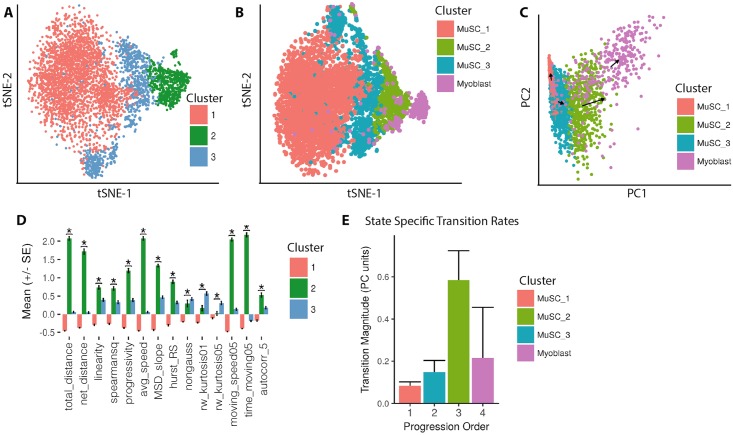
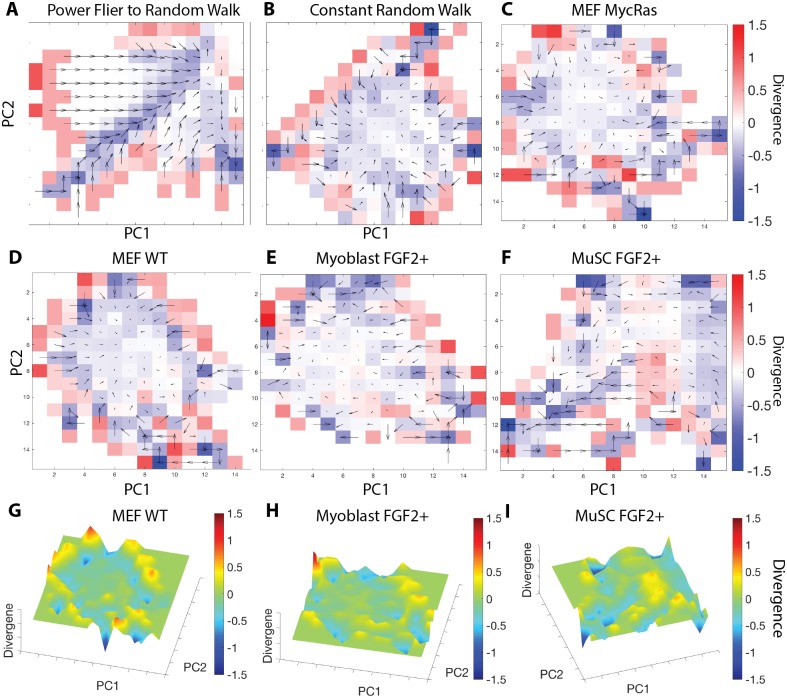
Cell populations display heterogeneous and dynamic phenotypic states at multiple scales. Similar to molecular features commonly used to explore cell heterogeneity, cell behavior is a rich phenotypic space that may allow for identification of relevant cell states. Inference of cell state from cell behavior across a time course may enable the investigation of dynamics of transitions between heterogeneous cell states, a task difficult to perform with destructive molecular observations. Cell motility is one such easily observed cell behavior with known biomedical relevance. To investigate heterogenous cell states and their dynamics through the lens of cell behavior, we developed Heteromotility, a software tool to extract quantitative motility features from timelapse cell images. In mouse embryonic fibroblasts (MEFs), myoblasts, and muscle stem cells (MuSCs), Heteromotility analysis identifies multiple motility phenotypes within the population. In all three systems, the motility state identity of individual cells is dynamic. Quantification of state transitions reveals that MuSCs undergoing activation transition through progressive motility states toward the myoblast phenotype. Transition rates during MuSC activation suggest non-linear kinetics. By probability flux analysis, we find that this MuSC motility state system breaks detailed balance, while the MEF and myoblast systems do not. Balanced behavior state transitions can be captured by equilibrium formalisms, while unbalanced switching between states violates equilibrium conditions and would require an external driving force. Our data indicate that the system regulating cell behavior can be decomposed into a set of attractor states which depend on the identity of the cell, together with a set of transitions between states. These results support a conceptual view of cell populations as dynamical systems, responding to inputs from signaling pathways and generating outputs in the form of state transitions and observable motile behaviors.
细胞群体在多个尺度上表现出异质和动态的表型状态。类似于常用于探索细胞异质性的分子特征,细胞行为是一个丰富的表型空间,可能允许识别相关的细胞状态。从细胞行为推断细胞状态跨越时间过程可能允许研究异质细胞状态之间的动态转换,这是一个难以用破坏性的分子观察来完成的任务。细胞迁移是一种具有已知生物医学相关性的易于观察的细胞行为。为了通过细胞行为的视角研究异质细胞状态及其动力学,我们开发了 Heteromotility,这是一种从延时细胞图像中提取定量运动特征的软件工具。在小鼠胚胎成纤维细胞 (MEF)、成肌细胞和肌肉干细胞 (MuSCs) 中,Heteromotility 分析在群体中识别出多种运动表型。在所有三个系统中,单个细胞的运动状态身份都是动态的。状态转换的定量分析表明,激活中的 MuSCs 通过向成肌细胞表型的渐进运动状态进行过渡。MuSC 激活过程中的转换速率表明存在非线性动力学。通过概率通量分析,我们发现这种 MuSC 运动状态系统打破了详细平衡,而 MEF 和成肌细胞系统没有。平衡行为状态转换可以通过平衡形式主义来捕获,而状态之间的不平衡切换违反了平衡条件,需要外部驱动力。我们的数据表明,调节细胞行为的系统可以分解为一组依赖于细胞身份的吸引子状态,以及一组状态之间的转换。这些结果支持将细胞群体视为动态系统的概念观点,该系统响应来自信号通路的输入,并以状态转换和可观察的运动行为的形式生成输出。