Laboratory for Neural Computation and Adaptation, RIKEN Brain Science Institute, Saitama, Japan.
Department of Informatics and Engineering, University of Sussex, Falmer, United Kingdom.
PLoS Comput Biol. 2018 Jan 17;14(1):e1005926. doi: 10.1371/journal.pcbi.1005926. eCollection 2018 Jan.
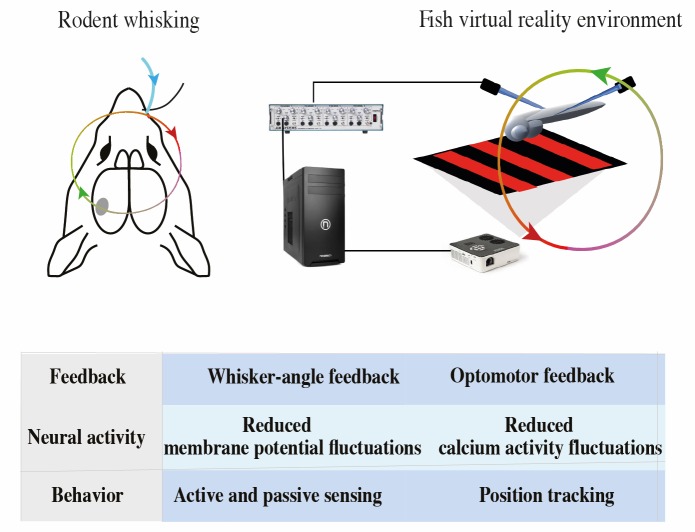
During active behaviours like running, swimming, whisking or sniffing, motor actions shape sensory input and sensory percepts guide future motor commands. Ongoing cycles of sensory and motor processing constitute a closed-loop feedback system which is central to motor control and, it has been argued, for perceptual processes. This closed-loop feedback is mediated by brainwide neural circuits but how the presence of feedback signals impacts on the dynamics and function of neurons is not well understood. Here we present a simple theory suggesting that closed-loop feedback between the brain/body/environment can modulate neural gain and, consequently, change endogenous neural fluctuations and responses to sensory input. We support this theory with modeling and data analysis in two vertebrate systems. First, in a model of rodent whisking we show that negative feedback mediated by whisking vibrissa can suppress coherent neural fluctuations and neural responses to sensory input in the barrel cortex. We argue this suppression provides an appealing account of a brain state transition (a marked change in global brain activity) coincident with the onset of whisking in rodents. Moreover, this mechanism suggests a novel signal detection mechanism that selectively accentuates active, rather than passive, whisker touch signals. This mechanism is consistent with a predictive coding strategy that is sensitive to the consequences of motor actions rather than the difference between the predicted and actual sensory input. We further support the theory by re-analysing previously published two-photon data recorded in zebrafish larvae performing closed-loop optomotor behaviour in a virtual swim simulator. We show, as predicted by this theory, that the degree to which each cell contributes in linking sensory and motor signals well explains how much its neural fluctuations are suppressed by closed-loop optomotor behaviour. More generally we argue that our results demonstrate the dependence of neural fluctuations, across the brain, on closed-loop brain/body/environment interactions strongly supporting the idea that brain function cannot be fully understood through open-loop approaches alone.
在跑步、游泳、刷动或嗅探等活动行为中,运动动作塑造了感觉输入,而感觉知觉则指导着未来的运动指令。持续的感觉和运动处理循环构成了一个闭环反馈系统,这是运动控制的核心,并且有人认为,这也是感知过程的核心。这种闭环反馈是通过全脑神经回路介导的,但反馈信号的存在如何影响神经元的动力学和功能还不太清楚。在这里,我们提出了一个简单的理论,即大脑/身体/环境之间的闭环反馈可以调节神经增益,从而改变内源性神经波动和对感觉输入的反应。我们在两个脊椎动物系统的建模和数据分析中支持了这一理论。首先,在啮齿动物刷动的模型中,我们表明,由刷动触须介导的负反馈可以抑制桶状皮层中相干的神经波动和对感觉输入的神经反应。我们认为,这种抑制提供了一种有吸引力的大脑状态转变(即全局大脑活动的显著变化)的解释,与啮齿动物开始刷动相一致。此外,这种机制提出了一种新的信号检测机制,该机制选择性地强调主动的、而不是被动的触须触摸信号。这种机制与一种预测编码策略一致,该策略对运动动作的后果敏感,而不是对预测和实际感觉输入之间的差异敏感。我们进一步通过重新分析以前发表的在虚拟游泳模拟器中进行闭环光运动行为的斑马鱼幼虫的双光子数据来支持该理论。我们表明,正如该理论所预测的那样,每个细胞在连接感觉和运动信号方面的贡献程度很好地解释了其神经波动在闭环光运动行为中被抑制的程度。更普遍地说,我们认为我们的结果表明,大脑中神经波动的程度取决于闭环大脑/身体/环境相互作用,这强烈支持了这样一种观点,即大脑功能不能仅通过开环方法来完全理解。