Department of Microbiology, Infectiology and Immunology, Faculté de Médecine, Université de Montréal, Montréal, QC, Canada.
Centre de Recherche du CHUM, Université de Montréal, 900 rue St-Denis, H2X0A9, Montréal, QC, Canada.
Retrovirology. 2018 Jan 17;15(1):9. doi: 10.1186/s12977-017-0385-y.
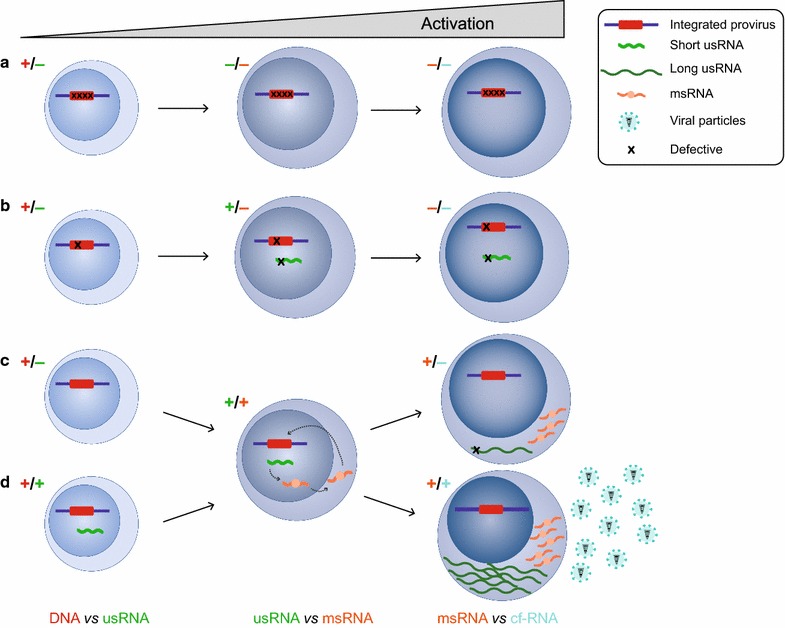
With the increasing number of therapeutic strategies tested in humans to reduce the size of the latent reservoir, the development of a robust, precise and clinical trial scalable assay that measures the frequency of infected cells carrying inducible replication-competent HIV is urgently needed. The size of the pool of cells carrying replication-competent HIV is largely overestimated by DNA assays, as a result of a large proportion of defective viruses, and underestimated by co-culture outgrowth assays. New culture methods that measure the inducible HIV reservoir have been developed during the past few years. In these induction assays, CD4 T cells from virally suppressed individuals are activated and HIV RNA is measured in cell extracts or cell supernatants. In this review, we summarize the principle and outcomes of these assays and discuss the potential of these methods in the evaluation of HIV eradication strategies.
随着越来越多的治疗策略在人体中被测试以缩小潜伏库的大小,迫切需要开发一种强大、精确和临床试验可扩展的测定方法,以测量携带诱导复制型 HIV 的感染细胞的频率。由于大量的缺陷病毒,DNA 测定法大大高估了携带复制型 HIV 的细胞池的大小,而共培养体外扩增测定法则低估了它。在过去几年中,已经开发出了新的测量可诱导 HIV 储存库的培养方法。在这些诱导测定中,从病毒抑制个体中分离出 CD4 T 细胞,激活它们,并测量细胞提取物或细胞上清液中的 HIV RNA。在这篇综述中,我们总结了这些测定的原理和结果,并讨论了这些方法在评估 HIV 清除策略中的潜力。