TWINCORE Centre for Experimental and Clinical Infection Research GmbH, Feodor-Lynen-Str. 7, 30625, Hannover, Germany.
Helmholtz-Centre for Infection Research, Inhoffenstr. 7, 38124, Braunschweig, Germany.
J Neuroinflammation. 2018 Jan 17;15(1):20. doi: 10.1186/s12974-017-1041-0.
Varicella zoster virus (VZV) reactivation spans the spectrum from uncomplicated segmental herpes zoster to life-threatening disseminated CNS infection. Moreover, in the absence of a small animal model for this human pathogen, studies of pathogenesis at the organismal level depend on analysis of human biosamples. Changes in cerebrospinal fluid (CSF) metabolites may reflect critical aspects of host responses and end-organ damage in neuroinfection and neuroinflammation. We therefore applied a targeted metabolomics screen of CSF to three clinically distinct forms of VZV reactivation and infectious and non-infectious disease controls in order to identify biomarkers for CNS involvement in VZV reactivation.
Metabolite profiles were determined by targeted liquid chromatography-mass spectrometry in CSF from patients with segmental zoster (shingles, n = 14), facial nerve zoster (n = 16), VZV meningitis/encephalitis (n = 15), enteroviral meningitis (n = 10), idiopathic Bell's palsy (n = 11), and normal pressure hydrocephalus (n = 15).
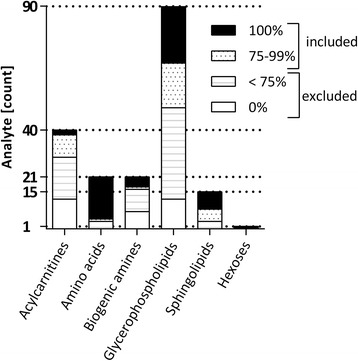
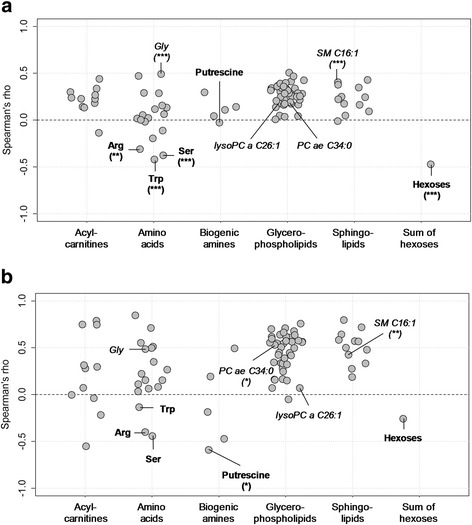
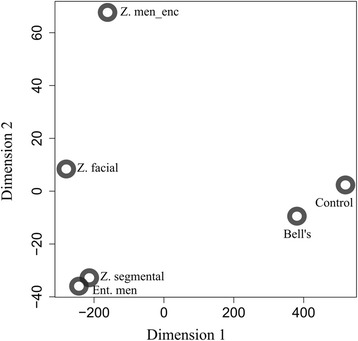
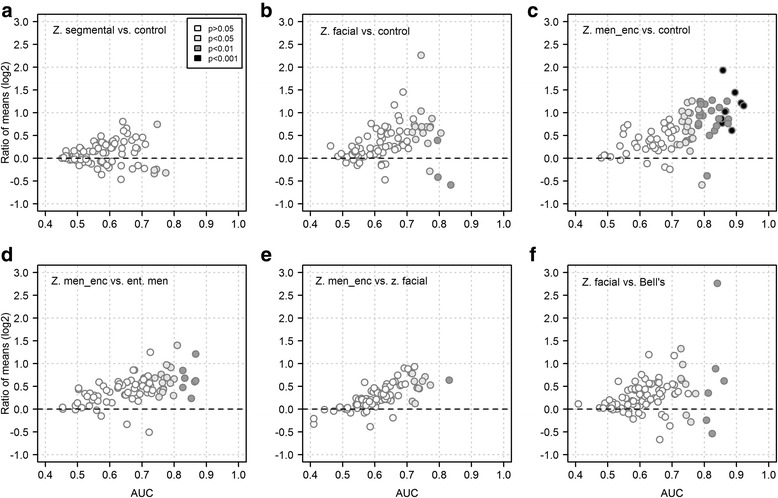
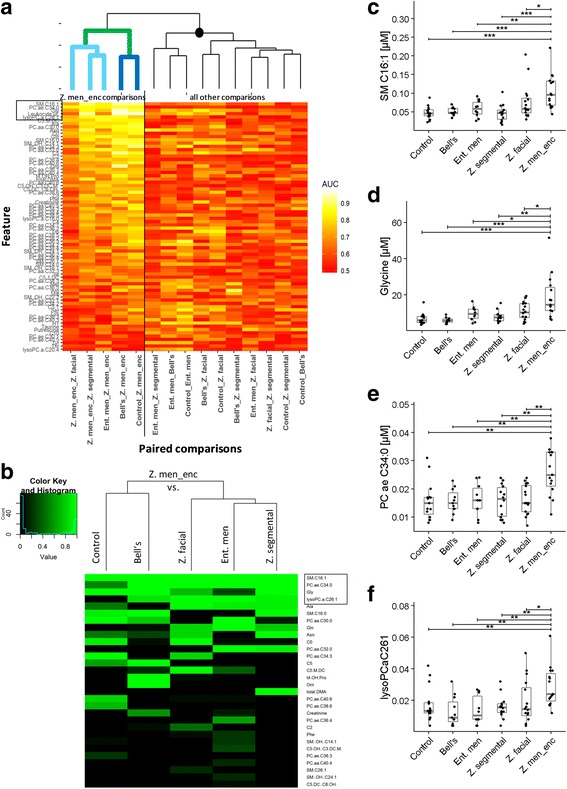
Concentrations of 88 metabolites passing quality assessment clearly separated the three VZV reactivation forms from each other and from the non-infected samples. Internal cross-validation identified four metabolites (SM C16:1, glycine, lysoPC a C26:1, PC ae C34:0) that were particularly associated with VZV meningoencephalitis. SM(OH) C14:1 accurately distinguished facial nerve zoster from Bell's palsy. Random forest construction revealed even more accurate classifiers (signatures comprising 2-4 metabolites) for most comparisons. Some of the most accurate biomarkers correlated only weakly with CSF leukocyte count, indicating that they do not merely reflect recruitment of inflammatory cells but, rather, specific pathophysiological mechanisms. Across all samples, only the sum of hexoses and the amino acids arginine, serine, and tryptophan correlated negatively with leukocyte count. Increased expression of the metabolites associated with VZV meningoencephalitis could be linked to processes relating to neuroinflammation/immune activation, neuronal signaling, and cell stress, turnover, and death (e.g., autophagy and apoptosis), suggesting that these metabolites might sense processes relating to end-organ damage.
The results provide proof-of-concept for the value of CSF metabolites as (1) disease-associated signatures suggesting pathophysiological mechanisms, (2) degree and nature of neuroinflammation, and (3) biomarkers for diagnosis and risk stratification of VZV reactivation and, likely, neuroinfections due to other pathogens.
Not applicable (non-interventional study).
水痘带状疱疹病毒(VZV)的再激活范围从单纯的节段性带状疱疹到危及生命的中枢神经系统播散性感染。此外,由于缺乏这种人类病原体的小动物模型,因此在机体水平上研究发病机制依赖于对人类生物样本的分析。脑脊液(CSF)代谢物的变化可能反映了神经感染和神经炎症中宿主反应和终末器官损伤的关键方面。因此,我们应用靶向代谢组学方法对三种临床表现不同的 VZV 再激活形式以及感染性和非感染性疾病对照进行 CSF 分析,以确定与 VZV 再激活相关的中枢神经系统受累的生物标志物。
通过靶向液相色谱-质谱法测定带状疱疹(带状疱疹,n=14)、面神经带状疱疹(n=16)、VZV 脑膜炎/脑炎(n=15)、肠道病毒脑膜炎(n=10)、特发性贝尔麻痹(n=11)和正常压力脑积水(n=15)患者的 CSF 中的代谢物谱。
通过质量评估筛选出 88 种代谢物,这些代谢物可明确区分三种 VZV 再激活形式与未感染的样本。内部交叉验证确定了 4 种代谢物(SM C16:1、甘氨酸、lysoPC a C26:1、PC ae C34:0)与 VZV 脑膜脑炎特别相关。SM(OH) C14:1 可准确区分面神经带状疱疹与贝尔麻痹。随机森林构建显示,对于大多数比较,更准确的分类器(由 2-4 种代谢物组成的特征)。一些最准确的生物标志物与 CSF 白细胞计数相关性较弱,这表明它们不仅反映了炎症细胞的募集,而是特定的病理生理机制。在所有样本中,只有己糖的总和以及精氨酸、丝氨酸和色氨酸这三种氨基酸与白细胞计数呈负相关。与 VZV 脑膜脑炎相关的代谢物表达增加可能与与神经炎症/免疫激活、神经元信号转导和细胞应激、周转和死亡(如自噬和细胞凋亡)相关的过程有关,这表明这些代谢物可能与终末器官损伤有关。
结果为 CSF 代谢物作为(1)与疾病相关的特征提示病理生理机制,(2)神经炎症的程度和性质,以及(3)VZV 再激活和可能由其他病原体引起的神经感染的诊断和风险分层的生物标志物提供了概念验证。
不适用(非干预性研究)。