Department of Endocrinology and Metabolism, The First Affiliated Hospital of Nanjing Medical University, 300 Guangzhou Road, Nanjing, 210029, China.
Department of Endocrinology, Nanjing Municipal Hospital for Governmental Organizations, Nanjing, 210018, China.
Lipids Health Dis. 2018 Jan 17;17(1):15. doi: 10.1186/s12944-018-0658-z.
Proprotein convertase subtilisin/kexin type 9 (PCSK9), which plays a crucial role in lipoprotein metabolism, has been also regarded as an important marker for atherosclerosis. Available evidence indicated that 2-h postchallenge plasma glucose (2-hPG) could be another biomarker for atherosclerosis. However, currently the association between circulating PCSK9 and 2-hPG remains unclear. Here, we explored this potential link in a Chinese Han population.
Totally, 600 Chinese Han subjects from Nanjing district, China, were enrolled for the 75-g oral glucose tolerance test (OGTT), and they included normal glucose tolerance (NGT, n = 200), impaired glucose regulation (IGR, n = 200), and type 2 diabetes (T2DM, n = 200). Anthropometric and biochemical determinations such as serum lipid measurements were made. A sandwich ELISA assay was performed to measure serum PCSK9 levels in all subjects.
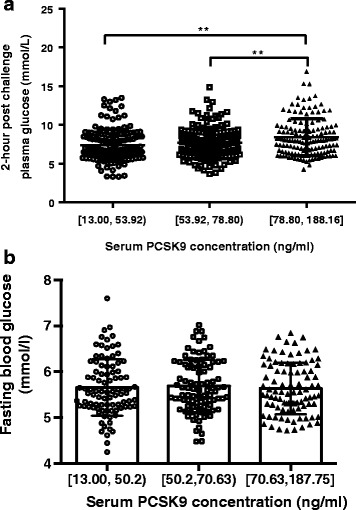
Serum PCSK9 concentrations were higher in IGR group (77.63 ± 28.14 ng/ml) and T2DM group (90.62 ± 39.96 ng/ml) than in NGT group (65.33 ± 32.68 ng/ml), and it was significantly higher in T2DM group than in IGR group (p < 0.01). Serum PCSK9 levels positively correlated with 2-hPG and LDL-C in all subgroups, but presented a positive correlation with fasting blood glucose (FBG) only in T2DM group. Using multiple regression model analysis, we also found that PCSK9 levels closely correlated with 2-hPG in all tested groups. According to multinomial logistic regression analysis, PCSK9 levels positively correlated with T2DM (OR = 1.017[1.010-1.025], p < 0.001) even after adjustment for lipid levels. Moreover, in subjects with normal FBG level, 2-hPG gradually and significantly increased across PCSK9 tertiles (6.68 ± 2.01, 7.48 ± 2.10 and 8.27 ± 2.41 mmol/L, respectively, p < 0.01); however, in subjects with normal 2-hPG levels, no such difference was observed.
PCSK9 levels increase as glucose metabolism deteriorated. Serum PCSK9 levels positively correlated with 2-hPG in patients with metabolic diseases.
前蛋白转化酶枯草溶菌素 9(PCSK9)在脂蛋白代谢中起着至关重要的作用,也被认为是动脉粥样硬化的重要标志物。现有证据表明,2 小时餐后血糖(2-hPG)可能是另一个动脉粥样硬化的生物标志物。然而,目前循环 PCSK9 与 2-hPG 之间的关系尚不清楚。在这里,我们在中国汉族人群中探讨了这种潜在的联系。
总共纳入了 600 名来自中国南京地区的汉族受试者进行 75g 口服葡萄糖耐量试验(OGTT),其中包括正常糖耐量(NGT,n=200)、糖调节受损(IGR,n=200)和 2 型糖尿病(T2DM,n=200)。对所有受试者进行了包括血清脂质测量在内的人体测量和生化测定。采用夹心 ELISA 法测定所有受试者的血清 PCSK9 水平。
IGR 组(77.63±28.14ng/ml)和 T2DM 组(90.62±39.96ng/ml)的血清 PCSK9 浓度均高于 NGT 组(65.33±32.68ng/ml),且 T2DM 组显著高于 IGR 组(p<0.01)。血清 PCSK9 水平与所有亚组的 2-hPG 和 LDL-C 呈正相关,但仅在 T2DM 组与空腹血糖(FBG)呈正相关。使用多元回归模型分析,我们还发现 PCSK9 水平与所有测试组的 2-hPG 密切相关。根据多项逻辑回归分析,PCSK9 水平与 T2DM 呈正相关(OR=1.017[1.010-1.025],p<0.001),即使在调整了血脂水平后也是如此。此外,在 FBG 水平正常的受试者中,随着 PCSK9 三分位的增加,2-hPG 逐渐显著升高(分别为 6.68±2.01、7.48±2.10 和 8.27±2.41mmol/L,p<0.01);然而,在 2-hPG 水平正常的受试者中,没有观察到这种差异。
随着葡萄糖代谢恶化,PCSK9 水平升高。在代谢性疾病患者中,血清 PCSK9 水平与 2-hPG 呈正相关。