Department of Experimental Psychology, University of Oxford, New Richards Building, Old Road Campus, Oxford OX3 7LG, UK
Department of Computer Sciences, Aalto University, Espoo, Finland.
Biol Lett. 2018 Jan;14(1). doi: 10.1098/rsbl.2017.0490.
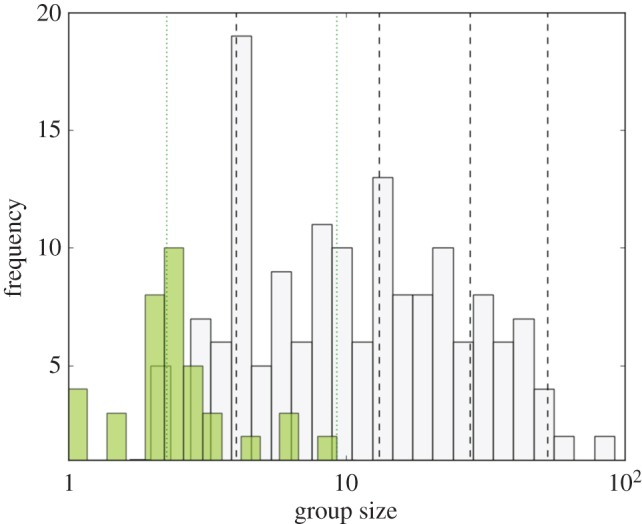
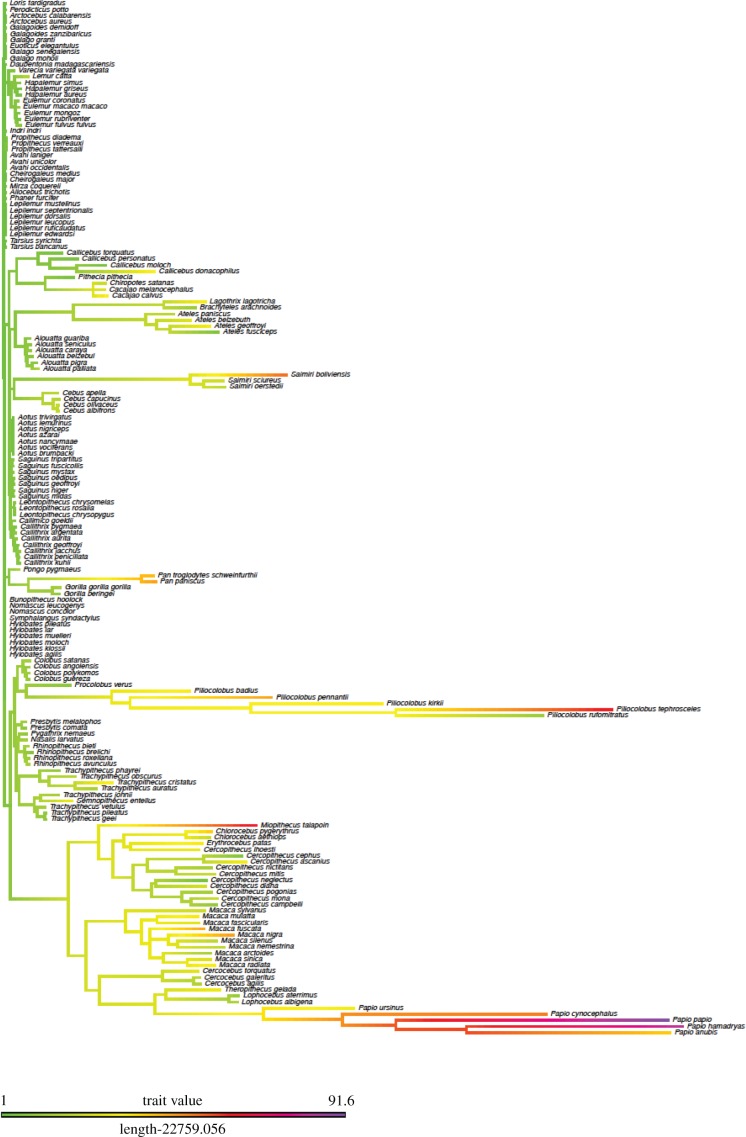
Primate groups vary considerably in size across species. Nonetheless, the distribution of mean species group size has a regular scaling pattern with preferred sizes approximating 2.5, 5, 15, 30 and 50 individuals (although strepsirrhines lack the latter two), with a scaling ratio of approximately 2.5 similar to that observed in human social networks. These clusters appear to form distinct social grades that are associated with rapid evolutionary change, presumably in response to intense environmental selection pressures. These findings may have wider implications for other highly social mammal taxa.
灵长类动物的群体大小在不同物种之间有很大差异。尽管如此,平均物种群体大小的分布具有规则的比例模式,首选大小近似为 2.5、5、15、30 和 50 个体(尽管树鼩目缺乏后两个大小),比例约为 2.5,类似于人类社交网络中观察到的比例。这些聚类似乎形成了不同的社会等级,与快速的进化变化有关,可能是对强烈的环境选择压力的反应。这些发现可能对其他高度社会化的哺乳动物类群具有更广泛的意义。