Wang Ying, Shao Shan, Luo Minna, Huang Shangke, Feng Lu, Yuan Na, Wu Fang, Dang Chengxue, Zhao Xinhan
Department of Surgical Oncology, The First Hospital Affiliated to The School of Medicine, Xi'an Jiaotong University, Xi'an, Shaanxi 710061, P.R. China.
Department of Oncology, The First Hospital Affiliated to The School of Medicine, Xi'an Jiaotong University, Xi'an, Shaanxi 710061, P.R. China.
Oncol Lett. 2017 Dec;14(6):7269-7275. doi: 10.3892/ol.2017.7130. Epub 2017 Oct 3.
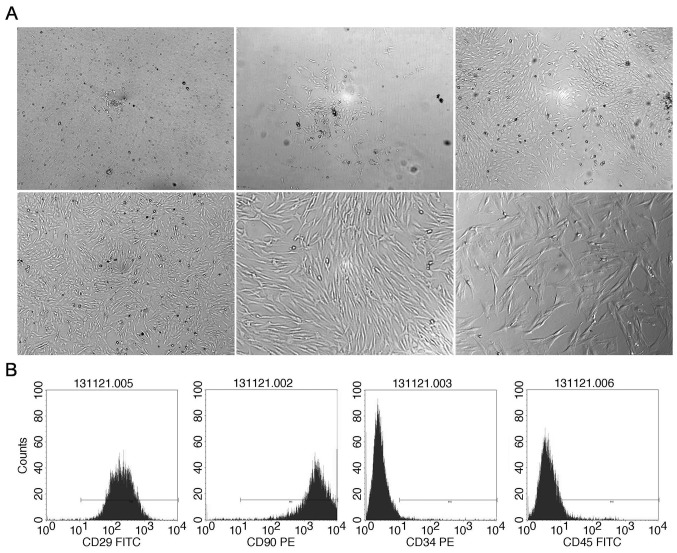
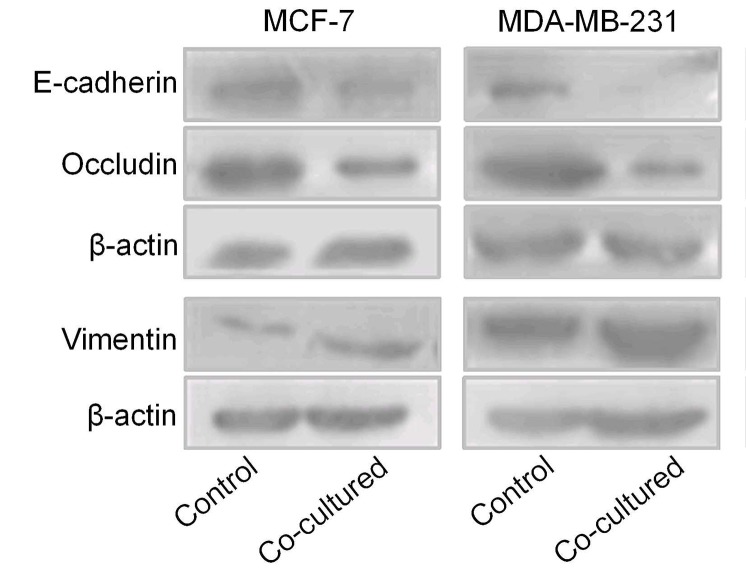
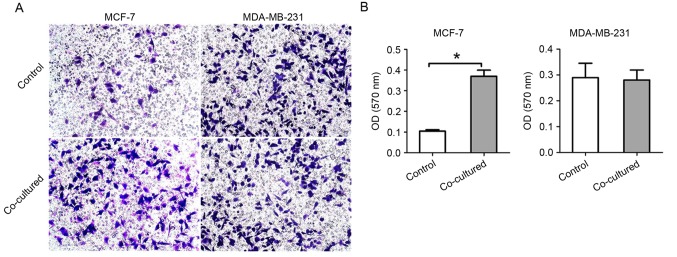
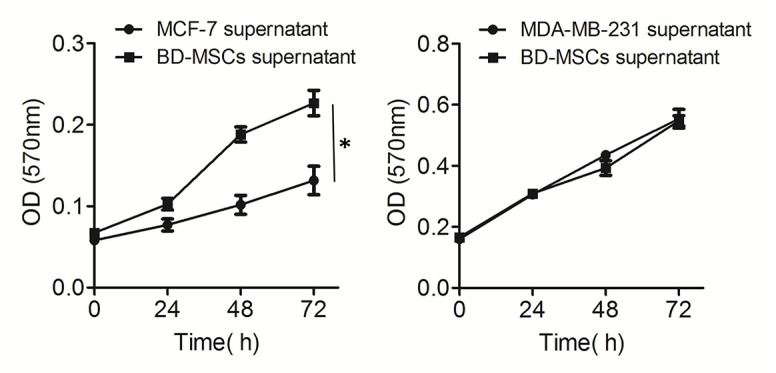
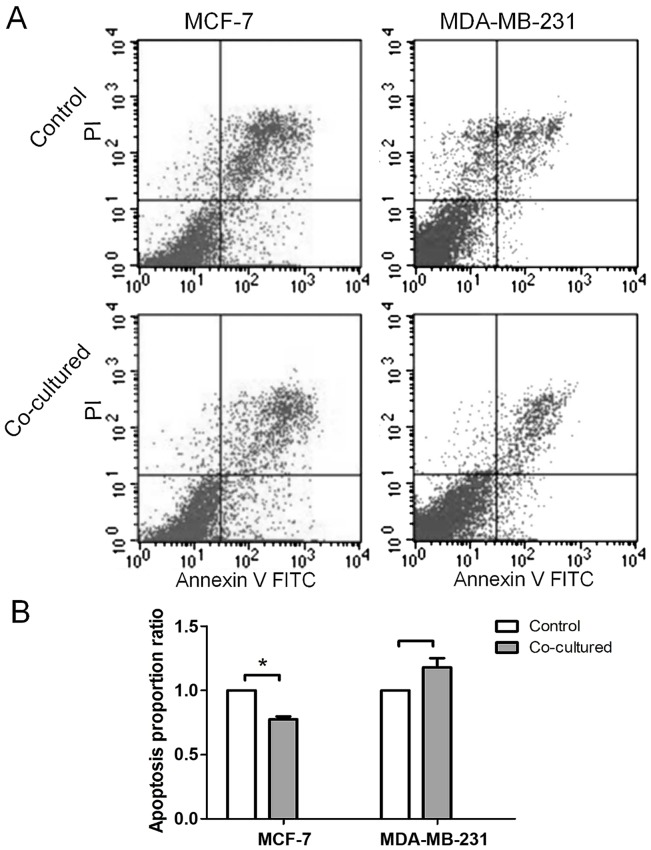
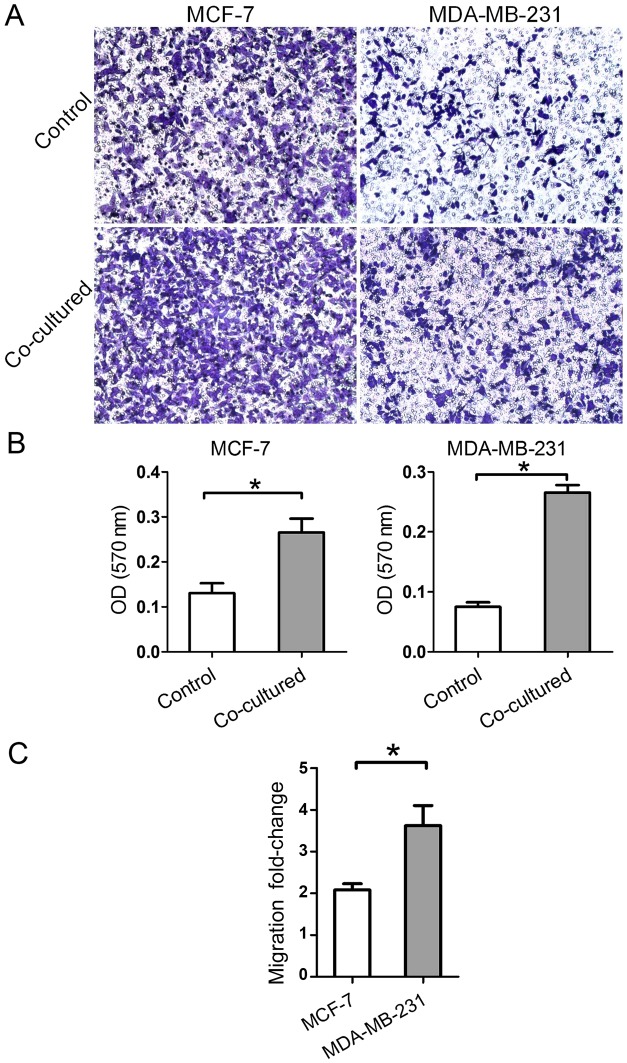
Breast cancer is a heterogeneous disease that can be classified into several molecular intrinsic subtypes according to hormone markers, including estrogen receptor, progesterone receptor and human epidermal growth factor receptor-2. Breast cancer cases with different hormone status vary with respect to patient morbidity, metastasis organotropism and disease progression. It is well known that the most preferential relapse site of breast cancer is in the bone, but the metastatic incidence is markedly higher in hormone receptor-positive cancer compared with that in hormone receptor-negative cancers. Bone marrow-derived mesenchymal stem cells (BMSCs) perform important roles at the site of metastasis; however, the effects in different tumors or tumor subtypes are controversial. The present study aimed to explore the various effects of BMSCs on the biological characteristics of different hormone receptor statuses. BMSCs were obtained from female rats and characterized by cell lineage-specific antigens. The MCF-7 and MDA-MB-231 breast cancer cell lines, which are hormone receptor-positive and -negative, respectively, were employed in the present study. The cancer cells were co-cultured with BMSCs, and changes in the biological characteristic of cell growth, apoptosis, migration and epithelial-mesenchymal transition (EMT) were assessed. BMSCs exhibited chemotactic attraction to MCF-7, promoted the proliferation of MCF-7 cells and reduced MCF-7 cell apoptosis. By contrast, BMSCs exerted no marked effects on these behaviors of MDA-MB-231 cells. However, following co-culture with BMSCs, the migratory ability was enhanced in the two cell lines. Furthermore, the expression of epithelial markers (epithelial-cadherin and occludin) was decreased, and mesenchymal marker vimentin was markedly increased in the two cell lines. Notably, the migratory ability of MDA-MB-231 cells was attenuated compared with that of MCF-7 cells. The results from the present study indicated that BMSCs may favor receptor-positive cancer cell proliferation in bone and promote enhanced invasiveness of receptor-negative compared with receptor-positive cancer cells.
乳腺癌是一种异质性疾病,可根据激素标志物分为几种分子内在亚型,这些激素标志物包括雌激素受体、孕激素受体和人表皮生长因子受体2。不同激素状态的乳腺癌病例在患者发病率、转移器官嗜性和疾病进展方面存在差异。众所周知,乳腺癌最常见的复发部位是骨骼,但激素受体阳性癌症的转移发生率明显高于激素受体阴性癌症。骨髓间充质干细胞(BMSC)在转移部位发挥重要作用;然而,其在不同肿瘤或肿瘤亚型中的作用存在争议。本研究旨在探讨BMSC对不同激素受体状态的生物学特性的各种影响。从雌性大鼠中获取BMSC,并通过细胞谱系特异性抗原进行鉴定。本研究采用了分别为激素受体阳性和阴性的MCF-7和MDA-MB-231乳腺癌细胞系。将癌细胞与BMSC共培养,并评估细胞生长、凋亡、迁移和上皮-间质转化(EMT)等生物学特性的变化。BMSC对MCF-7表现出趋化吸引作用,促进MCF-7细胞增殖并减少MCF-7细胞凋亡。相比之下,BMSC对MDA-MB-231细胞的这些行为没有显著影响。然而,与BMSC共培养后,两种细胞系的迁移能力均增强。此外,两种细胞系中上皮标志物(上皮钙黏蛋白和闭合蛋白)的表达降低,间质标志物波形蛋白的表达显著增加。值得注意的是,与MCF-7细胞相比,MDA-MB-231细胞的迁移能力减弱。本研究结果表明,BMSC可能有利于受体阳性癌细胞在骨中的增殖,并促进受体阴性癌细胞相比受体阳性癌细胞增强的侵袭性。