Wei Wei, Chen Yan, Xu Jie, Zhou Yu, Bai Xinping, Yang Ming, Zhu Ju
Department of Dermatology, Union Hospital, Tongji Medical College, Huazhong University of Science and Technology, Wuhan, Hubei, China.
Oncology Department, Huai'an Second People's Hospital, The Affiliated Huaian Hospital of Xuzhou Medical University, Huai'an, China.
J Cancer. 2018 Jan 1;9(2):400-406. doi: 10.7150/jca.21381. eCollection 2018.
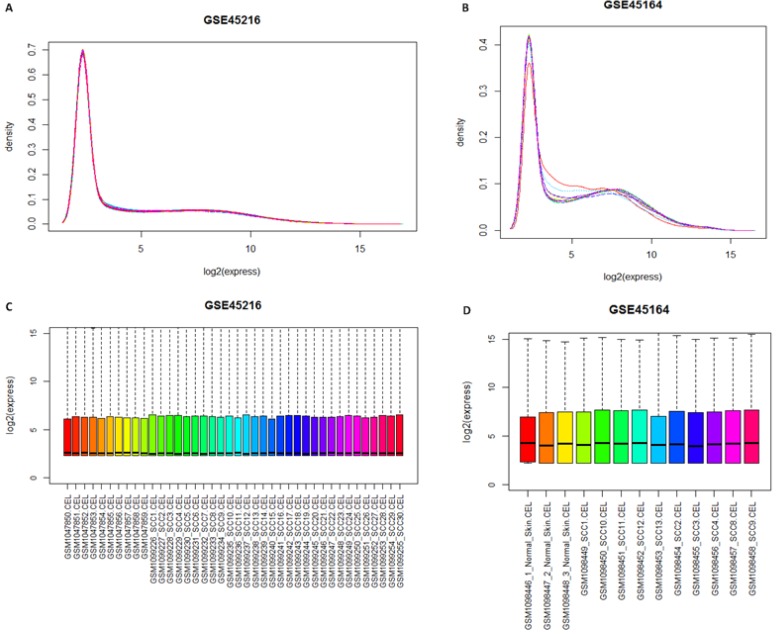
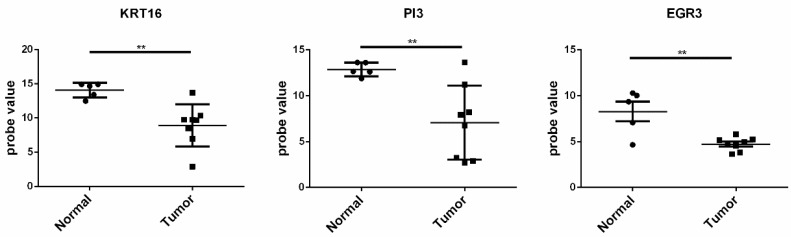
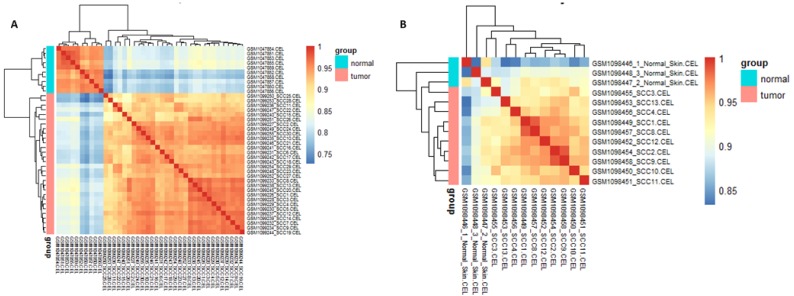
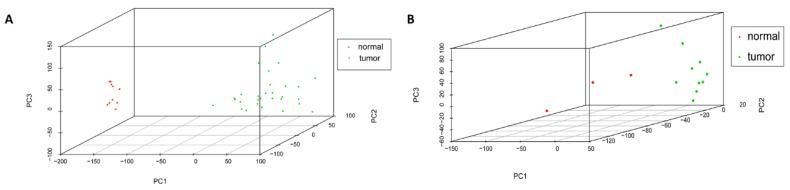
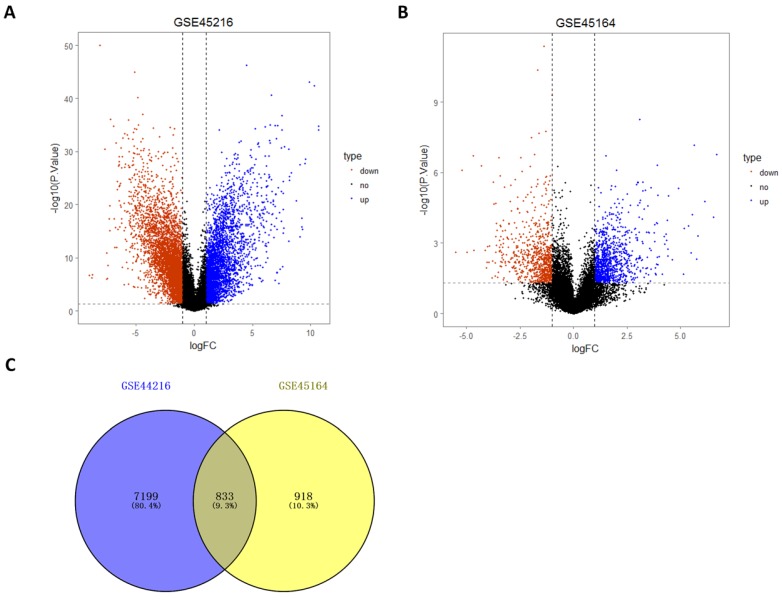
Cutaneous squamous cell carcinoma (CSCC) is one of the most malignant tumors worldwide. We aimed to explore the molecular mechanism of this CSCC and screen feature genes that can function as the biomarker of CSCC and thus provide a theoretical basis for the pathogenesis research and development of medicine. The method of microarray data analysis was used in this study to explore the differentially expressed genes between tissues of normal specimens and tissues of patients with CSCC. Besides, functional enrichment analysis and signal pathway were performed on these genes to screen the feature genes that are closely associated with CSCC can function as the potential biomarkers of CSCC.A total of 53 samples from two datasets, GSE45216 and GSE45164, were used in the differentially expressed analysis. And as a result, a total of 833 genes were screened out, including 465 up-regulated genes and 215 down-regulated genes. Candidate genes, including up-regulated genes like S100A12, MMP1, DEFB4B/DEFB4A, KRT16 and PI3, and down-regulated genes like EGR3, LRP4, C14orf132, PAMR1, CCL27, and KRT2 were screened out. All these genes were testified in the dataset of GSE66359. The result showed that only three genes, KRT16, PI3 and EGR3, were mostly differentially expressed and only EGR3 had the same expression pattern with both datasets, GSE45216 and GSE45164.Of note, EGR3 gene was found to be the most differentially expressed gene in cutaneous squamous cell carcinoma, which had the potential to function as the candidate genes and help in the diagnosis and prognostic treatments of CSCC.
皮肤鳞状细胞癌(CSCC)是全球最恶性的肿瘤之一。我们旨在探究这种皮肤鳞状细胞癌的分子机制,并筛选可作为皮肤鳞状细胞癌生物标志物的特征基因,从而为发病机制研究和药物研发提供理论依据。本研究采用微阵列数据分析方法,探究正常标本组织与皮肤鳞状细胞癌患者组织之间的差异表达基因。此外,对这些基因进行功能富集分析和信号通路分析,以筛选与皮肤鳞状细胞癌密切相关、可作为其潜在生物标志物的特征基因。在差异表达分析中,共使用了来自两个数据集GSE45216和GSE45164的53个样本。结果共筛选出833个基因,其中包括465个上调基因和215个下调基因。筛选出候选基因,上调基因如S100A12、MMP1、DEFB4B/DEFB4A、KRT16和PI3,下调基因如EGR3、LRP4、C14orf132、PAMR1、CCL27和KRT2。所有这些基因均在GSE66359数据集中得到验证。结果显示,只有三个基因KRT16、PI3和EGR3差异表达最为明显,且只有EGR3在数据集GSE45216和GSE45164中的表达模式相同。值得注意的是,EGR3基因被发现是皮肤鳞状细胞癌中差异表达最明显的基因,它有潜力作为候选基因,有助于皮肤鳞状细胞癌的诊断和预后治疗。