Qin Si, Yang Yu, Zhang Hao-Bin, Zheng Xiao-Huan, Li Hua-Run, Wen Ju
Department of Dermatology, Guangdong Second Provincial General Hospital, Guangzhou, China.
The Second School of Clinical Medicine, Southern Medical University, Guangzhou, China.
Transl Cancer Res. 2021 Jan;10(1):469-478. doi: 10.21037/tcr-20-2945.
Cutaneous squamous cell carcinoma (cSCC) is a relatively common cancer that accounts for nearly 50% of non-melanoma skin cancer cases. However, the genotypes that are linked with poor prognosis and/or high relapse rates and pathogenic mechanisms of cSCC are not fully understood. To address these points, three gene expression datasets were analyzed to identify candidate biomarker genes in cSCC.
The GSE117247, GSE32979, and GSE98767 datasets comprising a total of 32 cSCC samples and 31 normal skin tissue samples were obtained from the National Center for Biotechnology Information Gene Expression Omnibus database. Differentially expressed genes (DEGs) were identified and underwent pathway enrichment analyses with the Gene Ontology and Kyoto Encyclopedia of Genes and Genomes (KEGG). A putative DEG protein-protein interaction (PPI) network was also established that included hub genes. The expression of CDK1, MAD2L1, BUB1 ans CDC20 were examined in the study.
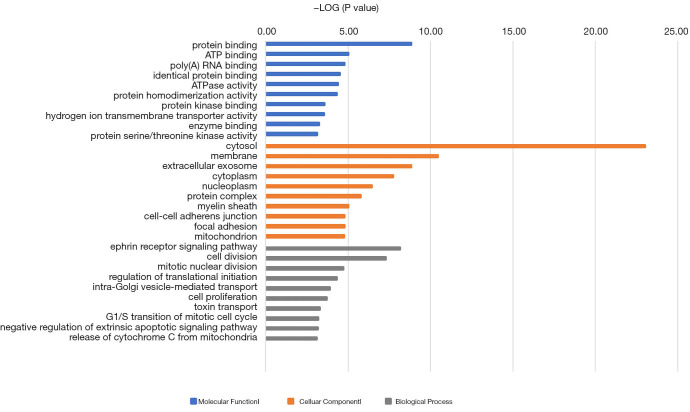
A total of 335 genes were identified, encompassing 219 found to be upregulated and 116 genes that were downregulated in cSCC, compared to normal tissue. Enriched functions of these DEGs were associated with Ephrin receptor signaling and cell division; cytosol, membrane, and extracellular exosomes; ATP-, poly(A) RNA-, and identical protein binding. We also established a PPI network comprising 332 nodes and identified KIF2C, CDC42, AURKA, MAD2L1, MYC, CDK1, FEN1, H2AFZ, BUB1, BUB1B, CKS2, CDC20, CCT2, ACTR2, ACTB, MAPK14, and HDAC1 as candidate hub genes. The expression of CDK1 are significantly higher in the cSCC tissues than that in normal skin.
The DEGs identified in this study are potential therapeutic targets and biomarkers for cSCC. CDK1 is a gene closely related to the occurrence and development of cSCC, which may play an important role. Bioinformatics analysis shows that it is involved in the important pathway of the pathogenesis of cSCC, and may be recognized and applied as a new biomarker in the future diagnosis and treatment of cSCC.
皮肤鳞状细胞癌(cSCC)是一种相对常见的癌症,占非黑色素瘤皮肤癌病例的近50%。然而,与cSCC预后不良和/或高复发率相关的基因型以及致病机制尚未完全明确。为了解决这些问题,对三个基因表达数据集进行了分析,以识别cSCC中的候选生物标志物基因。
从美国国立生物技术信息中心基因表达综合数据库中获取了GSE117247、GSE32979和GSE98767数据集,共包含32个cSCC样本和31个正常皮肤组织样本。识别差异表达基因(DEG),并使用基因本体论和京都基因与基因组百科全书(KEGG)进行通路富集分析。还建立了一个包含枢纽基因的假定DEG蛋白质-蛋白质相互作用(PPI)网络。在本研究中检测了CDK1、MAD2L1、BUB1和CDC20的表达。
共识别出335个基因,其中与正常组织相比,cSCC中有219个基因上调,116个基因下调。这些DEG的富集功能与 Ephrin 受体信号传导和细胞分裂、胞质溶胶、膜和细胞外囊泡、ATP、聚(A)RNA和相同蛋白质结合相关。我们还建立了一个包含332个节点的PPI网络,并将KIF2C、CDC42、AURKA、MAD2L1、MYC、CDK1、FEN1、H2AFZ、BUB1、BUB1B、CKS2、CDC20、CCT2、ACTR2、ACTB、MAPK14和HDAC1识别为候选枢纽基因。CDK1在cSCC组织中的表达明显高于正常皮肤。
本研究中识别出的DEG是cSCC潜在的治疗靶点和生物标志物。CDK1是一个与cSCC发生发展密切相关的基因,可能起重要作用。生物信息学分析表明,它参与了cSCC发病机制的重要通路,未来可能作为一种新的生物标志物在cSCC的诊断和治疗中得到认可和应用。