Department of Otolaryngology, Union Hospital, Tongji Medical College, Huazhong University of Science and Technology, Wuhan, Hubei 430022, P.R. China.
Department of Otolaryngology, Central Hospital of Huangshi, Huangshi, Hubei 435000, P.R. China.
Int J Mol Med. 2018 Apr;41(4):2086-2098. doi: 10.3892/ijmm.2018.3393. Epub 2018 Jan 17.
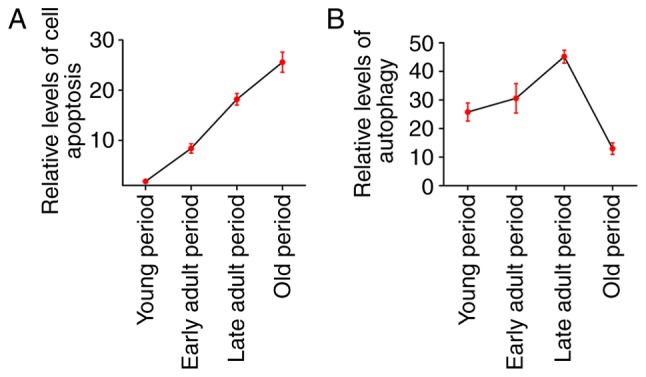
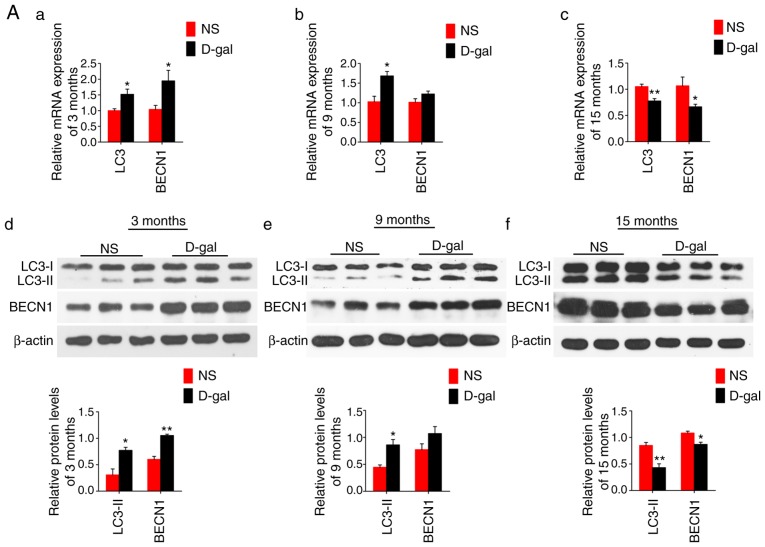
Presbycusis is the most common sensory impairment associated with aging; however, the underlying molecular mechanism remains unclear. Autophagy has been demonstrated to serve a key role in diverse diseases; however, no studies have examined its function in central presbycusis. The aim of the present study was to investigate the changes of autophagy in the physiological processes of the auditory cortex and its role in the degeneration of the auditory cortex, as well as the related mechanisms using naturally aging rats and a D‑galactose (D‑gal)‑induced mimetic rat model of aging. The present study demonstrated that autophagy increased from 3 months to 15 months in the normal saline (NS) control group, while it decreased in the D‑gal group. Compared with the age‑matched NS group, the D‑gal group demonstrated significantly increased levels of the autophagy‑related proteins, LC3 and Beclin 1 (BECN1) and the anti‑apoptotic proteins B‑cell lymphoma (BCL)2 and BCL‑extra large (BCL‑xL) at 3 months, with no obvious changes in cell apoptosis level and neuron ultrastructural morphology. However, LC3, BECN1, BCL2 and BCL‑xL were decreased at 15 months in the D-gal group, with cell apoptosis significantly increased and substantial neuron degeneration. Additionally, 5' AMP‑activated protein kinase (AMPK) activity was enhanced, and mechanistic target of rapamycin (mTOR) and ULK1 phosphorylation (Ser 757) activities were inhibited at 3 months compared with those of the NS group, while the opposite was observed at 9 and 15 months. The present results suggested that autophagy increases from young to adult and decreases at old age in the physiological processes of the auditory cortex, and has anti‑apoptotic as well as anti‑aging functions in the degeneration of the auditory cortex. Additionally, autophagy was regulated through AMPK activation and mTOR suppression, and impairment of autophagy may serve a key role in the degeneration of the auditory cortex, even in the pathogenesis of central presbycusis.
老年性聋是与衰老相关的最常见的感觉功能障碍;然而,其潜在的分子机制尚不清楚。自噬在多种疾病中起着关键作用;然而,目前还没有研究检查其在中枢性老年性聋中的功能。本研究旨在使用自然衰老大鼠和 D-半乳糖(D-gal)诱导的衰老模拟大鼠模型,研究自噬在听觉皮层生理过程中的变化及其在听觉皮层变性中的作用及其相关机制。本研究表明,在生理盐水(NS)对照组中,自噬从 3 个月增加到 15 个月,而在 D-gal 组中则减少。与年龄匹配的 NS 组相比,D-gal 组在 3 个月时自噬相关蛋白 LC3 和 Beclin1(BECN1)以及抗凋亡蛋白 B 细胞淋巴瘤(BCL)2 和 BCL 额外大(BCL-xL)的水平显著升高,细胞凋亡水平和神经元超微结构形态无明显变化。然而,在 D-gal 组中,LC3、BECN1、BCL2 和 BCL-xL 在 15 个月时降低,细胞凋亡明显增加,神经元大量变性。此外,与 NS 组相比,在 3 个月时,5' 腺苷酸活化蛋白激酶(AMPK)活性增强,雷帕霉素(mTOR)和 ULK1 磷酸化(Ser757)活性受到抑制,而在 9 和 15 个月时则相反。本研究结果表明,自噬在听觉皮层的生理过程中从幼年到成年增加,在老年时减少,在听觉皮层变性中具有抗凋亡和抗衰老作用。此外,自噬通过 AMPK 激活和 mTOR 抑制来调节,自噬受损可能在听觉皮层变性中发挥关键作用,甚至在中枢性老年性聋的发病机制中发挥关键作用。