Division of Geographic Medicine and Infectious Diseases, Tufts University School of Medicine, Boston, MA, United States of America.
Division of Gastrointestinal Sciences, Christian Medical College, Vellore, India.
PLoS Negl Trop Dis. 2018 Jan 18;12(1):e0006153. doi: 10.1371/journal.pntd.0006153. eCollection 2018 Jan.
Soil-transmitted helminth (STH) infections are among the most prevalent neglected tropical diseases (NTD) worldwide. Since the publication of the WHO road map to combat NTD in 2012, there has been a renewed commitment to control STH. In this study, we analysed the geographical distribution and effect of community type on prevalence of hookworm, Trichuris and Ascaris in south Asia and south east Asia.
We conducted a systematic review of open-access literature published in PubMed Central and the Global Atlas of Helminth Infection. A total of 4182 articles were available and after applying selection criteria, 174 studies from the region were retained for analysis.
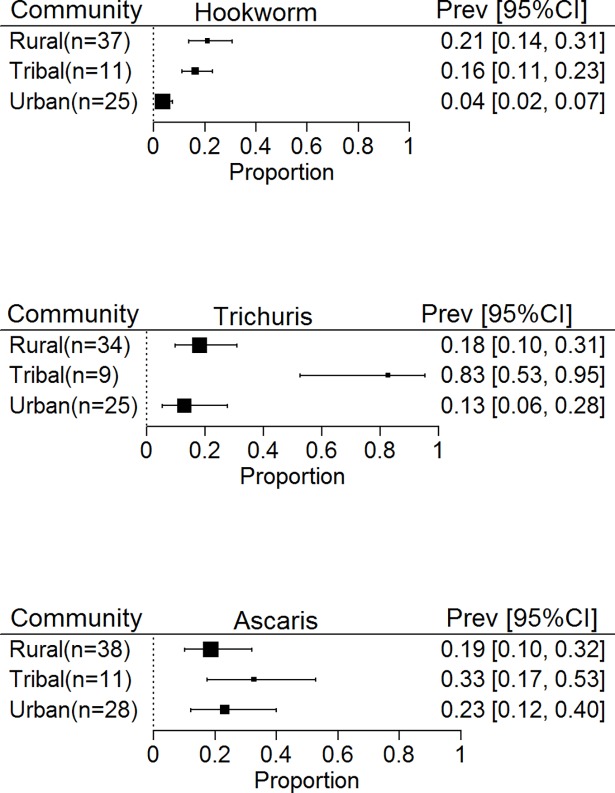
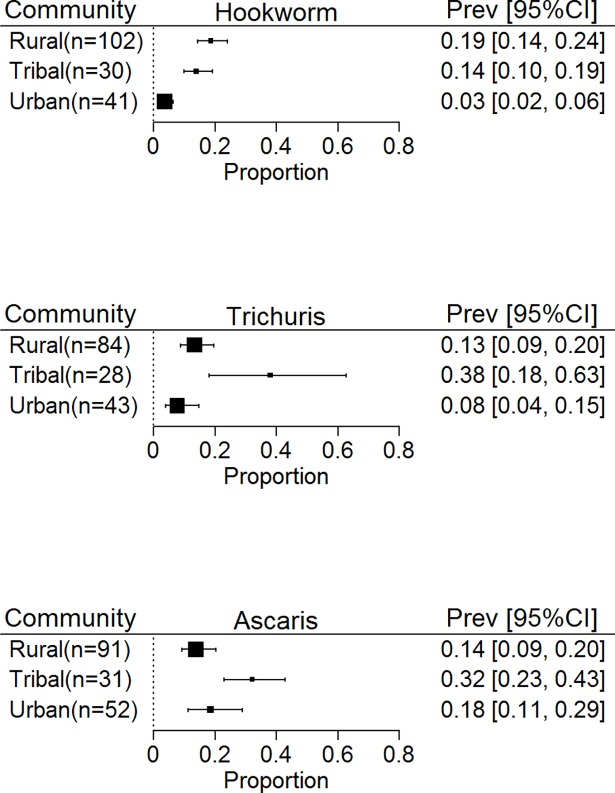
Ascaris was the commonest STH identified with an overall prevalence of 18% (95% CI, 14-23%) followed by Trichuris (14%, 9-19%) and hookworm (12%, 9-15%). Hookworm prevalence was highest in Laos, Vietnam and Cambodia. We found a geographical overlap in countries with high prevalence rates for Trichuris and Ascaris (Malaysia, Philippines, Myanmar, Vietnam and Bangladesh). When the effect of community type was examined, prevalence rates of hookworm was comparable in rural (19%, 14-24%) and tribal communities (14%, 10-19%). Tribal communities, however, showed higher prevalence of Trichuris (38%, 18-63%) and Ascaris (32%, 23-43%) than rural communities (13%, 9-20% and 14%, 9-20% respectively). Considerable between and within country heterogeneity in the distribution of STH (I2 >90%) was also noted. When available data from school aged children (SAC) were analysed, prevalence of Ascaris (25% 16-31%) and Trichuris (22%, 14-34%) were higher than among the general population while that of hookworm (10%, 7-16%) was comparable.
CONCLUSIONS/SIGNIFICANCE: Our analysis showed significant variation in prevalence rates between and within countries in the region. Highlighting the importance of community type in prevalence and species mix, we showed that tribal and rural communities had higher hookworm infections than urban communities and for ascariasis and trichuriasis, tribal populations had higher levels of infection than rural populations. We also found a higher prevalence of ascariasis and trichuriasis in SAC compared to the general population but comparable levels of hookworm infections. These key findings need to be taken into account in planning future MDA and other interventions.
土壤传播性蠕虫(STH)感染是全球最普遍的被忽视热带病(NTD)之一。自 2012 年世界卫生组织发布防治 NTD 路线图以来,人们对控制 STH 的承诺再次得到加强。在这项研究中,我们分析了南亚和东南亚社区类型对钩虫、鞭虫和蛔虫流行率的地理分布和影响。
我们对在 PubMed Central 和全球寄生虫感染地图集中发表的开放获取文献进行了系统评价。共有 4182 篇文章可供使用,在应用选择标准后,保留了该地区的 174 项研究进行分析。
蛔虫是最常见的 STH,总体流行率为 18%(95%CI,14-23%),其次是鞭虫(14%,9-19%)和钩虫(12%,9-15%)。钩虫的流行率在老挝、越南和柬埔寨最高。我们发现,在鞭虫和蛔虫高流行率的国家之间存在地理重叠(马来西亚、菲律宾、缅甸、越南和孟加拉国)。当检查社区类型的影响时,农村(19%,14-24%)和部落社区(14%,10-19%)的钩虫流行率相当。然而,部落社区的鞭虫(38%,18-63%)和蛔虫(32%,23-43%)的流行率高于农村社区(13%,9-20%和 14%,9-20%)。还注意到 STH 分布的国家间和国家内存在显著的异质性(I2>90%)。当分析来自学龄儿童(SAC)的可用数据时,蛔虫(25%,16-31%)和鞭虫(22%,14-34%)的流行率高于一般人群,而钩虫(10%,7-16%)的流行率相当。
结论/意义:我们的分析显示,该地区国家间和国家内的流行率存在显著差异。强调社区类型对流行率和物种组成的重要性,我们表明,部落和农村社区的钩虫感染率高于城市社区,而对于蛔虫病和鞭虫病,部落人口的感染水平高于农村人口。我们还发现,SAC 的蛔虫病和鞭虫病的流行率高于一般人群,但钩虫感染水平相当。这些关键发现需要在规划未来的 MDA 和其他干预措施时加以考虑。