Stella Judith L, Bauer Amy E, Croney Candace C
USDA-APHIS, Purdue University, W. Lafayette, Indiana, United States of America.
Departement of Comparative Pathobiology, Purdue University, W. Lafayette, Indiana, United States of America.
PLoS One. 2018 Jan 18;13(1):e0191395. doi: 10.1371/journal.pone.0191395. eCollection 2018.
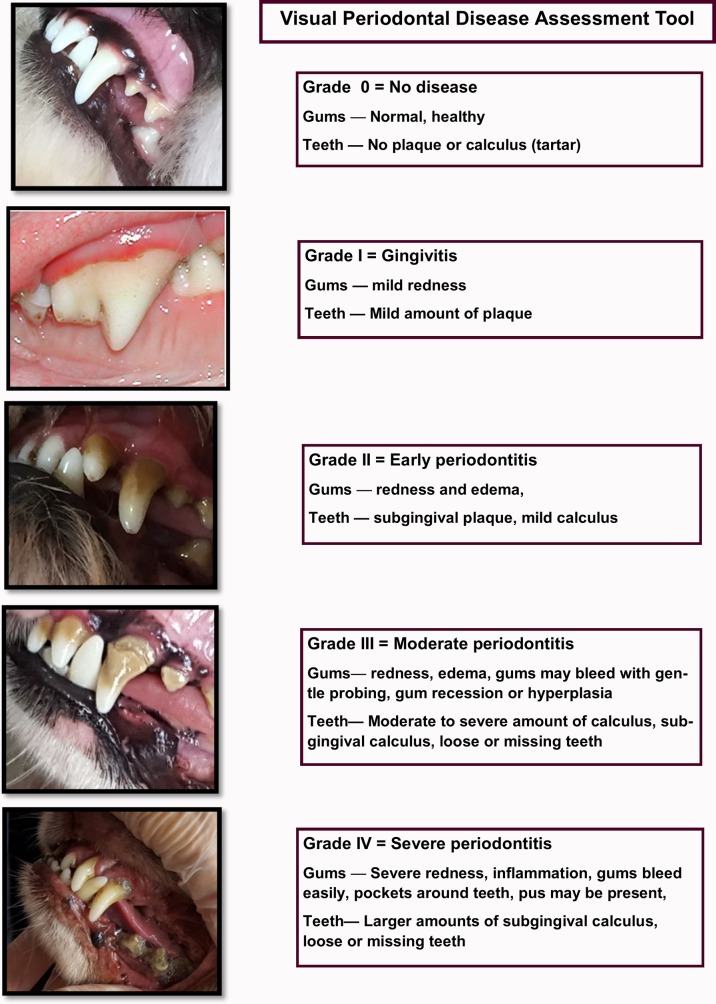
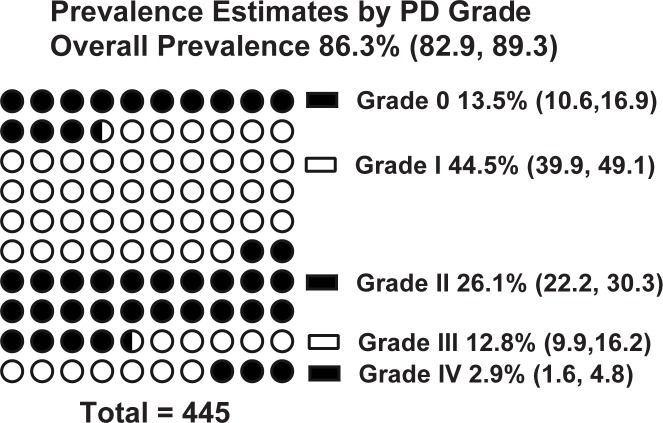
The objectives of this cross-sectional study were: 1) to estimate the prevalence and characterize the severity of periodontal disease in a population of dogs housed in commercial breeding facilities; 2) to characterize PD preventive care utilized by facility owners; and 3) to assess inter-rater reliability of a visual scoring assessment tool. Adult dogs (N = 445) representing 42 breeds at 24 CB facilities in Indiana and Illinois were assessed. Periodontal disease was scored visually using the American Veterinary Dental Collage 0-IV scale. Inter-rater reliability was assessed on 198 dogs and facility owners were asked to provide information about the preventive care utilized. The overall prevalence of periodontal disease (Grades I-IV) was 86.3% (95% CI: 82.9, 89.3). An ordered logistic regression analysis found age (OR = 1.4; 95% CI 1.24, 1.54; P<0.0001), facility (OR = 1.13; 95% CI 1.09, 1.18; P<0.0001), sex (OR = 1.7; 95% CI 1.12, 2.65; P = 0.013), and non-professional dental scaling (OR = 2.82; 95% CI 1.34, 5.91; P = 0.006) to be statistically significant. Inter-rater reliability analysis found agreement to be 86.2%, with a weighted kappa of 0.4731 (95% CI 0.3847, 0.5615) indicating moderate agreement. Risk of periodontal disease increased with increasing age. Additionally, a trend toward decreasing risk with increasing weight was also found, although it was not statistically significant. The trends identified agree with studies that have evaluated periodontal disease in the companion dog population and do not support the assumption that the dental health of dogs in commercial breeding facilities is worse than that of the population as a whole. Although there were few cases of severe periodontal disease and all facilities employed some type of preventive care in this sample, the large number of dogs with some degree of disease (Grades I-IV) suggests that further investigation of preventive care is warranted.
1)估计商业繁育设施中犬类群体牙周疾病的患病率并描述其严重程度特征;2)描述设施所有者采用的牙周疾病预防护理措施;3)评估一种视觉评分评估工具的评分者间信度。对印第安纳州和伊利诺伊州24个商业繁育设施中代表42个品种的成年犬(N = 445)进行了评估。使用美国兽医牙科学会0-IV级量表对牙周疾病进行视觉评分。对198只犬评估了评分者间信度,并要求设施所有者提供有关所采用预防护理措施的信息。牙周疾病(I-IV级)的总体患病率为86.3%(95%置信区间:82.9, 89.3)。有序逻辑回归分析发现年龄(比值比 = 1.4;95%置信区间1.24, 1.54;P<0.0001)、设施(比值比 = 1.13;95%置信区间1.09, 1.18;P<0.0001)、性别(比值比 = 1.7;95%置信区间1.12, 2.65;P = 0.013)和非专业洗牙(比值比 = 2.82;95%置信区间1.34, 5.91;P = 0.006)具有统计学意义。评分者间信度分析发现一致性为86.2%,加权kappa值为0.4731(95%置信区间0.3847, 0.5615),表明一致性中等。牙周疾病风险随年龄增长而增加。此外,还发现随着体重增加风险有降低趋势,尽管无统计学意义。所确定的趋势与评估伴侣犬群体牙周疾病的研究一致,并不支持商业繁育设施中犬类牙齿健康比整个群体更差的假设。尽管本样本中严重牙周疾病病例很少,且所有设施都采用了某种类型的预防护理措施,但大量患有某种程度疾病(I-IV级)的犬表明有必要进一步研究预防护理措施。