State Key Laboratory of Crop Stress Biology for Arid Areas, College of Agronomy, Northwest A & F University, Yangling, Shaanxi, 712100, China.
Innovation Experimental College, Northwest A & F University, Yangling, Shaanxi, 712100, China.
BMC Genomics. 2018 Jan 18;19(1):61. doi: 10.1186/s12864-018-4443-1.
Heat shock proteins (Hsps) are essential components in plant tolerance mechanism under various abiotic stresses. Hsp20 is the major family of heat shock proteins, but little of Hsp20 family is known in potato (Solanum tuberosum), which is an important vegetable crop that is thermosensitive.
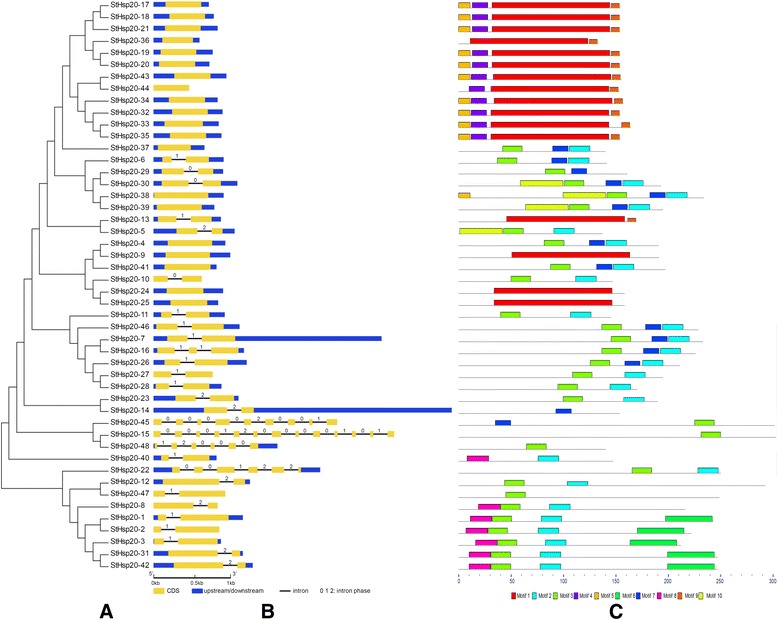
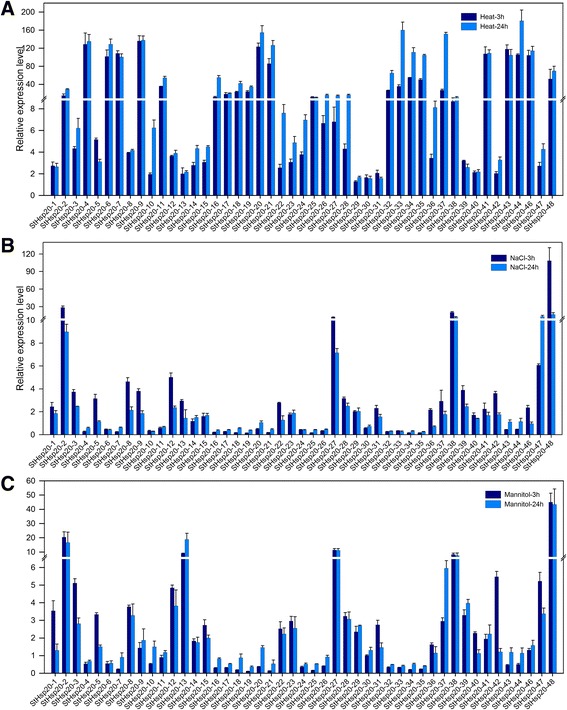
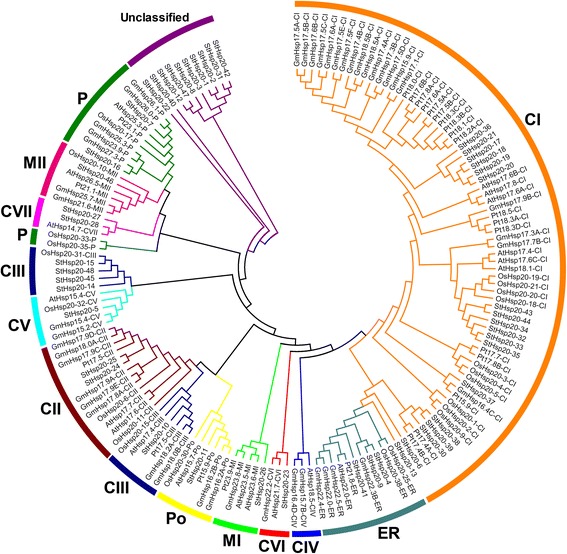
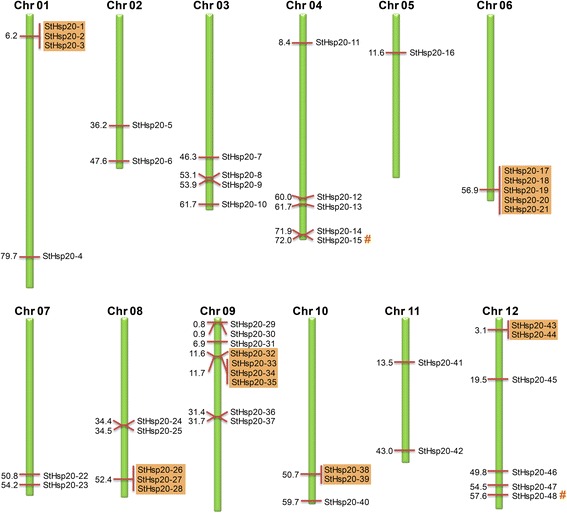
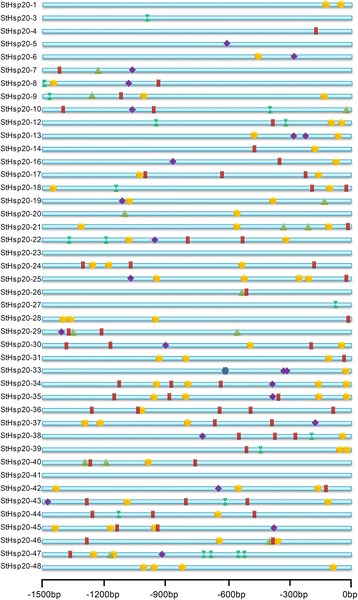
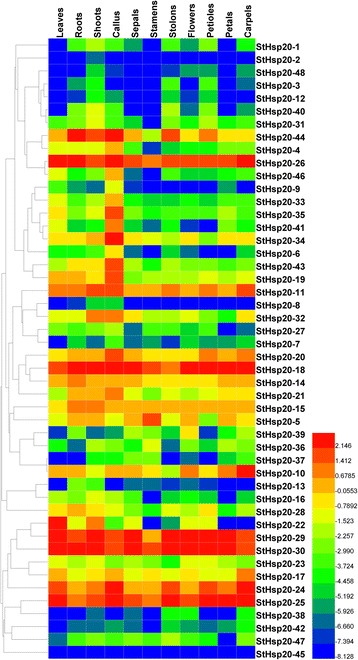
To reveal the mechanisms of potato Hsp20s coping with abiotic stresses, analyses of the potato Hsp20 gene family were conducted using bioinformatics-based methods. In total, 48 putative potato Hsp20 genes (StHsp20s) were identified and named according to their chromosomal locations. A sequence analysis revealed that most StHsp20 genes (89.6%) possessed no, or only one, intron. A phylogenetic analysis indicated that all of the StHsp20 genes, except 10, were grouped into 12 subfamilies. The 48 StHsp20 genes were randomly distributed on 12 chromosomes. Nineteen tandem duplicated StHsp20s and one pair of segmental duplicated genes (StHsp20-15 and StHsp20-48) were identified. A cis-element analysis inferred that StHsp20s, except for StHsp20-41, possessed at least one stress response cis-element. A heatmap of the StHsp20 gene family showed that the genes, except for StHsp20-2 and StHsp20-45, were expressed in various tissues and organs. Real-time quantitative PCR was used to detect the expression level of StHsp20 genes and demonstrated that the genes responded to multiple abiotic stresses, such as heat, salt or drought stress. The relative expression levels of 14 StHsp20 genes (StHsp20-4, 6, 7, 9, 20, 21, 33, 34, 35, 37, 41, 43, 44 and 46) were significantly up-regulated (more than 100-fold) under heat stress.
These results provide valuable information for clarifying the evolutionary relationship of the StHsp20 family and in aiding functional characterization of StHsp20 genes in further research.
热休克蛋白(Hsps)是植物在各种非生物胁迫下耐受机制的重要组成部分。Hsp20 是热休克蛋白的主要家族,但在马铃薯(Solanum tuberosum)中对 Hsp20 家族知之甚少,马铃薯是一种重要的蔬菜作物,对热敏感。
为了揭示马铃薯 Hsp20 应对非生物胁迫的机制,使用基于生物信息学的方法对马铃薯 Hsp20 基因家族进行了分析。总共鉴定出 48 个推定的马铃薯 Hsp20 基因(StHsp20s),并根据其染色体位置进行了命名。序列分析表明,大多数 StHsp20 基因(89.6%)没有内含子,或者只有一个内含子。系统发育分析表明,除 10 个外,所有的 StHsp20 基因都被分为 12 个亚家族。48 个 StHsp20 基因随机分布在 12 条染色体上。鉴定出 19 个串联重复的 StHsp20s 和一对片段重复基因(StHsp20-15 和 StHsp20-48)。顺式作用元件分析推断,除了 StHsp20-41 之外,StHsp20 都至少含有一个应激反应顺式作用元件。StHsp20 基因家族的热图显示,除了 StHsp20-2 和 StHsp20-45 之外,这些基因在各种组织和器官中都有表达。实时定量 PCR 用于检测 StHsp20 基因的表达水平,表明这些基因对多种非生物胁迫(如热、盐或干旱胁迫)有反应。在热胁迫下,14 个 StHsp20 基因(StHsp20-4、6、7、9、20、21、33、34、35、37、41、43、44 和 46)的相对表达水平显著上调(超过 100 倍)。
这些结果为阐明 StHsp20 家族的进化关系以及辅助 StHsp20 基因的功能特征提供了有价值的信息,有助于进一步的研究。