Copenhagen Academy for Medical Education and Simulation (CAMES), Herlev Ringvej 75, 2730, Herlev, Denmark.
The University of Copenhagen, Nørregade 10, 1017, Copenhagen, Denmark.
Scand J Trauma Resusc Emerg Med. 2018 Jan 18;26(1):9. doi: 10.1186/s13049-018-0474-5.
Assessment of laypersons' Paediatric Basic Life Support (PBLS) skills is important to ensure acquisition of effective PBLS competencies. However limited evidence exists on which PBLS skills are essential for laypersons. The same challenges exist with respect to the assessment of foreign body airway obstruction management (FBAOM) skills. We aimed to establish international consensus on how to assess laypersons' PBLS and FBAOM skills.
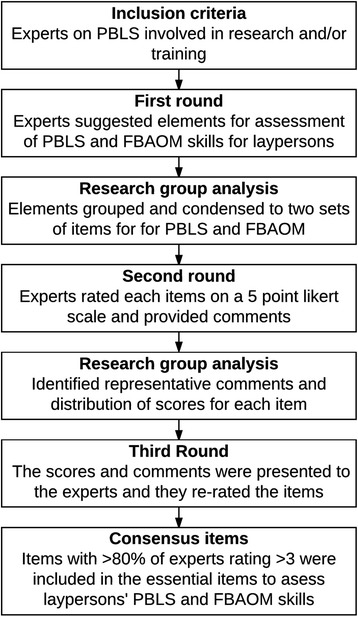
A Delphi consensus survey was conducted. Out of a total of 84 invited experts, 28 agreed to participate. During the first Delphi round experts suggested items to assess laypersons' PBLS and FBAOM skills. In the second round, the suggested items received comments from and were rated by 26 experts (93%) on a 5-point scale (1 = not relevant to 5 = essential). Revised items were anonymously presented in a third round for comments and 23 (82%) experts completed a re-rating. Items with a score above 3 by more than 80% of the experts in the third round were included in an assessment instrument.
In the first round, 19 and 15 items were identified to assess PBLS and FBAOM skills, respectively. The ratings and comments from the last two rounds resulted in nine and eight essential assessment items for PBLS and FBAOM skills, respectively. The PBLS items included: "Responsiveness"," Call for help", "Open airway"," Check breathing", "Rescue breaths", "Compressions", "Ventilations", "Time factor" and "Use of AED". The FBAOM items included: "Identify different stages of foreign body airway obstruction", "Identify consciousness", "Call for help", "Back blows", "Chest thrusts/abdominal thrusts according to age", "Identify loss of consciousness and change to CPR", "Assessment of breathing" and "Ventilation".
For assessment of laypersons some PBLS and FBAOM skills described in guidelines are more important than others. Four out of nine of PBLS skills focus on airway and breathing skills, supporting the major importance of these skills for laypersons' resuscitation attempts.
International consensus on how to assess laypersons' paediatric basic life support and foreign body airway obstruction management skills was established. The assessment of these skills may help to determine when laypersons have acquired competencies.
Not relevant.
评估非专业人员的儿科基本生命支持(PBLS)技能对于确保他们获得有效的 PBLS 能力非常重要。然而,对于非专业人员来说,哪些 PBLS 技能是必不可少的,目前证据有限。在评估异物气道阻塞管理(FBAOM)技能方面也存在同样的挑战。我们的目标是就如何评估非专业人员的 PBLS 和 FBAOM 技能达成国际共识。
进行了德尔菲共识调查。在总共 84 名受邀专家中,有 28 名同意参与。在第一轮德尔菲调查中,专家们提出了评估非专业人员 PBLS 和 FBAOM 技能的项目。在第二轮中,26 名专家(93%)对建议的项目进行了评论和 5 分制评分(1=不相关,5=必不可少)。修订后的项目在第三轮匿名提交供评论,23 名(82%)专家重新进行了评分。在第三轮中,得分超过 3 分且得到 80%以上专家认可的项目被纳入评估工具。
在第一轮中,分别确定了 19 项和 15 项 PBLS 和 FBAOM 技能评估项目。在最后两轮的评分和评论中,分别确定了 9 项和 8 项 PBLS 和 FBAOM 技能的必备评估项目。PBLS 项目包括:“反应能力”、“呼救”、“开放气道”、“检查呼吸”、“复苏呼吸”、“按压”、“通气”、“时间因素”和“使用 AED”。FBAOM 项目包括:“识别异物气道阻塞的不同阶段”、“识别意识”、“呼救”、“背部拍打”、“根据年龄进行胸部推压/腹部推压”、“识别意识丧失并改为心肺复苏”、“呼吸评估”和“通气”。
对于评估非专业人员的某些 PBLS 和 FBAOM 技能,指南中描述的技能比其他技能更重要。9 项 PBLS 技能中有 4 项侧重于气道和呼吸技能,这表明这些技能对非专业人员的复苏尝试非常重要。
就如何评估非专业人员的儿科基本生命支持和异物气道阻塞管理技能达成了国际共识。这些技能的评估可能有助于确定非专业人员何时获得了能力。
不相关。