College of Health Solutions, Arizona State University, 550 N 3rd Street, Phoenix, AZ, 85004, USA.
College of Nursing and Health Innovation, Arizona State University, 500 N 3rd Street, Phoenix, AZ, 85004, USA.
Int J Behav Nutr Phys Act. 2018 Jan 18;15(1):9. doi: 10.1186/s12966-018-0647-7.
To examine longitudinal associations between food insecurity (FI) and health behaviors/outcomes among a diverse sample of university freshmen.
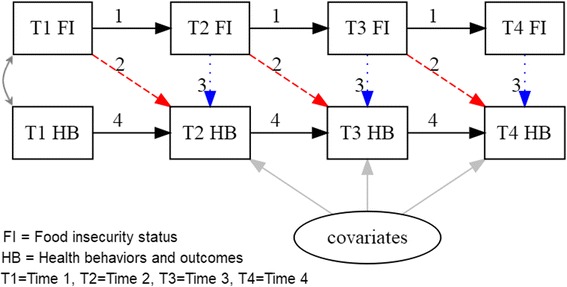
Freshman students (n = 1138; 65% female; 49% non-white) participating in the Social impact of Physical Activity and nutRition in College study completed surveys on health behaviors and had height/weight measured up to 4 times (T1-T4) in Arizona during 2015-2016. Structural equation models were estimated to determine if, after adjusting for covariates, FI predicted concurrent behaviors/outcomes and subsequent behaviors/outcomes. Analyses reported here were conducted in 2017.
The prevalence of FI was significantly higher at the end of each semester (35% and 36%, respectively) than at the start of the year (28%). Longitudinally, FI was not related to any health behaviors/outcomes at future time points. However, FI was significantly and inversely associated with concurrent breakfast consumption on most days of the week (OR = 0.67, 99% CI = 0.46, 0.99), daily evening meal consumption (OR = 0.55, 99% CI = 0.36, 0.86) healthy eating habits on campus (OR = 0.68, 99% CI = 0.46, 1.00), healthy physical activity habits on campus (OR = 0.66, 99% CI = 0.44, 1.00), and positively related to the likelihood of experiencing stress (OR = 1.69, 99% CI = 1.16, 2.46) and depressed mood (OR = 1.98, 99% CI = 1.34, 2.91).
Compared with US prevalence rates, the sample FI prevalence was high. FI was related to poorer eating patterns, physical activity behaviors, and mental health, even after adjusting for prior levels of behavior.
在一个多样化的大学新生样本中,研究食物不安全(FI)与健康行为/结果之间的纵向关联。
参与体育活动和营养对大学生社会影响研究的新生学生(n=1138;65%女性;49%非白人)在 2015-2016 年期间在亚利桑那州完成了健康行为调查,并进行了多达 4 次(T1-T4)的身高/体重测量。使用结构方程模型来确定在调整了协变量后,FI 是否预测了同期行为/结果和后续行为/结果。本报告中的分析于 2017 年进行。
FI 的患病率在每个学期末(分别为 35%和 36%)显著高于年初(28%)。纵向来看,FI 与未来时间点的任何健康行为/结果均无关。然而,FI 与大多数日子的同期早餐消费(OR=0.67,99%CI=0.46,0.99)、每天的晚餐消费(OR=0.55,99%CI=0.36,0.86)、校园内的健康饮食习惯(OR=0.68,99%CI=0.46,1.00)、校园内的健康体育活动习惯(OR=0.66,99%CI=0.44,1.00)呈显著负相关,而与压力体验的可能性呈正相关(OR=1.69,99%CI=1.16,2.46)和抑郁情绪(OR=1.98,99%CI=1.34,2.91)。
与美国的流行率相比,该样本的 FI 流行率较高。FI 与较差的饮食模式、体育活动行为和心理健康有关,即使在调整了之前的行为水平后也是如此。