Section of Forensic Genetics, Department of Forensic Medicine, Faculty of Health and Medical Sciences, University of Copenhagen, DK-2100, Copenhagen, Denmark.
Sci Rep. 2018 Jan 18;8(1):1110. doi: 10.1038/s41598-018-19574-w.
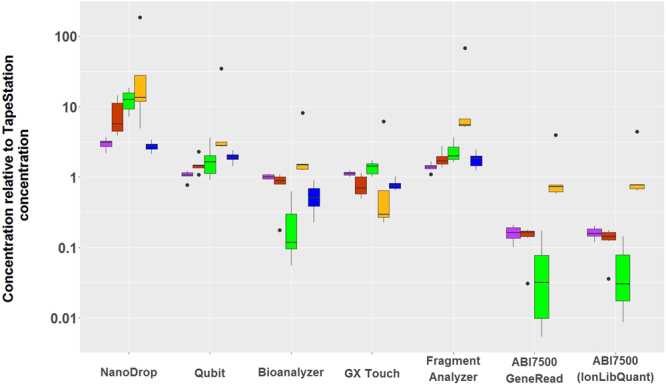
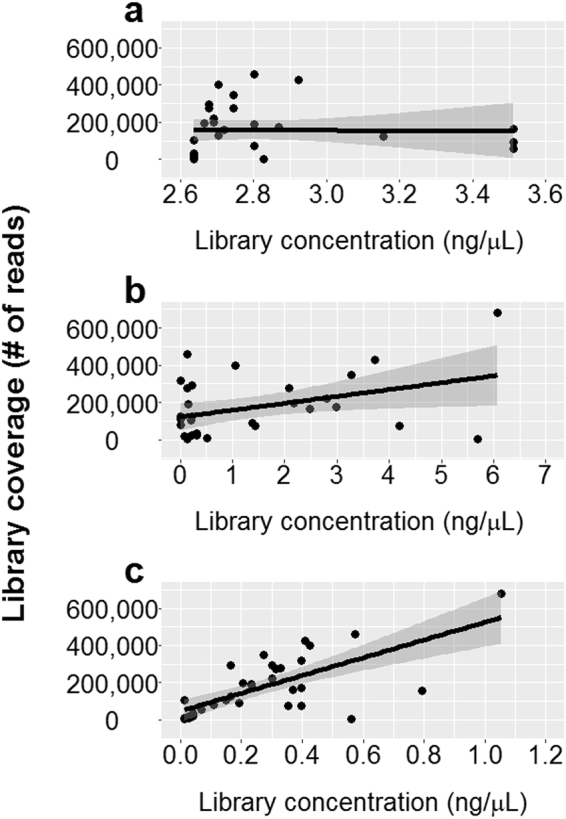
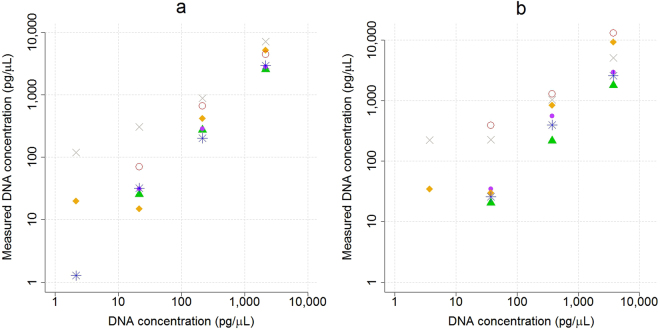
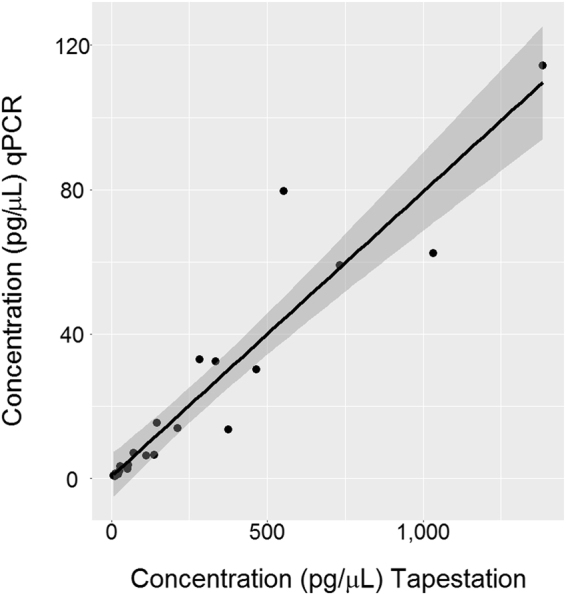
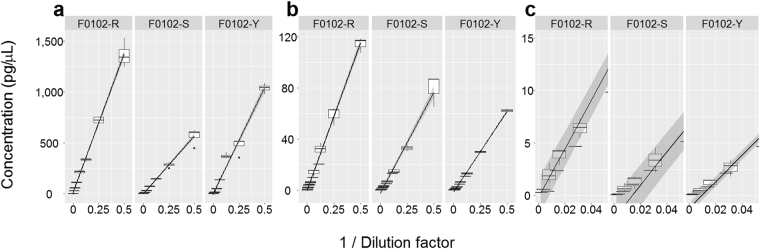
Quantification of massively parallel sequencing libraries is important for acquisition of monoclonal beads or clusters prior to clonal amplification and to avoid large variations in library coverage when multiple samples are included in one sequencing analysis. No gold standard for quantification of libraries exists. We assessed eight methods of quantification of libraries by quantifying 54 amplicon, six capture, and six shotgun fragment libraries. Chemically synthesized double-stranded DNA was also quantified. Light spectrophotometry, i.e. NanoDrop, was found to give the highest concentration estimates followed by Qubit and electrophoresis-based instruments (Bioanalyzer, TapeStation, GX Touch, and Fragment Analyzer), while SYBR Green and TaqMan based qPCR assays gave the lowest estimates. qPCR gave more accurate predictions of sequencing coverage than Qubit and TapeStation did. Costs, time-consumption, workflow simplicity, and ability to quantify multiple samples are discussed. Technical specifications, advantages, and disadvantages of the various methods are pointed out.
文库的定量分析对于在克隆扩增之前获得单克隆珠粒或簇非常重要,并且在一个测序分析中包含多个样本时,可避免文库覆盖度的较大差异。目前尚不存在文库定量分析的金标准。我们通过定量分析 54 个扩增子、6 个捕获和 6 个鸟枪法片段文库评估了 8 种文库定量方法。此外,还对化学合成的双链 DNA 进行了定量分析。结果发现,光分光光度法(如 NanoDrop)给出的浓度估计值最高,其次是 Qubit 和基于电泳的仪器(Bioanalyzer、TapeStation、GX Touch 和 Fragment Analyzer),而基于 SYBR Green 和 TaqMan 的 qPCR 测定给出的估计值最低。qPCR 比 Qubit 和 TapeStation 更能准确预测测序覆盖度。此外,还讨论了成本、耗时、工作流程的简单性以及定量分析多个样本的能力。指出了各种方法的技术规格、优点和缺点。