Esteve Ernest, Rathleff Michael Skovdal, Vicens-Bordas Jordi, Clausen Mikkel Bek, Hölmich Per, Sala Lluís, Thorborg Kristian
Sportclínic, Physiotherapy and Sports Training Centre, Girona, Spain.
School of Health and Sport Sciences (EUSES), University of Girona, Salt, Spain.
Orthop J Sports Med. 2018 Jan 11;6(1):2325967117747275. doi: 10.1177/2325967117747275. eCollection 2018 Jan.
Hip adductor muscle weakness and a history of groin injury both have been identified as strong risk factors for sustaining a new groin injury. Current groin pain and age have been associated with hip adductor strength. These factors could be related, but this has never been investigated.
To investigate whether soccer athletes with past-season groin pain and with different durations of past-season groin pain had lower preseason hip adductor squeeze strength compared with those without past-season groin pain. We also investigated whether differences in preseason hip adductor squeeze strength in relation to past-season groin pain and duration were influenced by current groin pain and age.
Cross-sectional study; Level of evidence, 3.
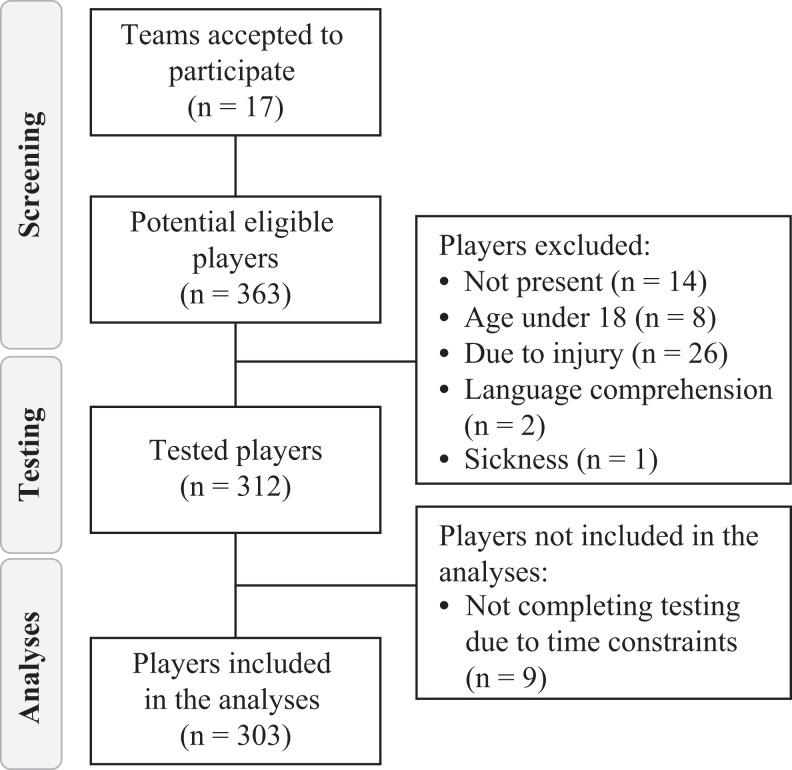
In total, 303 male soccer athletes (mean age, 23 ± 4 years; mean weight, 74.0 ± 7.9 kg; mean height, 178.1 ± 6.3 cm) were included in this study. Self-reported data regarding current groin pain, past-season groin pain, and duration were collected. Hip adductor squeeze strength was obtained using 2 different reliable testing procedures: (1) the short-lever (resistance placed between the knees, feet at the examination bed, and 45° of hip flexion) and (2) the long-lever (resistance placed between the ankles and 0° of hip flexion) squeeze tests.
There was no difference between those with (n = 123) and without (n = 180) past-season groin pain for hip adductor squeeze strength when adjusting for current groin pain and age. However, athletes with past-season groin pain lasting longer than 6 weeks (n = 27) showed 11.5% and 15.3% lower values on the short-lever ( = .006) and long-lever ( < .001) hip adductor squeeze strength tests, respectively, compared with those without past-season groin pain.
Male soccer athletes with past-season groin pain lasting longer than 6 weeks are likely to begin the next season with a high-risk groin injury profile, including a history of groin pain and hip adduction weakness.
髋内收肌力量薄弱以及腹股沟损伤史均已被确定为再次发生腹股沟损伤的重要危险因素。当前的腹股沟疼痛和年龄与髋内收肌力量有关。这些因素可能相互关联,但从未得到过研究。
调查与没有上赛季腹股沟疼痛的足球运动员相比,有上赛季腹股沟疼痛以及不同时长上赛季腹股沟疼痛的足球运动员在赛季前的髋内收肌挤压强度是否更低。我们还调查了与上赛季腹股沟疼痛及其持续时间相关的赛季前髋内收肌挤压强度差异是否受当前腹股沟疼痛和年龄的影响。
横断面研究;证据等级,3级。
本研究共纳入303名男性足球运动员(平均年龄23±4岁;平均体重74.0±7.9千克;平均身高178.1±6.3厘米)。收集了关于当前腹股沟疼痛、上赛季腹股沟疼痛及其持续时间的自我报告数据。采用两种不同的可靠测试方法来获取髋内收肌挤压强度:(1)短杠杆测试(阻力置于双膝之间,双脚放在检查床上,髋关节屈曲45°)和(2)长杠杆测试(阻力置于双踝之间,髋关节屈曲0°)。
在对当前腹股沟疼痛和年龄进行校正后,有(n = 123)和没有(n = 180)上赛季腹股沟疼痛的运动员在髋内收肌挤压强度方面没有差异。然而,与没有上赛季腹股沟疼痛的运动员相比,上赛季腹股沟疼痛持续超过6周的运动员(n = 27)在短杠杆(P = .006)和长杠杆(P < .001)髋内收肌挤压强度测试中的数值分别低11.5%和15.3%。
上赛季腹股沟疼痛持续超过6周的男性足球运动员在下个赛季开始时很可能具有高风险的腹股沟损伤特征,包括腹股沟疼痛史和髋内收肌无力。