Hobbs M, Green Mark A, Griffiths C, Jordan H, Saunders J, Grimmer H, McKenna J
Carnegie, Leeds Beckett University, Leeds LS6 3QT, UK.
School of Social and Health Sciences, Leeds Trinity University, LS18 5HD, UK.
SSM Popul Health. 2017 Aug 12;3:722-729. doi: 10.1016/j.ssmph.2017.07.007. eCollection 2017 Dec.
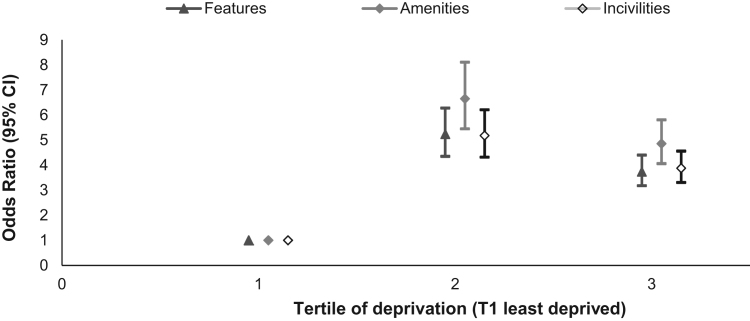
Public health is increasingly engaging with multi-faceted obesity prevention efforts. Although parks represent key community assets for broader public health, they may not be distributed equitably and associations with obesity are equivocal. We investigated park access and quality relative to deprivation and obesity with individual-level data from the Yorkshire Health Study. Compared to the least deprived areas, the moderately and most deprived areas had a greater park access and park quality in terms of features and amenities. However, parks in the moderately and most deprived areas also had the most safety concerns and incivilities. Although deprivation was associated with obesity, contrary to current policy guidance, both park access and quality appear less important for understanding variations in obesity within this study. Although sub-group analyses by deprivation tertile revealed that low quality park amenities in highly and moderately deprived areas may be important for understanding obesity prevalence, all other associations were non-significant.
公共卫生领域越来越积极地参与到多方面的肥胖预防工作中。尽管公园是促进更广泛公共卫生的关键社区资产,但它们的分布可能不均衡,且与肥胖的关联并不明确。我们利用约克郡健康研究的个体层面数据,调查了与贫困和肥胖相关的公园可达性和质量。与最不贫困地区相比,中等贫困和最贫困地区在公园可达性以及公园在设施和便利设施方面的质量上更高。然而,中等贫困和最贫困地区的公园也存在最多的安全问题和不文明行为。尽管贫困与肥胖有关,但与当前的政策指导相反,在本研究中,公园可达性和质量对于理解肥胖差异似乎不太重要。尽管按贫困三分位数进行的亚组分析显示,高度和中等贫困地区低质量的公园便利设施可能对于理解肥胖患病率很重要,但所有其他关联均不显著。