Laditka James N, Laditka Sarah B
Department of Public Health Sciences, University of North Carolina at Charlotte, 9201 University City Boulevard, Charlotte, NC 28223, United States.
SSM Popul Health. 2017 Dec 26;4:126-134. doi: 10.1016/j.ssmph.2017.12.006. eCollection 2018 Apr.
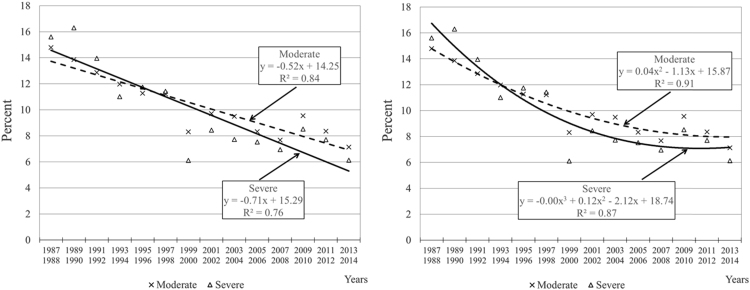
The United States workforce is aging. At the same time more people have chronic conditions, for longer periods. Given these trends the importance of work disability, physical or nervous problems that limit a person's type or amount of work, is increasing. No research has examined transitions among multiple levels of work disability, recovery from work disability, or trends. Limited research has focused on work disability among African Americans and Hispanics, or separately for women and men. We examined these areas using data from 30,563 adults in the 1968-2015 Panel Study of Income Dynamics. We estimated annual probabilities of work disability, recovery, and death with multinomial logistic Markov models. Microsimulations accounting for age and education estimated outcomes for African American, Hispanic, and non-Hispanic white women and men. Results from these nationally representative data suggested that the majority of Americans experience work disability during working life. Most spells ended with recovery or reduced severity. Among women, African Americans and Hispanics had less moderate and severe work disability than whites. Among men, African Americans became severely work disabled more often than whites, recovered from severe spells more often and had shorter severe spells, yet had more severe work disability at age 65. Hispanic men were more likely to report at least one spell of severe work disability than whites; they also had substantially more recovery from severe work disability, and a lower percentage of working years with work disability. Among African Americans and Hispanics, men were considerably more likely than women to have severe work disability at age 65. Work disability declined significantly across the study period for all groups. Although work disability has declined over several decades, it remains common. Results suggest that the majority of work disability spells end with recovery, underscoring the importance of rehabilitation and workplace accommodation.
美国劳动力队伍正在老龄化。与此同时,越来越多的人患有慢性疾病,且患病时间更长。鉴于这些趋势,工作残疾(即限制一个人工作类型或工作量的身体或神经问题)的重要性日益增加。尚无研究探讨工作残疾多个级别之间的转变、从工作残疾中恢复的情况或相关趋势。有限的研究聚焦于非裔美国人和西班牙裔中的工作残疾情况,或分别针对女性和男性的情况。我们利用1968 - 2015年收入动态面板研究中30563名成年人的数据对这些领域进行了研究。我们用多项逻辑马尔可夫模型估计了工作残疾、恢复和死亡的年度概率。考虑年龄和教育因素的微观模拟估计了非裔美国人、西班牙裔以及非西班牙裔白人女性和男性的结果。这些具有全国代表性的数据结果表明,大多数美国人在工作生涯中会经历工作残疾。大多数阶段以恢复或严重程度减轻告终。在女性中,非裔美国人和西班牙裔的中度和重度工作残疾情况比白人少。在男性中,非裔美国人比白人更常出现严重工作残疾,从严重阶段恢复的情况更频繁且严重阶段持续时间更短,但在65岁时工作残疾情况更严重。西班牙裔男性比白人更有可能报告至少一次严重工作残疾阶段;他们从严重工作残疾中恢复的情况也显著更多,且工作残疾的工作年限占比更低。在非裔美国人和西班牙裔中,65岁时男性出现严重工作残疾的可能性比女性大得多。在整个研究期间,所有群体的工作残疾情况都显著下降。尽管工作残疾在几十年间有所下降,但仍然很常见。结果表明,大多数工作残疾阶段以恢复告终,这凸显了康复和工作场所便利设施的重要性。