DONALD Study Dortmund, Department of Nutrition and Food Sciences, Nutritional Epidemiology, University of Bonn, 44225 Dortmund, Germany.
Robert Koch-Institute, Department of Epidemiology and Health Monitoring, Robert Koch Institute, 13302 Berlin, Germany.
Nutrients. 2018 Jan 19;10(1):103. doi: 10.3390/nu10010103.
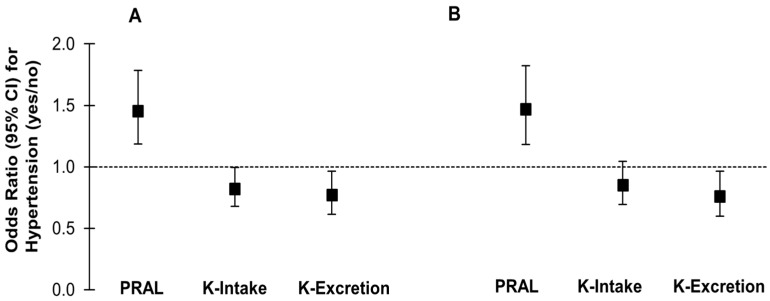
Diets rich in fruits and vegetables, like the Dietary Approaches to Stop Hypertension (DASH)-diet, are usually characterized by high potassium intake and reduced dietary acid load, and have been shown to reduce blood pressure (BP). However, the relevance of potential renal acid load (PRAL) for BP has not been compared with the relevance to BP of urinary biomarker (K-urine)- and dietary food frequency questionnaire (K-FFQ)-based estimates of potassium intake in a general adult population sample. For 6788 participants (aged 18-79 years) of the representative German Health-Interview and Examination Survey for Adults (DEGS1), associations of PRAL, K-urine, and K-FFQ with BP and hypertension prevalence were cross-sectionally examined in multivariable linear and logistic regression models. PRAL was significantly associated with higher systolic BP ( = 0.0002) and higher hypertension prevalence (Odds ratio [OR] high vs. low PRAL = 1.45, = 0.0004) in models adjusted for age, sex, body mass index (BMI), estimated sodium intake, kidney function, relevant medication, and further important covariates. Higher estimates of K-FFQ and K-urine were related to lower systolic BP ( = 0.04 and < 0.0001) and lower hypertension prevalence (OR = 0.82, = 0.04 and OR = 0.77, = 0.02) as well as a lower diastolic BP ( = 0.03 and = 0.0003). Our results show, for the first time in a comparative analysis of a large representative population sample, significant relationships of BP and hypertension prevalence with questionnaire- and biomarker-based estimates of potassium intake and with an estimate of dietary acid load.
富含水果和蔬菜的饮食,如饮食方法阻止高血压 (DASH) 饮食,通常的特点是钾摄入量高,饮食酸负荷降低,并已被证明可降低血压 (BP)。然而,潜在的肾酸负荷 (PRAL) 与 BP 的相关性尚未与基于尿生物标志物 (K-尿) 和膳食食物频率问卷 (K-FFQ) 的钾摄入量估计值与 BP 的相关性进行比较在一般成年人群样本中。对于代表性的德国健康访谈和成人检查调查 (DEGS1) 的 6788 名参与者 (年龄 18-79 岁),在多变量线性和逻辑回归模型中,PRAL、K-尿和 K-FFQ 与 BP 和高血压患病率的相关性进行了横断面研究。在调整年龄、性别、体重指数 (BMI)、估计钠摄入量、肾功能、相关药物和其他重要协变量后,PRAL 与更高的收缩压 ( = 0.0002) 和更高的高血压患病率 (比值比 [OR] 高 vs. 低 PRAL = 1.45, = 0.0004) 显著相关。K-FFQ 和 K-尿的更高估计值与更低的收缩压 ( = 0.04 和 < 0.0001) 和更低的高血压患病率 (OR = 0.82, = 0.04 和 OR = 0.77, = 0.02) 以及更低的舒张压 ( = 0.03 和 = 0.0003) 相关。我们的研究结果首次在对大型代表性人群样本的比较分析中表明,BP 和高血压患病率与基于问卷和生物标志物的钾摄入量估计值以及饮食酸负荷估计值之间存在显著关系。