Department of Health Education and Promotion, School of Public Health, International Campus, Tehran University of Medical Sciences, Tehran, Iran.
Department of Public Health, College of Medicine and Health Sciences, Wachemo University, Hossana, Ethiopia.
Eur J Public Health. 2018 Dec 1;28(6):1149-1155. doi: 10.1093/eurpub/ckx231.
The outcome of breast cancer treatment largely depends on the timing of detection. The health promotion interventions have an immense contribution to early detection and improved survival. Therefore, this review aimed to provide evidence on the efficacy of the health promotion interventions to increase the uptake of breast cancer screening and to develop effective interventions targeting women.
Online databases (PubMed/MEDLINE/PubMed Central, Ovid/MEDILINE, EMBASE, Web of Science and Google Scholar) were searched for studies published between January 2005 and January 2017. A quality coding system was assessed using Cochrane checklists for randomized controlled trial (RCT) and Downs and Black checklists for non-RCT. The score was rated for the included articles by each researcher independently and the average score is given accordingly. This study was registered in PROSPERO as [PROSPERO 2017: CRD42017060488].
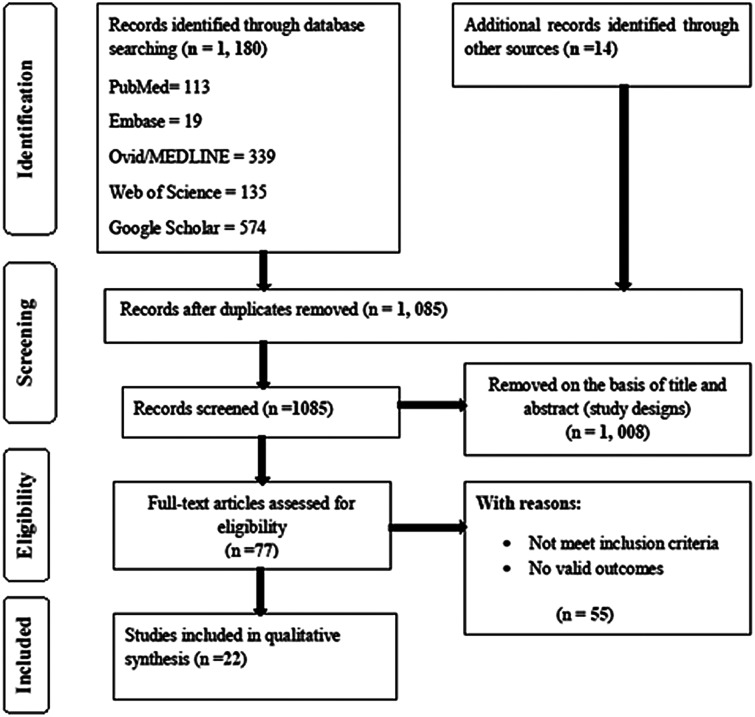
The review dovetailed 22 studies. Thirteen studies (59.10%) were conducted in the Unite States, 4 in Iran (18.18%), 2 in India (9.09%) and 1 each in Turkey, Saudi Arabia and Israel. The interventions were classified as 'individual-based', 'community-based', 'group-based teachings and training' and 'behavioral model based'. The majority of the studies showed favorable outcomes after health promotion interventions, including improvements in women's view of breast screening, breast self-examination and knowledge of breast screening.
The review confirmed that most of the health promotion interventions targeting women boosted the breast screening in one or another way. However, the limited quality of the included studies showed that further research is needed to improve the trials in the next future.
乳腺癌治疗的结果在很大程度上取决于发现的时间。健康促进干预措施对早期发现和提高生存率有巨大的贡献。因此,本综述旨在提供关于健康促进干预措施增加乳腺癌筛查率的疗效的证据,并为针对女性的有效干预措施提供依据。
在线数据库(PubMed/MEDLINE/PubMed Central、Ovid/MEDILINE、EMBASE、Web of Science 和 Google Scholar)检索了 2005 年 1 月至 2017 年 1 月期间发表的研究。使用 Cochrane 清单对随机对照试验(RCT)和 Downs 和 Black 清单对非 RCT 进行质量编码系统评估。每位研究人员独立对纳入的文章进行评分,并给出相应的平均分。本研究已在 PROSPERO 注册为 [PROSPERO 2017:CRD42017060488]。
综述共纳入 22 项研究。其中 13 项研究(59.10%)在美国进行,4 项在伊朗(18.18%),2 项在印度(9.09%),1 项分别在土耳其、沙特阿拉伯和以色列。干预措施分为“个体为基础”、“社区为基础”、“团体教学和培训”和“基于行为模式”。大多数研究显示健康促进干预后有良好的效果,包括改善女性对乳房筛查的看法、乳房自我检查和乳房筛查知识。
本综述证实,大多数针对女性的健康促进干预措施以一种或另一种方式促进了乳房筛查。然而,纳入研究的质量有限表明,需要进一步研究以提高未来的试验质量。