Maman Issaka, Tchacondo Tchadjobo, Kere Abiba Banla, Piten Ebekalisai, Beissner Marcus, Kobara Yiragnima, Kossi Komlan, Badziklou Kossi, Wiedemann Franz Xaver, Amekuse Komi, Bretzel Gisela, Karou Damintoti Simplice
Institut National d'Hygiène (INH), National Reference Laboratory for Buruli ulcer disease in Togo, 26 QAD Rue Nangbeto, 1BP, 1396, Lomé, Togo.
Ecole Supérieure des Techniques Biologiques et Alimentaires (ESTBA), Laboratoire des Sciences Biologiques et des Substances Bioactives, Université de Lomé, Lomé, Togo.
BMC Infect Dis. 2018 Jan 19;18(1):48. doi: 10.1186/s12879-018-2958-3.
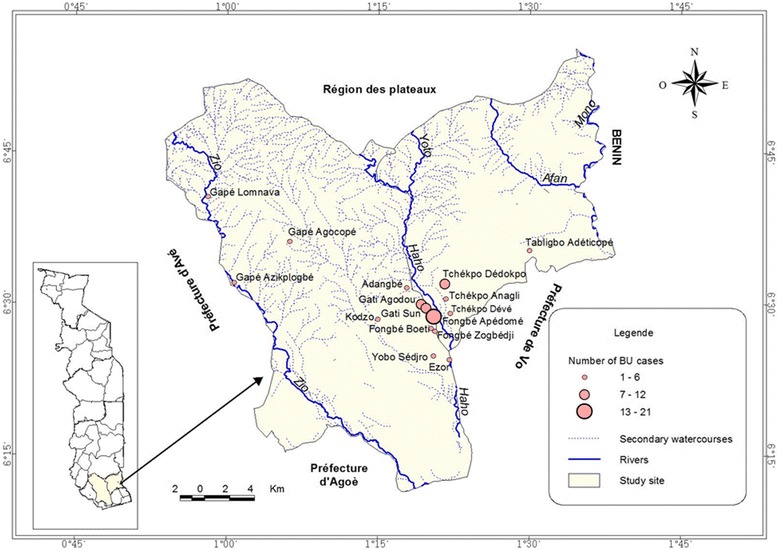
Buruli ulcer (BU) is a neglected mycobacterial skin infection caused by Mycobacterium ulcerans. This disease mostly affects poor rural populations, especially in areas with low hygiene standards and sanitation coverage. The objective of this study was to identify these risk factors in the districts of Zio and Yoto of the Maritime Region in Togo.
We conducted a case-control study in Zio and Yoto, two districts proved BU endemic from November 2014 to May 2015. BU cases were diagnosed according to the WHO clinical case definition at the Centre Hospitalier Régional de Tsévié (CHR Tsévié) and confirmed by Ziehl-Neelsen (ZN) microscopy and IS2404 polymerase chain reaction (PCR). For each case, up to two controls matched by sex and place of residence were recruited. Socio-demographic, environmental or behavioral data were collected and conditional logistic regression analysis was used to identify and compare risk factors between BU cases and controls.
A total of 83 cases and 128 controls were enrolled. The median age was 15 years (range 3-65 years). Multivariate conditional logistic regression analysis after adjustment for potential confounders identified age (< 10 years (OR =11.48, 95% CI = 3.72-35.43) and 10-14 years (OR = 3.63, 95% CI = 1.22-10.83)), receiving insect bites near a river (OR = 7.8, 95% CI = 1.48-41.21) and bathing with water from open borehole (OR = 5.77, (1.11-29.27)) as independent predictors of acquiring BU infection.
This study identified age, bathing with water from open borehole and receiving insect bites near a river as potential risk of acquiring BU infection in Zio and Yoto districts of the Maritime Region in south Togo.
布氏溃疡(BU)是由溃疡分枝杆菌引起的一种被忽视的分枝杆菌性皮肤感染。这种疾病主要影响贫困农村人口,尤其是在卫生标准和卫生设施覆盖率较低的地区。本研究的目的是确定多哥滨海地区齐奥和约托两个区的这些危险因素。
2014年11月至2015年5月,我们在已被证明为布氏溃疡流行区的齐奥和约托两个区开展了一项病例对照研究。布氏溃疡病例在Tsévié地区中心医院(CHR Tsévié)根据世界卫生组织临床病例定义进行诊断,并通过齐尔-尼尔森(ZN)显微镜检查和IS2404聚合酶链反应(PCR)进行确诊。对于每例病例,招募至多两名按性别和居住地点匹配的对照。收集社会人口学、环境或行为数据,并使用条件逻辑回归分析来识别和比较布氏溃疡病例与对照之间的危险因素。
共纳入83例病例和128名对照。中位年龄为15岁(范围3 - 65岁)。在对潜在混杂因素进行调整后的多变量条件逻辑回归分析确定年龄(<10岁(比值比[OR]=11.48,95%置信区间[CI]=3.72 - 35.43)和10 - 14岁(OR = 3.63,95% CI = 1.22 - 10.83))、在河边被昆虫叮咬(OR = 7.8,95% CI = 1.48 - 41.21)以及用露天钻孔的水洗澡(OR = 5.77,(1.11 - 29.27))为感染布氏溃疡的独立预测因素。
本研究确定年龄、用露天钻孔的水洗澡以及在河边被昆虫叮咬是多哥南部滨海地区齐奥和约托两个区感染布氏溃疡的潜在风险因素。