Department of Hematology, University Hospital Essen, University of Duisburg-Essen, Essen, Germany.
Institute of Cell Biology (Cancer Research), University Hospital Essen, University of Duisburg-Essen, Essen, Germany.
Blood Cancer J. 2018 Jan 19;8(1):11. doi: 10.1038/s41408-017-0036-5.
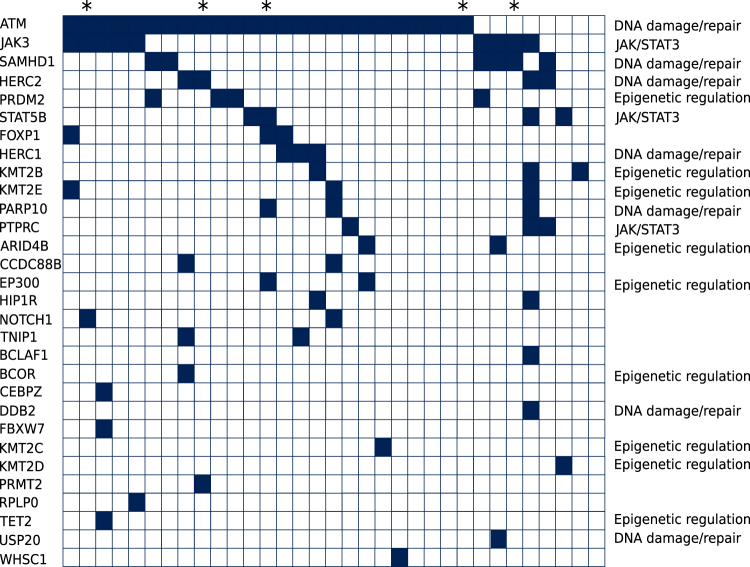
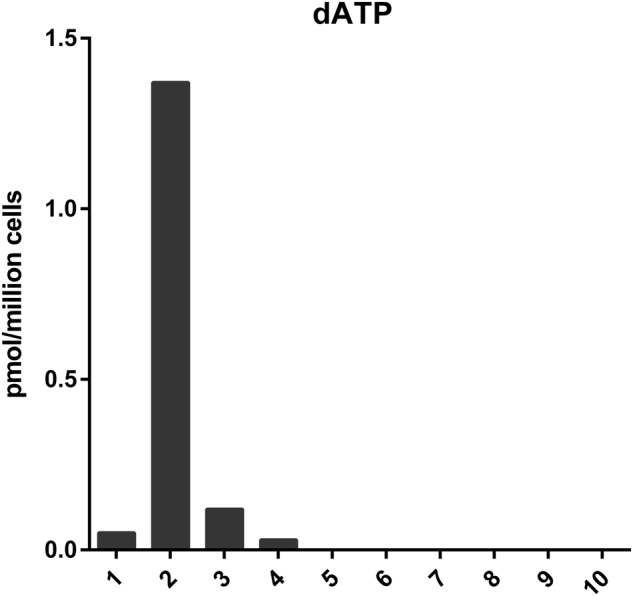
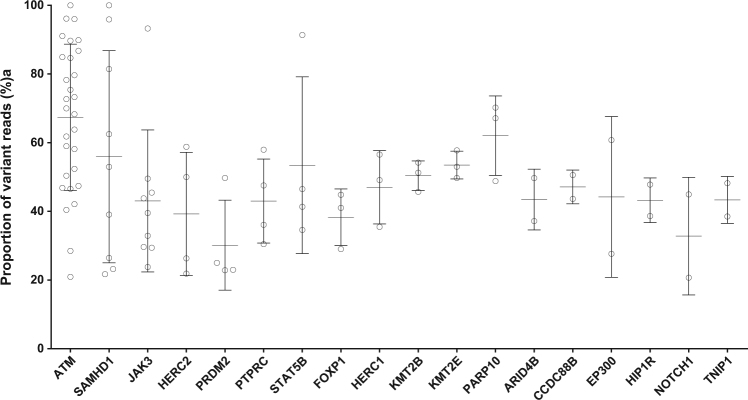
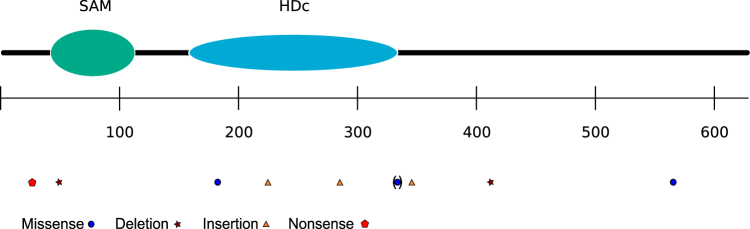
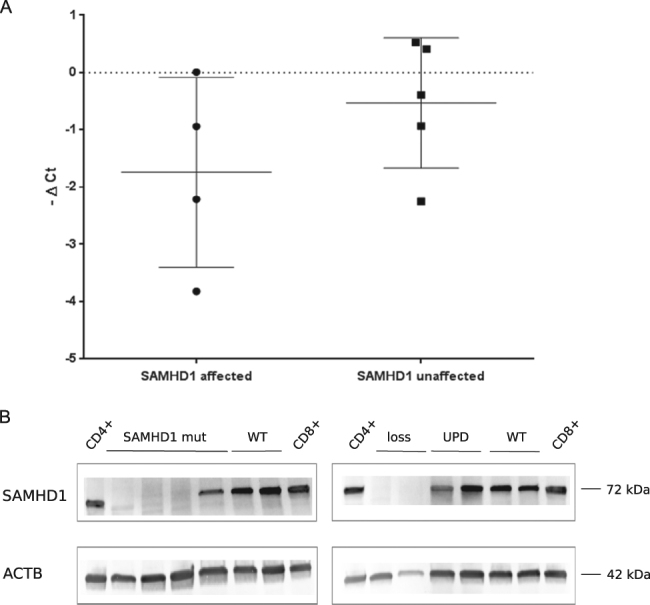
T-cell prolymphocytic leukemia (T-PLL) is an aggressive malignancy with a median survival of the patients of less than two years. Besides characteristic chromosomal translocations, frequent mutations affect the ATM gene, JAK/STAT pathway members, and epigenetic regulators. We here performed a targeted mutation analysis for 40 genes selected from a RNA sequencing of 10 T-PLL in a collection of 28 T-PLL, and an exome analysis of five further cases. Nonsynonymous mutations were identified in 30 of the 40 genes, 18 being recurrently mutated. We identified recurrently mutated genes previously unknown to be mutated in T-PLL, which are SAMHD1, HERC1, HERC2, PRDM2, PARP10, PTPRC, and FOXP1. SAMHD1 regulates cellular deoxynucleotide levels and acts as a potential tumor suppressor in other leukemias. We observed destructive mutations in 18% of cases as well as deletions in two further cases. Taken together, we identified additional genes involved in JAK/STAT signaling (PTPRC), epigenetic regulation (PRDM2), or DNA damage repair (SAMHD1, PARP10, HERC1, and HERC2) as being recurrently mutated in T-PLL. Thus, our study considerably extends the picture of pathways involved in molecular pathogenesis of T-PLL and identifies the tumor suppressor gene SAMHD1 with ~20% of T-PLL affected by destructive lesions likely as major player in T-PLL pathogenesis.
T 细胞前淋巴细胞白血病(T-PLL)是一种侵袭性恶性肿瘤,患者的中位生存期不到两年。除了特征性的染色体易位外,频繁的突变还影响 ATM 基因、JAK/STAT 通路成员和表观遗传调节剂。我们在这里对 28 例 T-PLL 中的 10 例进行了 RNA 测序,选择了 40 个基因进行靶向突变分析,并对另外 5 例进行了外显子组分析。在 40 个基因中,有 30 个基因发生了非同义突变,其中 18 个是复发性突变。我们鉴定了一些以前未知在 T-PLL 中发生突变的复发性突变基因,包括 SAMHD1、HERC1、HERC2、PRDM2、PARP10、PTPRC 和 FOXP1。SAMHD1 调节细胞内脱氧核苷酸水平,在其他白血病中作为潜在的肿瘤抑制因子发挥作用。我们观察到 18%的病例存在破坏性突变,另外 2 例存在缺失。总的来说,我们鉴定了其他参与 JAK/STAT 信号通路(PTPRC)、表观遗传调控(PRDM2)或 DNA 损伤修复(SAMHD1、PARP10、HERC1 和 HERC2)的基因在 T-PLL 中复发性突变。因此,我们的研究大大扩展了 T-PLL 分子发病机制中涉及的途径,并确定了肿瘤抑制基因 SAMHD1,约 20%的 T-PLL 受破坏性病变影响,可能是 T-PLL 发病机制中的主要因素。