Department of Preventive Medicine, Keck School of Medicine, University of Southern California, Los Angeles, CA, USA.
Department of Preventive Medicine, Keck School of Medicine, University of Southern California, Los Angeles, CA, USA.
Neuroimage. 2018 May 15;172:194-205. doi: 10.1016/j.neuroimage.2018.01.020. Epub 2018 Feb 3.
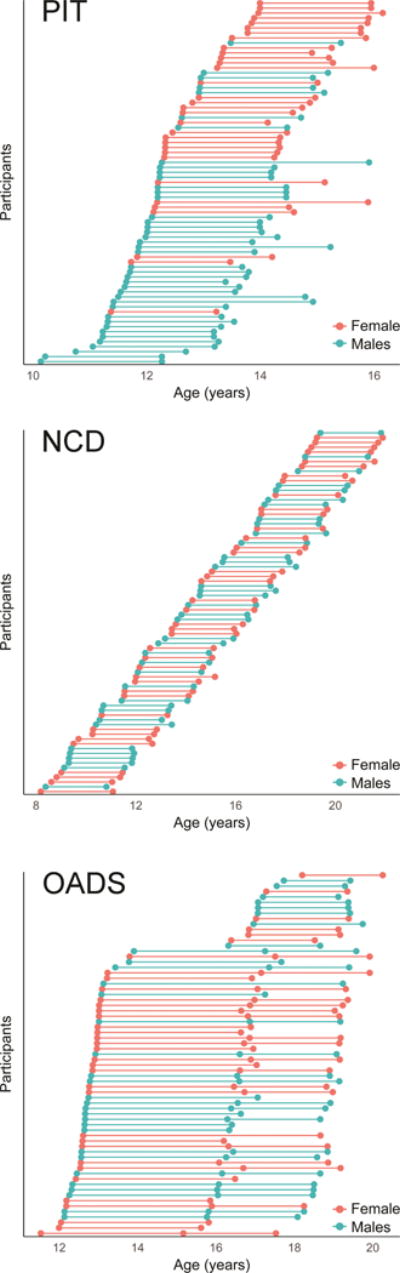
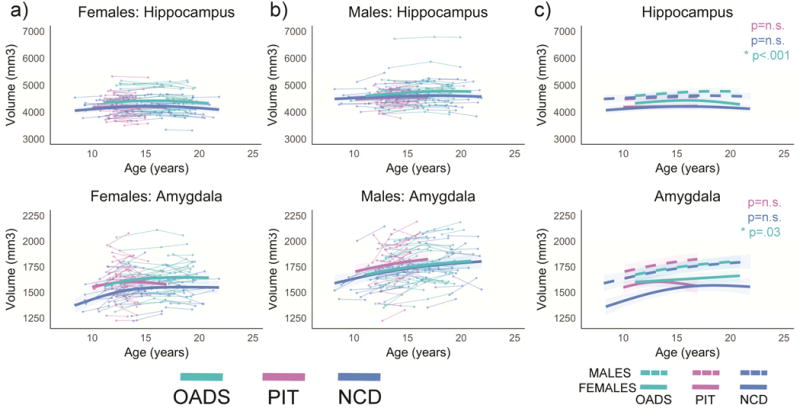
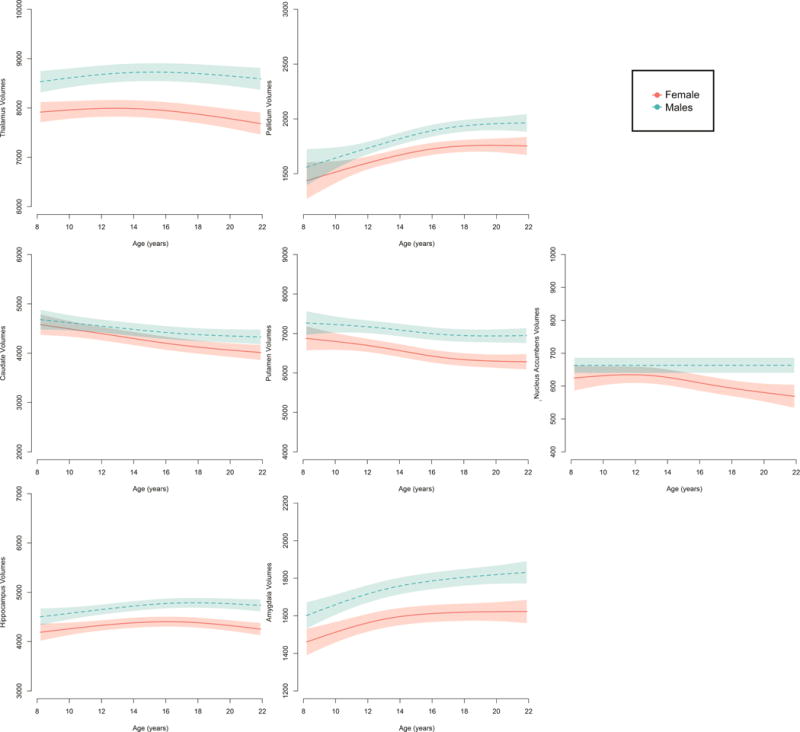
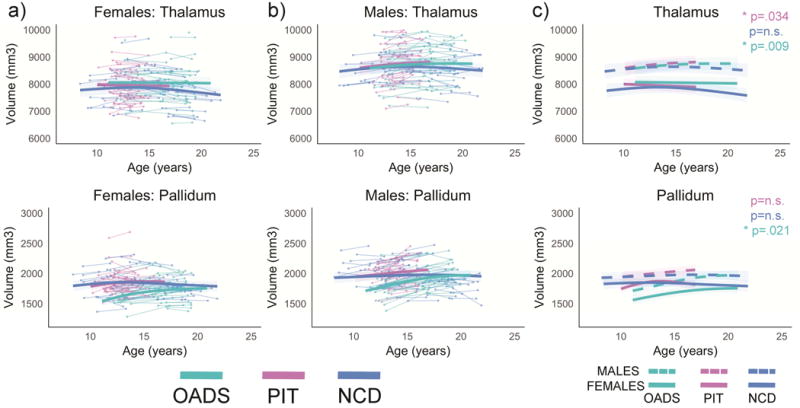
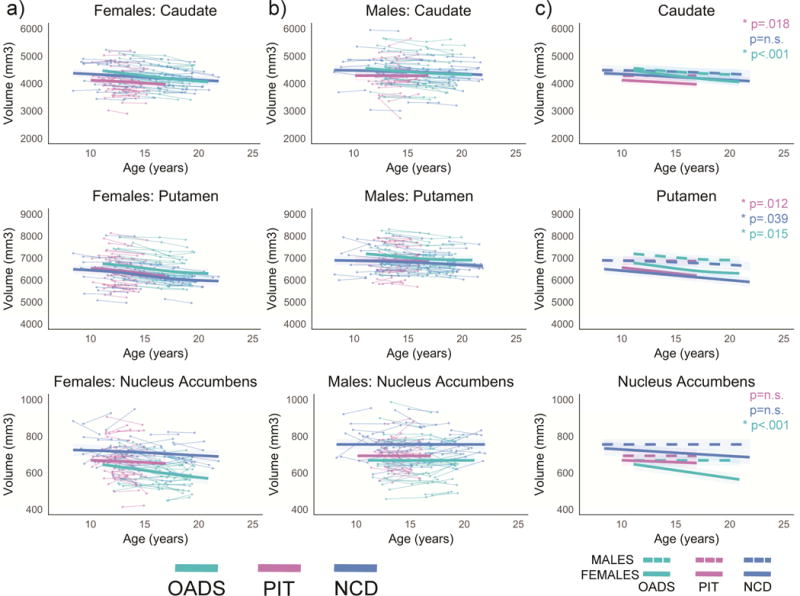
The developmental patterns of subcortical brain volumes in males and females observed in previous studies have been inconsistent. To help resolve these discrepancies, we examined developmental trajectories using three independent longitudinal samples of participants in the age-span of 8-22 years (total 216 participants and 467 scans). These datasets, including Pittsburgh (PIT; University of Pittsburgh, USA), NeuroCognitive Development (NCD; University of Oslo, Norway), and Orygen Adolescent Development Study (OADS; The University of Melbourne, Australia), span three countries and were analyzed together and in parallel using mixed-effects modeling with both generalized additive models and general linear models. For all regions and across all samples, males were found to have significantly larger volumes as compared to females, and significant sex differences were seen in age trajectories over time. However, direct comparison of sample trajectories and sex differences identified within samples were not consistent. The trajectories for the amygdala, putamen, and nucleus accumbens were most consistent between the three samples. Our results suggest that even after using similar preprocessing and analytic techniques, additional factors, such as image acquisition or sample composition may contribute to some of the discrepancies in sex specific patterns in subcortical brain changes across adolescence, and highlight region-specific variations in congruency of developmental trajectories.
先前研究中观察到的男性和女性皮质下脑体积的发育模式一直不一致。为了帮助解决这些差异,我们使用三个独立的纵向样本研究了参与者在 8-22 岁年龄段的发展轨迹(共 216 名参与者和 467 次扫描)。这些数据集包括匹兹堡(PIT;美国匹兹堡大学)、神经认知发展(NCD;挪威奥斯陆大学)和奥里根青少年发展研究(OADS;澳大利亚墨尔本大学),涵盖三个国家,并使用混合效应模型(包括广义加性模型和广义线性模型)进行了联合和并行分析。对于所有区域和所有样本,男性的体积明显大于女性,并且随着时间的推移,在年龄轨迹上存在显著的性别差异。然而,对样本轨迹和样本内识别的性别差异的直接比较并不一致。杏仁核、壳核和伏隔核的轨迹在三个样本之间最为一致。我们的研究结果表明,即使使用了类似的预处理和分析技术,额外的因素,如图像采集或样本组成,可能会导致青春期皮质下脑变化的性别特异性模式存在一些差异,并突出了发育轨迹一致性的区域特异性变化。