Institute of Psychology, Chinese Academy of Sciences, Beijing, 100101, China; Department of Psychology, University of Chinese Academy of Sciences, Beijing, 100049, China.
School of Psychology, Capital Normal University, Beijing, 100048, China.
Dev Cogn Neurosci. 2021 Dec;52:101028. doi: 10.1016/j.dcn.2021.101028. Epub 2021 Oct 28.
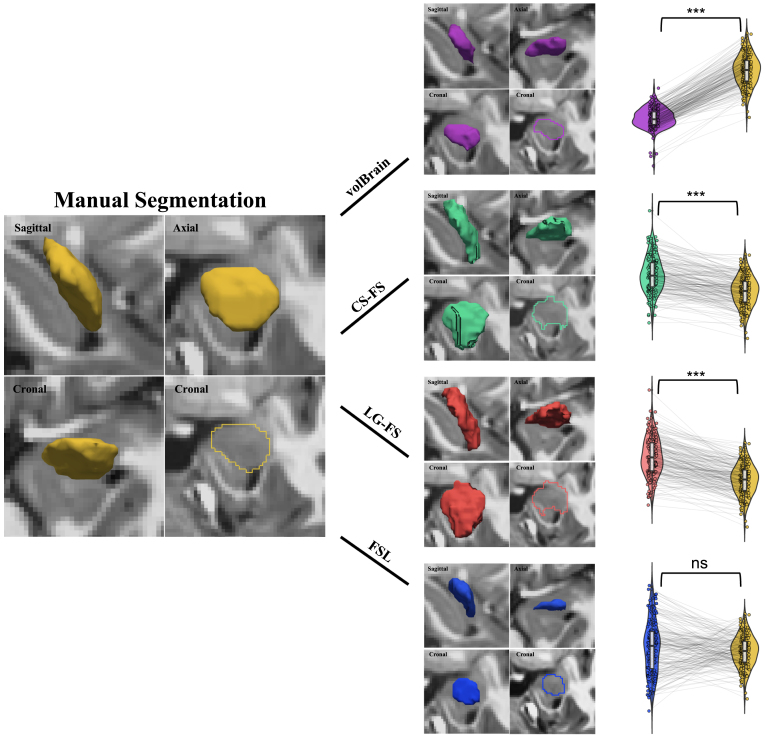
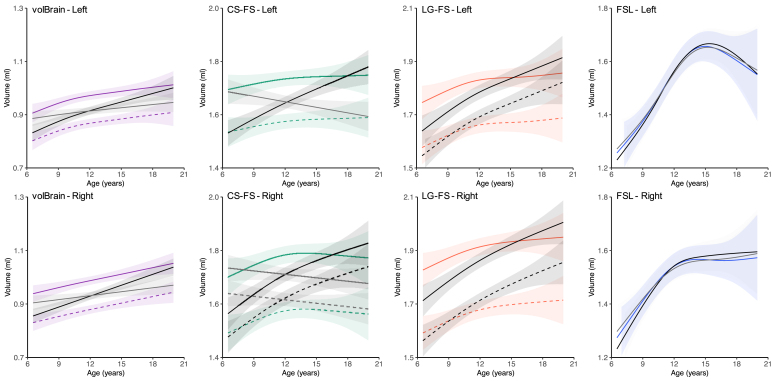
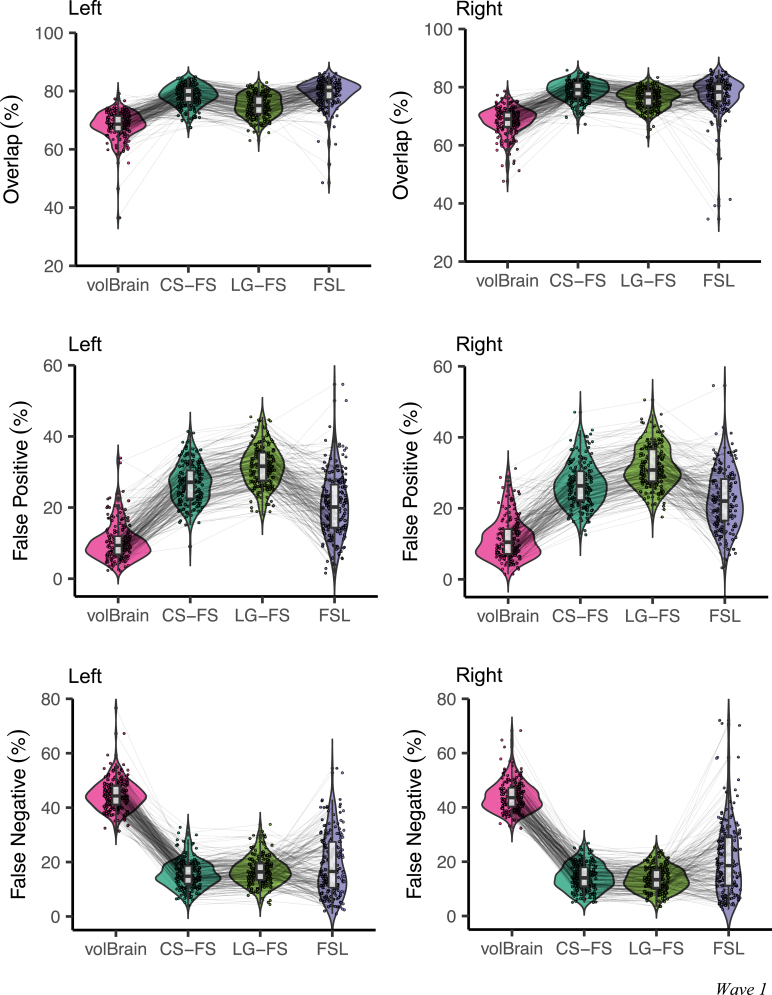
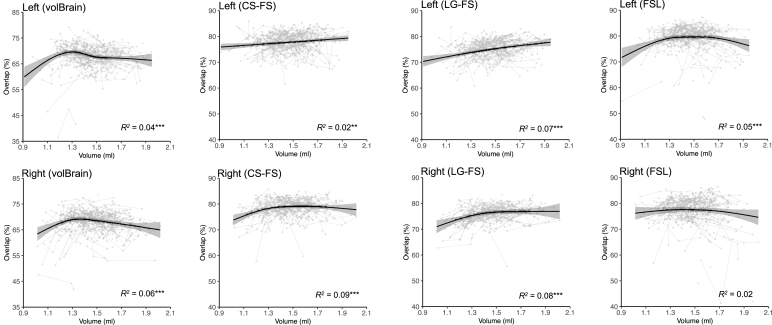
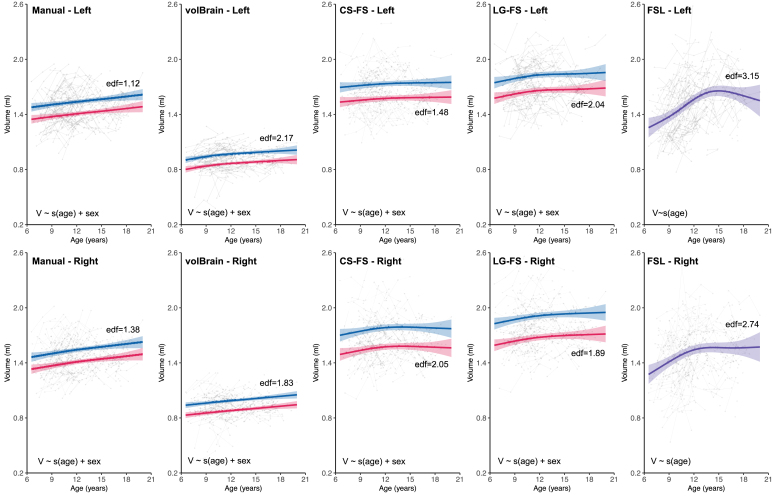
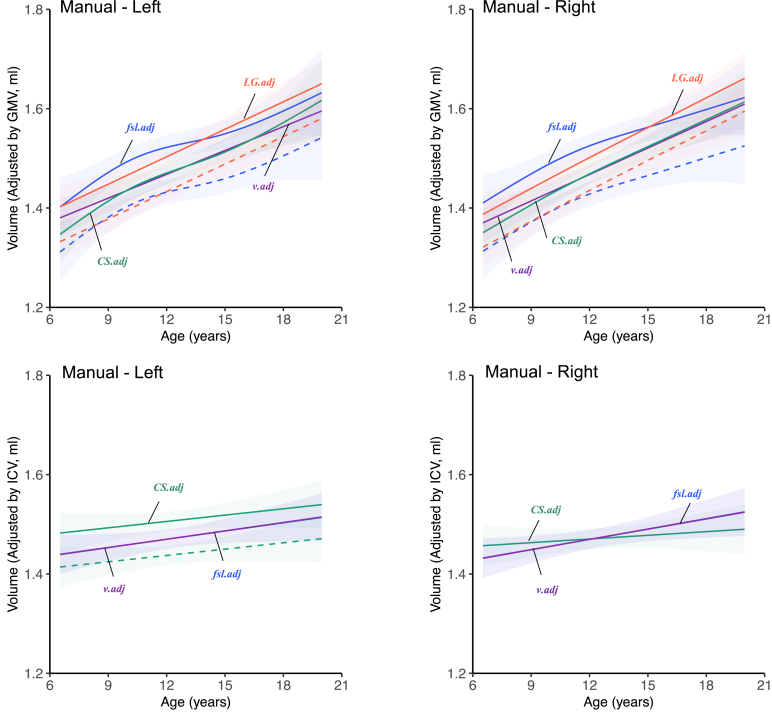
The developmental pattern of the amygdala throughout childhood and adolescence has been inconsistently reported in previous neuroimaging studies. Given the relatively small size of the amygdala on full brain MRI scans, discrepancies may be partly due to methodological differences in amygdalar segmentation. To investigate the impact of volume extraction methods on amygdala volume, we compared FreeSurfer, FSL and volBrain segmentation measurements with those obtained by manual tracing. The manual tracing method, which we used as the 'gold standard', exhibited almost perfect intra- and inter-rater reliability. We observed systematic differences in amygdala volumes between automatic (FreeSurfer and volBrain) and manual methods. Specifically, compared with the manual tracing, FreeSurfer estimated larger amygdalae, and volBrain produced smaller amygdalae while FSL demonstrated a mixed pattern. The tracing bias was not uniform, but higher for smaller amygdalae. We further modeled amygdalar growth curves using accelerated longitudinal cohort data from the Chinese Color Nest Project (http://deepneuro.bnu.edu.cn/?p=163). Trajectory modeling and statistical assessments of the manually traced amygdalae revealed linearly increasing and parallel developmental patterns for both girls and boys, although the amygdalae of boys were larger than those of girls. Compared to these trajectories, the shapes of developmental curves were similar when using the volBrain derived volumes. FreeSurfer derived trajectories had more nonlinearities and appeared flatter. FSL derived trajectories demonstrated an inverted U shape and were significantly different from those derived from manual tracing method. The use of amygdala volumes adjusted for total gray-matter volumes, but not intracranial volumes, resolved the shape discrepancies and led to reproducible growth curves between manual tracing and the automatic methods (except FSL). Our findings revealed steady growth of the human amygdala, mirroring its functional development across the school age. Methodological improvements are warranted for current automatic tools to achieve more accurate amygdala structure at school age, calling for next generation tools.
儿童期和青春期杏仁核的发育模式在以前的神经影像学研究中报道不一致。鉴于全脑 MRI 扫描中杏仁核的相对较小尺寸,差异可能部分归因于杏仁核分割的方法学差异。为了研究体积提取方法对杏仁核体积的影响,我们比较了 FreeSurfer、FSL 和 volBrain 分割测量值与手动追踪获得的测量值。我们使用手动追踪方法作为“金标准”,其表现出几乎完美的内部和内部评分者可靠性。我们观察到自动(FreeSurfer 和 volBrain)和手动方法之间杏仁核体积存在系统差异。具体来说,与手动追踪相比,FreeSurfer 估计的杏仁核较大,而 volBrain 产生的杏仁核较小,而 FSL 则表现出混合模式。追踪偏差不均匀,但对于较小的杏仁核更高。我们进一步使用来自中国色彩巢项目的加速纵向队列数据(http://deepneuro.bnu.edu.cn/?p=163)对杏仁核生长曲线进行建模。使用手动追踪的杏仁核进行轨迹建模和统计评估,揭示了女孩和男孩的线性增长和并行发育模式,尽管男孩的杏仁核大于女孩的杏仁核。与这些轨迹相比,使用 volBrain 衍生体积时,发育曲线的形状相似。FreeSurfer 衍生的轨迹具有更多的非线性,并且显得更平坦。FSL 衍生的轨迹呈倒 U 形,与手动追踪方法衍生的轨迹明显不同。使用调整后的总灰质体积而不是颅内体积的杏仁核体积,解决了形状差异,并在手动追踪和自动方法之间产生了可重复的生长曲线(除 FSL 外)。我们的研究结果揭示了人类杏仁核的稳定增长,反映了其在整个学龄期的功能发育。需要对当前的自动工具进行方法改进,以在学龄期获得更准确的杏仁核结构,这需要新一代的工具。