Li Xiong, Wu Yuansheng, Li Boqun, Yang Yonghong, Yang Yongping
Key Laboratory for Plant Diversity and Biogeography of East Asia, Kunming Institute of Botany, Chinese Academy of Sciences, Kunming, China.
Germplasm Bank of Wild Species, Kunming Institute of Botany, Chinese Academy of Sciences, Kunming, China.
Front Plant Sci. 2018 Jan 4;8:2207. doi: 10.3389/fpls.2017.02207. eCollection 2017.
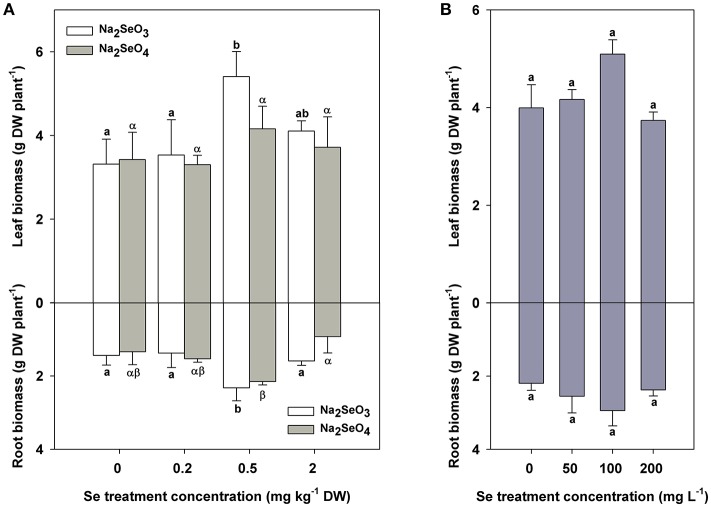
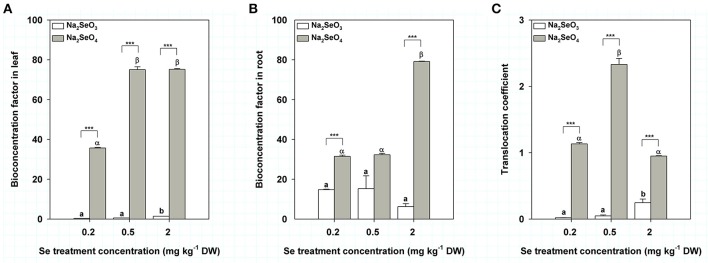
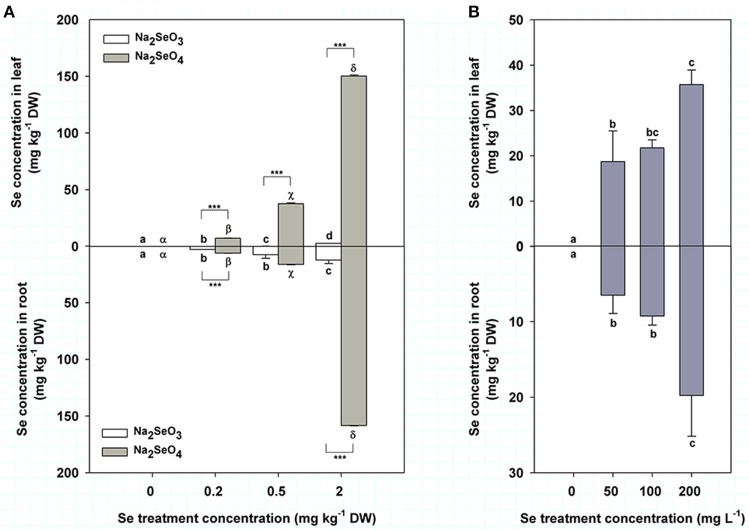
Selenium (Se) is an essential trace element for humans. About 70% of the regions in China, including most of the Tibetan Plateau, are faced with Se deficiency problems. Turnip is mainly distributed around the Tibetan Plateau and is one of the few local crops. In the present study, we compared the absorption and translocation differences of Se (IV) selenite and Se (VI) selenate in turnip. The results showed that Se treatment, either by soil addition (0.2-2 mg Se kg dry soil) or by foliar spraying (50-200 mg L Se), could significantly increase the Se concentrations in turnips, and 0.5 mg Se (IV) or Se (VI) kg dry matter in soils could improve the biomasses of turnips. Moreover, turnip absorbed significantly more Se (VI) than Se (IV) at the same concentration and also transferred much more Se (VI) from roots to leaves. Based on the Se concentrations, as well as the bioconcentration factors and translocation coefficients, we considered that turnip might be a potential Se indicator plant. Subsequently, we estimated the daily Se intake for adults based on the Se concentrations in turnip roots. The results indicated that Se (IV) should be more suitable as an artificial Se fertilizer for turnips, although the levels found in most samples in this study could cause selenosis to humans. In addition, we also estimated the optimum and maximum Se concentrations for treating turnips based on the linear relations between Se concentrations in turnip roots and Se treatment concentrations. The results provided preliminary and useful information about Se biofortification in turnips.
硒(Se)是人体必需的微量元素。中国约70%的地区,包括青藏高原的大部分地区,都面临着缺硒问题。萝卜主要分布在青藏高原周边地区,是少数当地作物之一。在本研究中,我们比较了萝卜对亚硒酸盐(Se(IV))和硒酸盐(Se(VI))的吸收和转运差异。结果表明,通过土壤添加(0.2 - 2 mg Se/kg干土)或叶面喷施(50 - 200 mg/L Se)进行硒处理,均可显著提高萝卜中的硒含量,土壤中0.5 mg Se(IV)或Se(VI)/kg干物质可提高萝卜的生物量。此外,在相同浓度下,萝卜吸收的Se(VI)比Se(IV)显著更多,并且从根部向叶片转运的Se(VI)也更多。基于硒含量以及生物富集系数和转运系数,我们认为萝卜可能是一种潜在的硒指示植物。随后,我们根据萝卜根中的硒含量估算了成年人的每日硒摄入量。结果表明,虽然本研究中大多数样品中的硒含量可能会导致人类硒中毒,但Se(IV)作为萝卜的人工硒肥可能更合适。此外,我们还根据萝卜根中硒含量与硒处理浓度之间的线性关系,估算了处理萝卜的最佳和最大硒浓度。这些结果为萝卜的硒生物强化提供了初步且有用的信息。