Moon Jinkyoo, Yu Junghoon, Choi Jaewoo, Kim MinYoung, Min Kyunghoon
Department of Rehabilitation Medicine, CHA Bundang Medical Center, CHA University, Seongnam, Korea.
Ann Rehabil Med. 2017 Dec;41(6):969-978. doi: 10.5535/arm.2017.41.6.969. Epub 2017 Dec 28.
To identify different contributions of motor and sensory variables for independent ambulation of patients with incomplete spinal cord injury (SCI), and reveal the most significant contributors among the variables.
The retrospective study included 30 patients with incomplete SCI and lesions were confirmed by magnetic resonance imaging. Motor and sensory scores were collected according to the International Standards for Neurological Classification of Spinal Cord Injury. The variables were analyzed by plotting ROC (receiver operating characteristic) curves to estimate their differential contributions for independent walking. The most significant functional determinant was identified through the subsequent logistic regression analysis.
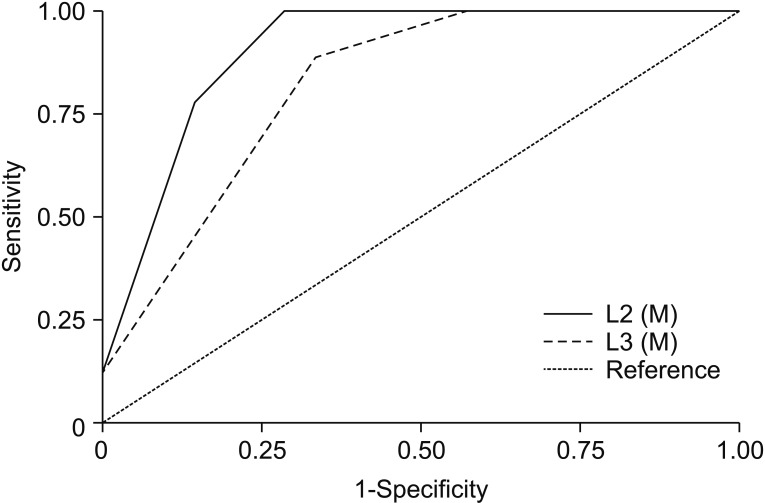
Motor and sensory scores were significantly different between the ambulators and non-ambulators. The majority was associated to the function of lower extremities. Calculation of area under ROC curves (AUC) revealed that strength of hip flexor (L2) (AUC=0.905, p<0.001) and knee extensor (L3) (AUC=0.820, p=0.006) contributed the greatest to independent walking. Also, hip flexor strength (L2) was the single most powerful predictor of ambulation by the logistic regression analysis (odds ratio=6.3, p=0.049), and the model fit well to the data.
The most important potential contributor for independent walking in patients with incomplete SCI is the muscle strength of hip flexors, followed by knee extensors compared with other sensory and motor variables.
确定运动和感觉变量对不完全性脊髓损伤(SCI)患者独立行走的不同贡献,并揭示这些变量中最显著的影响因素。
这项回顾性研究纳入了30例不完全性SCI患者,其损伤情况经磁共振成像确认。根据脊髓损伤神经学分类国际标准收集运动和感觉评分。通过绘制ROC(受试者工作特征)曲线分析这些变量,以评估它们对独立行走的不同贡献。通过后续的逻辑回归分析确定最显著的功能决定因素。
行走者和非行走者之间的运动和感觉评分存在显著差异。大多数与下肢功能相关。ROC曲线下面积(AUC)计算显示,髋屈肌(L2)力量(AUC = 0.905,p < 0.001)和膝伸肌(L3)力量(AUC = 0.820,p = 0.006)对独立行走的贡献最大。此外,通过逻辑回归分析,髋屈肌力量(L2)是行走的单一最强预测因素(优势比 = 6.3,p = 0.049),且模型与数据拟合良好。
与其他感觉和运动变量相比,不完全性SCI患者独立行走最重要的潜在影响因素是髋屈肌的肌肉力量,其次是膝伸肌力量。