Department of Neuromedicine and Movement Science (INB), Faculty of Medicine and Health Sciences, Norwegian University of Science and Technology, Postbox 8905, 7491, Trondheim, Norway.
Norwegian Advisory Unit on Headaches, St. Olavs University Hospital, Trondheim, Norway.
J Headache Pain. 2018 Jan 22;19(1):8. doi: 10.1186/s10194-018-0838-2.
Headache is the most frequent symptom following head injury, but long-term follow-up of headache after head injury entails methodological challenges. In a population-based cohort study, we explored whether subjects hospitalized due to a head injury more often developed a new headache or experienced exacerbation of previously reported headache compared to the surrounding population.
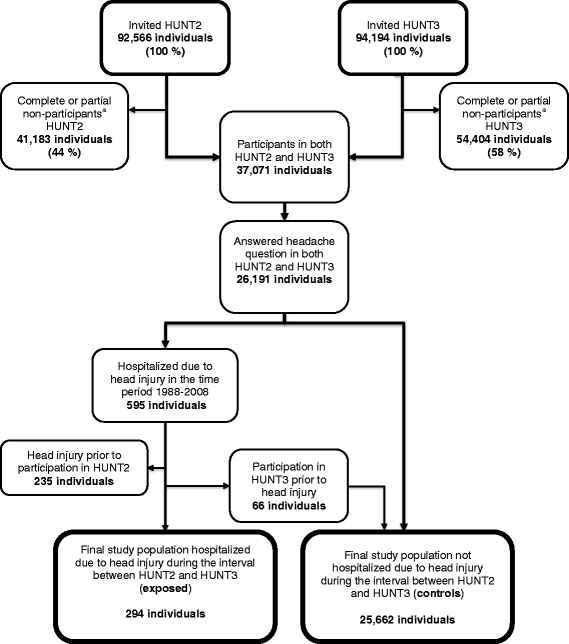
This population-based historical cohort study included headache data from two large epidemiological surveys performed with an 11-year interval. This was linked with data from hospital records on exposure to head injury occurring between the health surveys. Participants in the surveys who had not been hospitalized because of a head injury comprised the control group. The head injuries were classified according to the Head Injury Severity Scale (HISS). Multinomial logistic regression was performed to investigate the association between head injury and new headache or exacerbation of pre-existing headache in a population with known pre-injury headache status, controlling for potential confounders.
The exposed group consisted of 294 individuals and the control group of 25,662 individuals. In multivariate analyses, adjusting for age, sex, anxiety, depression, education level, smoking and alcohol use, mild head injury increased the risk of new onset headache suffering (OR 1.74, 95% CI 1.05-2.87), stable headache suffering (OR 1.70, 95% CI 1.15-2.50) and exacerbation of previously reported headache (OR 1.93, 95% CI 1.24-3.02). The reference category was participants without headache in both surveys.
Individuals hospitalized due to a head injury were more likely to have new onset and worsening of pre-existing headache and persistent headache, compared to the surrounding general population. The results support the entity of the ICHD-3 beta diagnosis "persistent headache attributed to traumatic injury to the head".
头痛是颅脑损伤后最常见的症状,但长期随访颅脑损伤后的头痛存在方法学挑战。在一项基于人群的队列研究中,我们探讨了与周围人群相比,因头部受伤住院的患者是否更常出现新发头痛或既往报告的头痛加重。
本基于人群的历史队列研究纳入了两项相隔 11 年进行的大型流行病学调查中的头痛数据。将这些数据与健康调查期间头部受伤住院记录的数据进行了关联。调查中未因头部受伤住院的参与者构成对照组。头部受伤根据头部损伤严重程度量表(HISS)进行分类。采用多变量逻辑回归分析,在已知受伤前头痛状况的人群中,调查头部受伤与新发头痛或原有头痛加重之间的关系,同时控制潜在混杂因素。
暴露组包括 294 名参与者,对照组包括 25662 名参与者。在多变量分析中,调整年龄、性别、焦虑、抑郁、教育程度、吸烟和饮酒因素后,轻度头部损伤增加新发头痛(OR 1.74,95%CI 1.05-2.87)、稳定头痛(OR 1.70,95%CI 1.15-2.50)和原有头痛加重(OR 1.93,95%CI 1.24-3.02)的风险。参考类别为两次调查均无头痛的参与者。
与周围一般人群相比,因头部受伤住院的患者更易出现新发和原有头痛加重以及持续性头痛。这些结果支持 ICHD-3 beta 诊断“创伤性头部损伤所致持续性头痛”的实体存在。