Pfeifer Mischa D, Scholkmann Felix, Labruyère Rob
Rehabilitation Center for Children and Adolescents, University Children's Hospital Zurich, Affoltern am Albis, Switzerland.
Biomedical Optics Research Laboratory, Department of Neonatology, University Hospital Zurich, University of Zurich, Zurich, Switzerland.
Front Hum Neurosci. 2018 Jan 8;11:641. doi: 10.3389/fnhum.2017.00641. eCollection 2017.
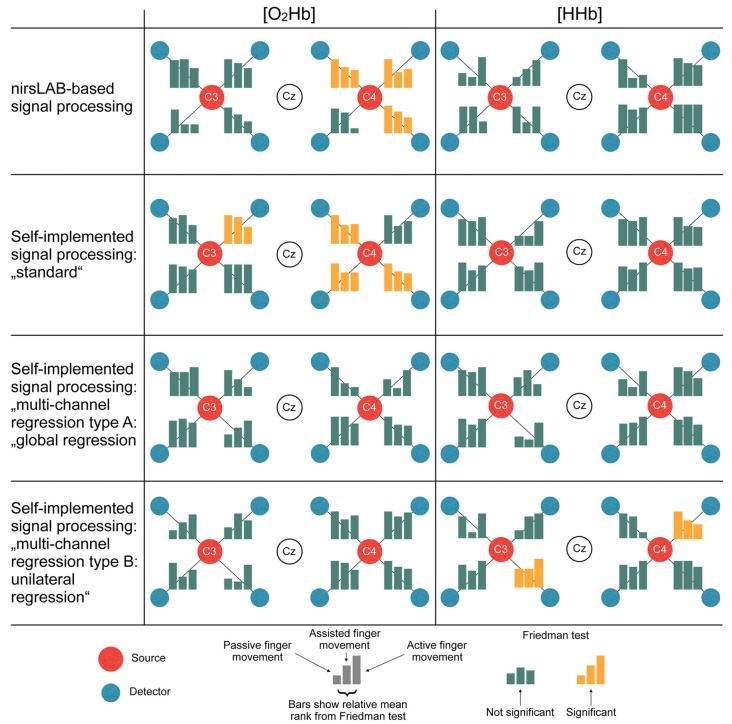
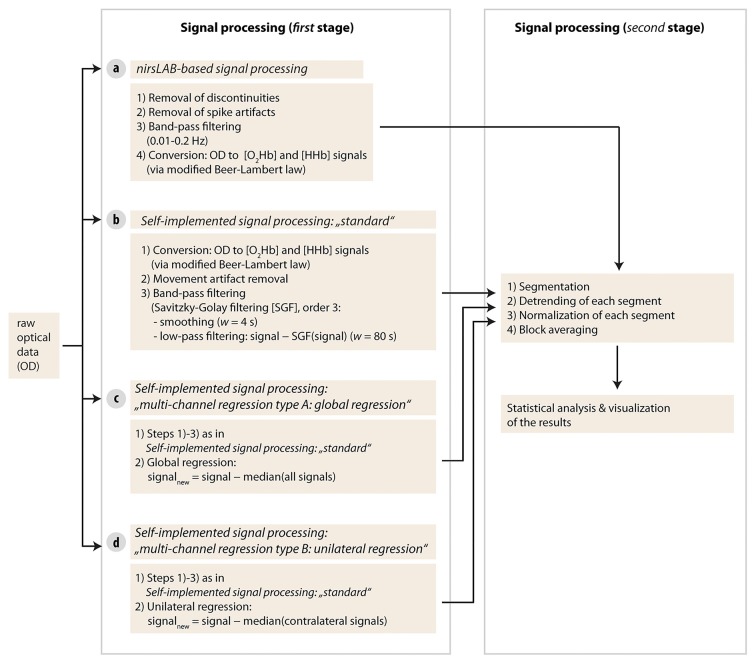
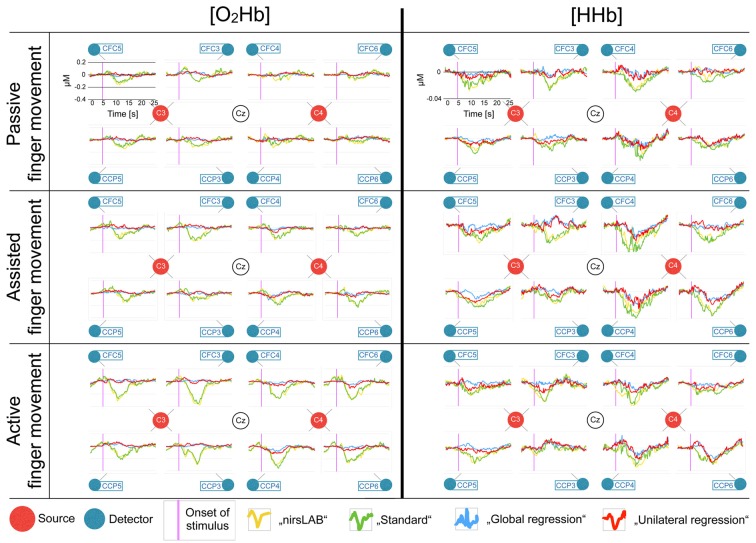
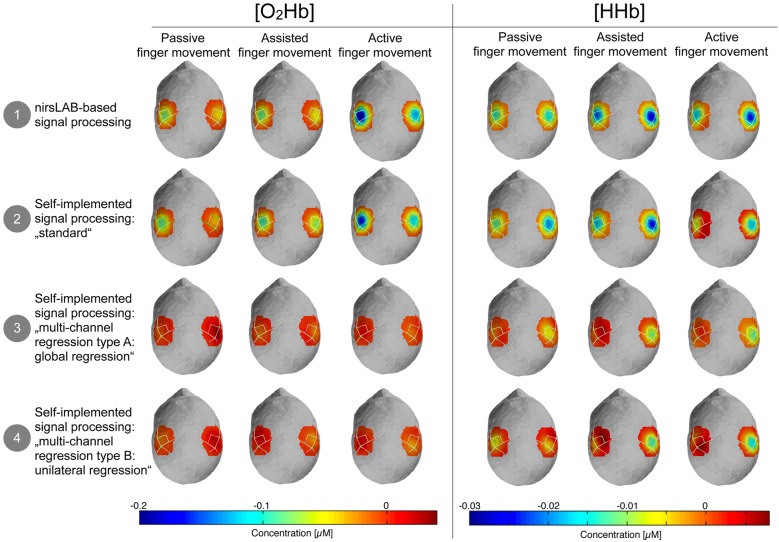
Even though research in the field of functional near-infrared spectroscopy (fNIRS) has been performed for more than 20 years, consensus on signal processing methods is still lacking. A significant knowledge gap exists between established researchers and those entering the field. One major issue regularly observed in publications from researchers new to the field is the failure to consider possible signal contamination by hemodynamic changes unrelated to neurovascular coupling (i.e., scalp blood flow and systemic blood flow). This might be due to the fact that these researchers use the signal processing methods provided by the manufacturers of their measurement device without an advanced understanding of the performed steps. The aim of the present study was to investigate how different signal processing approaches (including and excluding approaches that partially correct for the possible signal contamination) affect the results of a typical functional neuroimaging study performed with fNIRS. In particular, we evaluated one standard signal processing method provided by a commercial company and compared it to three customized approaches. We thereby investigated the influence of the chosen method on the statistical outcome of a clinical data set (task-evoked motor cortex activity). No short-channels were used in the present study and therefore two types of multi-channel corrections based on multiple long-channels were applied. The choice of the signal processing method had a considerable influence on the outcome of the study. While methods that ignored the contamination of the fNIRS signals by task-evoked physiological noise yielded several significant hemodynamic responses over the whole head, the statistical significance of these findings disappeared when accounting for part of the contamination using a multi-channel regression. We conclude that adopting signal processing methods that correct for physiological confounding effects might yield more realistic results in cases where multi-distance measurements are not possible. Furthermore, we recommend using manufacturers' standard signal processing methods only in case the user has an advanced understanding of every signal processing step performed.
尽管功能近红外光谱(fNIRS)领域的研究已经开展了20多年,但在信号处理方法上仍未达成共识。资深研究人员与刚进入该领域的人员之间存在显著的知识差距。在该领域新研究人员的出版物中经常观察到的一个主要问题是,未能考虑与神经血管耦合无关的血流动力学变化(即头皮血流和全身血流)可能造成的信号污染。这可能是因为这些研究人员使用测量设备制造商提供的信号处理方法,而对所执行的步骤缺乏深入理解。本研究的目的是调查不同的信号处理方法(包括和排除部分校正可能信号污染的方法)如何影响使用fNIRS进行的典型功能神经成像研究的结果。特别是,我们评估了一家商业公司提供的一种标准信号处理方法,并将其与三种定制方法进行比较。我们由此研究了所选方法对临床数据集(任务诱发的运动皮层活动)统计结果的影响。本研究未使用短通道,因此应用了基于多个长通道的两种多通道校正方法。信号处理方法的选择对研究结果有相当大的影响。虽然忽略任务诱发的生理噪声对fNIRS信号污染的方法在整个头部产生了几个显著的血流动力学反应,但当使用多通道回归考虑部分污染时,这些发现的统计显著性消失了。我们得出结论,在无法进行多距离测量的情况下,采用校正生理混杂效应的信号处理方法可能会产生更现实的结果。此外,我们建议仅在用户对所执行的每个信号处理步骤有深入理解的情况下使用制造商的标准信号处理方法。