Roumelioti Maria-Eleni, Glew Robert H, Khitan Zeid J, Rondon-Berrios Helbert, Argyropoulos Christos P, Malhotra Deepak, Raj Dominic S, Agaba Emmanuel I, Rohrscheib Mark, Murata Glen H, Shapiro Joseph I, Tzamaloukas Antonios H
Division of Nephrology, Department of Medicine, University of New Mexico School of Medicine, Albuquerque, NM 87131, United States.
Department of Surgery, University of New Mexico School of Medicine, Albuquerque, NM 87131, United States.
World J Nephrol. 2018 Jan 6;7(1):1-28. doi: 10.5527/wjn.v7.i1.1.
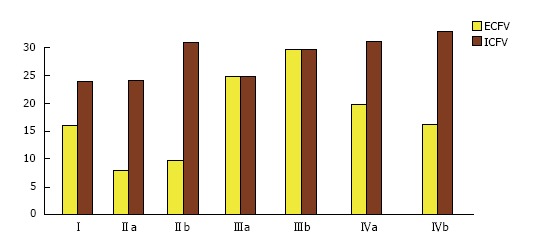
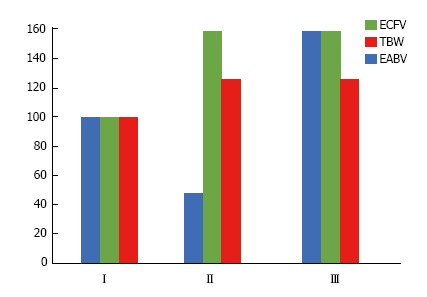
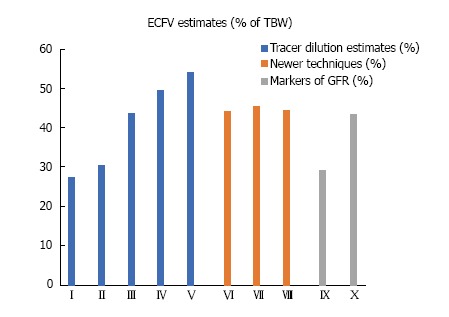
The regulation of body fluid balance is a key concern in health and disease and comprises three concepts. The first concept pertains to the relationship between total body water (TBW) and total effective solute and is expressed in terms of the tonicity of the body fluids. Disturbances in tonicity are the main factor responsible for changes in cell volume, which can critically affect brain cell function and survival. Solutes distributed almost exclusively in the extracellular compartment (mainly sodium salts) and in the intracellular compartment (mainly potassium salts) contribute to tonicity, while solutes distributed in TBW have no effect on tonicity. The second body fluid balance concept relates to the regulation and measurement of abnormalities of sodium salt balance and extracellular volume. Estimation of extracellular volume is more complex and error prone than measurement of TBW. A key function of extracellular volume, which is defined as the effective arterial blood volume (EABV), is to ensure adequate perfusion of cells and organs. Other factors, including cardiac output, total and regional capacity of both arteries and veins, Starling forces in the capillaries, and gravity also affect the EABV. Collectively, these factors interact closely with extracellular volume and some of them undergo substantial changes in certain acute and chronic severe illnesses. Their changes result not only in extracellular volume expansion, but in the need for a larger extracellular volume compared with that of healthy individuals. Assessing extracellular volume in severe illness is challenging because the estimates of this volume by commonly used methods are prone to large errors in many illnesses. In addition, the optimal extracellular volume may vary from illness to illness, is only partially based on volume measurements by traditional methods, and has not been determined for each illness. Further research is needed to determine optimal extracellular volume levels in several illnesses. For these reasons, extracellular volume in severe illness merits a separate third concept of body fluid balance.
体液平衡的调节是健康和疾病中的一个关键问题,它包含三个概念。第一个概念涉及总体水(TBW)与总有效溶质之间的关系,并以体液的张力来表示。张力的紊乱是导致细胞体积变化的主要因素,这可能会严重影响脑细胞的功能和存活。几乎仅分布在细胞外液(主要是钠盐)和细胞内液(主要是钾盐)中的溶质对张力有贡献,而分布在TBW中的溶质对张力没有影响。第二个体液平衡概念涉及钠盐平衡异常和细胞外液量的调节与测量。细胞外液量的估计比TBW的测量更复杂且更容易出错。细胞外液量的一个关键功能,即有效动脉血容量(EABV),是确保细胞和器官的充分灌注。其他因素,包括心输出量、动脉和静脉的总容量和局部容量、毛细血管中的 Starling 力以及重力,也会影响EABV。总体而言,这些因素与细胞外液量密切相互作用,其中一些在某些急性和慢性重症疾病中会发生显著变化。它们的变化不仅会导致细胞外液量扩张,还会导致与健康个体相比需要更大的细胞外液量。在重症疾病中评估细胞外液量具有挑战性,因为常用方法对该容量的估计在许多疾病中容易出现较大误差。此外,最佳细胞外液量可能因疾病而异,仅部分基于传统方法的容量测量,并且尚未针对每种疾病确定。需要进一步研究以确定几种疾病中的最佳细胞外液量水平。出于这些原因,重症疾病中的细胞外液量值得作为体液平衡的第三个单独概念。