Guo Dan, Xie Jiangtao, Zhao Junjie, Huang Tingqin, Guo Xiaoye, Song Jinning
Department of Neurosurgery, The First Affiliated Hospital of Xi'an Jiaotong University, Xi'an.
Department of Neurosurgery, The Central Hospital of Xianyang, Xianyang, Shaanxi, China.
Neuroreport. 2018 Mar 21;29(5):368-379. doi: 10.1097/WNR.0000000000000975.
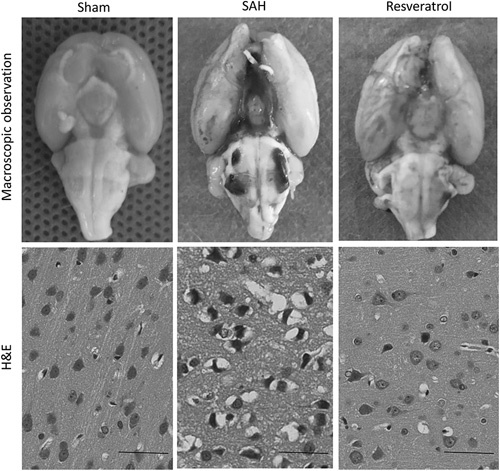
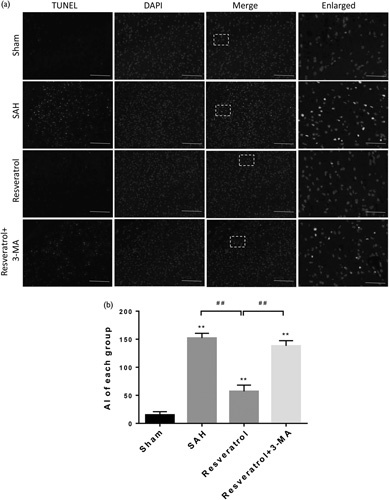
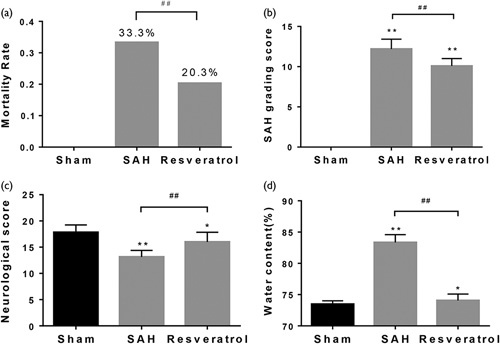
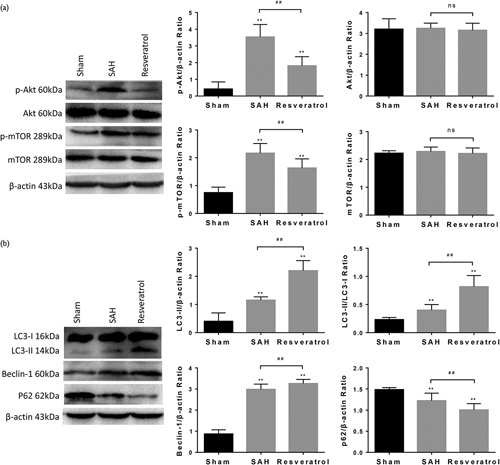
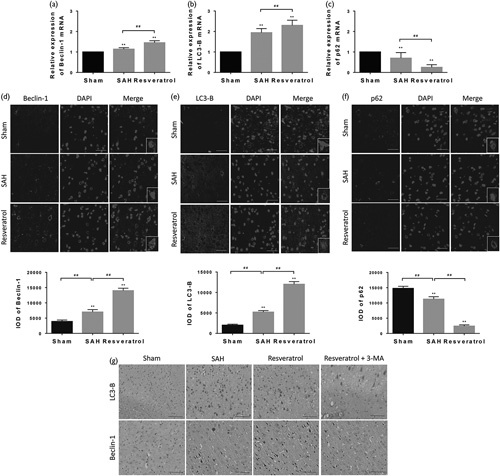
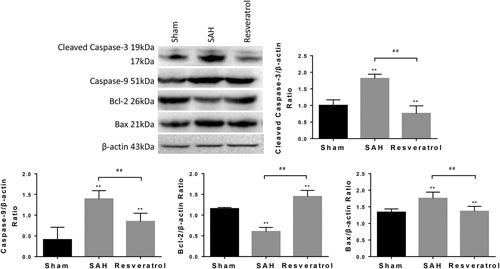
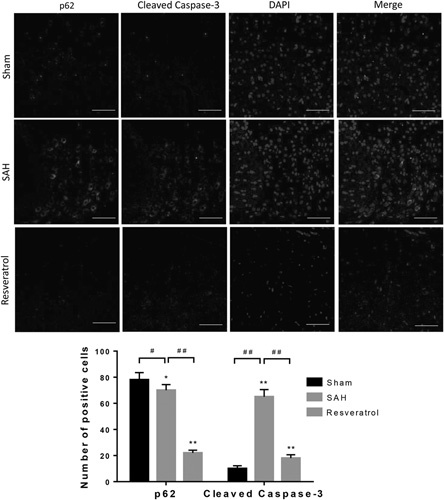
Early brain injury (EBI) plays a key role in determining the prognosis of patients suffering from subarachnoid hemorrhage (SAH). Resveratrol, a natural polyphenol, serves a neuroprotection function on EBI after SAH. However, the potential mechanism of resveratrol on EBI remains to be elucidated. Akt, also known as protein kinase B, and mammalian target of rapamycin (mTOR), the downstream protein of Akt, play key roles in cell survival and apoptosis, cell cycle regulation, and cellular protein homeostasis. In the present study, we examined the effect of resveratrol on EBI and their potential relationship with the Akt/mTOR pathway, autophagy, and apoptosis. Rats received intraperitoneal administration of resveratrol or vehicle immediately after establishing SAH model. We found that mortality and brain edema were significantly lower, whereas the neurological score was higher for resveratrol-treated rats. HE staining showed that resveratrol significantly reduced the neuronal pyknosis and swelling in the resveratrol-treated rats compared with SAH rats. The results were assessed by western blot, reverse transcription-PCR , and immunohistochemistry and immunofluorescence at 24 h after injury to determine changes in the expression of the Akt/mTOR signaling pathway, autophagy, and apoptosis proteins. Western blot analysis showed that the expression of beclin-1, LC3-II, LC3-II/LC3-I, and Bcl-2 was increased in resveratrol-treated rats, whereas the expression of p-Akt, p-mTOR, p62, cleaved caspase-3, caspase-9, and Bcl-2-associated X protein was decreased. Immunohistochemistry analysis of beclin-1, LC3-B treated with resveratrol alone or in combination with 3-methyladenine (autophagy inhibitor) suggested that resveratrol induced the autophagy process and the inhibitor blocked the occurrence of autophagy, and also increased the number of terminal deoxynucleotidyl transferase-mediated digoxigenin-DUTP-biotin nick-end labeling (+) cells. Taken together, these findings indicate that resveratrol exerts neuroprotective effects on EBI after SAH by regulating autophagy and apoptosis mediated by the Akt/mTOR pathway.
早期脑损伤(EBI)在决定蛛网膜下腔出血(SAH)患者的预后方面起着关键作用。白藜芦醇是一种天然多酚,对SAH后的EBI具有神经保护作用。然而,白藜芦醇对EBI的潜在作用机制仍有待阐明。Akt,也称为蛋白激酶B,以及Akt的下游蛋白哺乳动物雷帕霉素靶蛋白(mTOR),在细胞存活和凋亡、细胞周期调控以及细胞蛋白质稳态中起关键作用。在本研究中,我们研究了白藜芦醇对EBI的影响及其与Akt/mTOR途径、自噬和凋亡的潜在关系。在建立SAH模型后,大鼠立即腹腔注射白藜芦醇或溶剂。我们发现,与SAH大鼠相比,白藜芦醇治疗组大鼠的死亡率和脑水肿显著降低,而神经功能评分更高。苏木精-伊红(HE)染色显示,与SAH大鼠相比,白藜芦醇治疗组大鼠的神经元固缩和肿胀明显减轻。在损伤后24小时通过蛋白质免疫印迹法、逆转录-聚合酶链反应(RT-PCR)、免疫组织化学和免疫荧光评估结果,以确定Akt/mTOR信号通路、自噬和凋亡蛋白表达的变化。蛋白质免疫印迹分析显示,白藜芦醇治疗组大鼠中beclin-1、微管相关蛋白1轻链3-II(LC3-II)、LC3-II/LC3-I和Bcl-2的表达增加,而磷酸化Akt(p-Akt)、磷酸化mTOR(p-mTOR)、p62、裂解的半胱天冬酶-3、半胱天冬酶-9和Bcl-2相关X蛋白的表达降低。单独使用白藜芦醇或与3-甲基腺嘌呤(自噬抑制剂)联合处理后对beclin-1、LC3-B的免疫组织化学分析表明,白藜芦醇诱导了自噬过程,该抑制剂阻断了自噬的发生,并且还增加了末端脱氧核苷酸转移酶介导的地高辛-脱氧尿苷三磷酸-生物素缺口末端标记(TUNEL)阳性细胞的数量。综上所述,这些发现表明白藜芦醇通过调节Akt/mTOR途径介导的自噬和凋亡对SAH后的EBI发挥神经保护作用。