Kim So Young, Kim Min-Su, Park Bumjung, Kim Jin-Hwan, Choi Hyo Geun
Department of Otorhinolaryngology-Head & Neck Surgery, CHA Bundang Medical Center, CHA University, Seongnam, Korea.
Department of Otorhinolaryngology-Head & Neck Surgery, Korea University Ansan Hospital, Ansan, Korea.
PLoS One. 2018 Jan 23;13(1):e0191713. doi: 10.1371/journal.pone.0191713. eCollection 2018.
Previous studies have suggested that excessive internet use may cause lack of sleep. However, recent studies have hypothesized that lack of sleep may instigate internet use for leisure. To elucidate the potential effects of sleep time on internet use, we explored the different associations between sleep time and internet use according to its purpose.
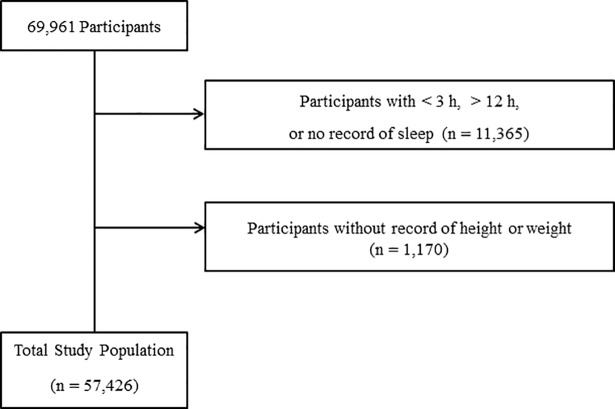
The population-based, cross-sectional study group from the Korea Youth Risk Behavior Web-based Survey (KYRBWS) collected data from 57,425 middle school students in 2014 and 2015. Sleep time over the past 7 days was classified into the following groups: < 7 h (6 h); ≥ 7 h, < 8 h (7 h); ≥ 8 h, < 9 h (8 h); and ≥ 9 h (9+ h). Internet use time per day was separately surveyed for leisure and for study and categorized as follows: 0 h; > 0 h, ≤ 1 h (1 h); > 1 h, ≤ 2 h (2 h); and > 2 h (2+ h) per day. Information on age, sex, region of residence, body mass index (BMI), economic level, parental education level, stress level, school performance level, and sleep satisfaction were retrieved. The relationships between sleep time and internet use time for leisure/study were analyzed using multinomial logistic regression with complex sampling. In the subgroup analysis according to sleep satisfaction (good, normal, and poor), the associations of sleep time with internet use for leisure were analyzed using the same methods.
Compared to 9+ h of sleep, less sleep was related to a long internet use time (2+ h) for leisure (adjusted odds ratio, AOR [95% confidence interval, CI] of sleep: 8 h = 1.23 [1.14-1.32]; 7 h = 1.42 [1.31-1.54]; and 6 h = 1.56 [1.44-1.70]; P < 0.001). Conversely, a relationship between less sleep and a long internet use time (2+ h) for study was evident only for 6 h of sleep (AOR of sleep: 8 h = 0.84 [0.84-1.04]; 7 h = 1.05 [0.94-1.17]; and 6 h = 1.32 [1.27-1.59]; P < 0.001). In the subgroup analysis according to sleep satisfaction, less sleep was associated with a long internet use time for leisure in all sleep satisfaction groups, although the relationship was more significant in the lower sleep satisfaction group.
Less sleep was significantly related to long-term use of the internet for leisure, whereas this association was not definite for internet use for study. Furthermore, poor sleep quality potentiated the relationship between less sleep time and internet use for leisure.
以往研究表明,过度使用互联网可能导致睡眠不足。然而,最近的研究推测,睡眠不足可能会促使人们为了休闲而使用互联网。为了阐明睡眠时间对互联网使用的潜在影响,我们根据互联网使用目的,探讨了睡眠时间与互联网使用之间的不同关联。
基于韩国青少年风险行为网络调查(KYRBWS)的人群横断面研究组在2014年和2015年收集了57425名中学生的数据。过去7天的睡眠时间分为以下几组:<7小时(6小时);≥7小时,<8小时(7小时);≥8小时,<9小时(8小时);以及≥9小时(9+小时)。每天用于休闲和学习的互联网使用时间分别进行调查,并分类如下:0小时;>0小时,≤1小时(1小时);>1小时,≤2小时(2小时);以及>2小时(2+小时)/天。收集了有关年龄、性别、居住地区、体重指数(BMI)、经济水平、父母教育水平、压力水平、学业成绩水平和睡眠满意度的信息。使用复杂抽样的多项逻辑回归分析睡眠时间与休闲/学习互联网使用时间之间的关系。在根据睡眠满意度(良好、正常和差)进行的亚组分析中,使用相同方法分析睡眠时间与休闲互联网使用之间的关联。
与睡眠9+小时相比,睡眠时间减少与休闲时长时间使用互联网(2+小时)相关(调整优势比,AOR[95%置信区间,CI]:8小时睡眠=1.23[1.14-1.32];7小时睡眠=1.42[1.31-1.54];6小时睡眠=1.56[1.44-1.70];P<0.001)。相反,仅在睡眠6小时时,睡眠时间减少与长时间用于学习的互联网使用时间(2+小时)之间存在明显关系(睡眠AOR:8小时睡眠=0.84[0.84-1.04];7小时睡眠=1.05[0.94-1.17];6小时睡眠=1.32[1.27-1.59];P<0.001)。在根据睡眠满意度进行的亚组分析中,在所有睡眠满意度组中,睡眠时间减少都与休闲时长时间使用互联网相关,尽管在睡眠满意度较低的组中这种关系更显著。
睡眠时间减少与长期休闲使用互联网显著相关,而这种关联在用于学习的互联网使用方面并不确定。此外,睡眠质量差加剧了睡眠时间减少与休闲互联网使用之间的关系。