Department of Psychology and Neuroscience, Duke University, Durham, NC 27708.
Department of Neurobiology, Duke University, Durham, NC 27708.
Proc Natl Acad Sci U S A. 2018 Feb 6;115(6):E1309-E1318. doi: 10.1073/pnas.1717948115. Epub 2018 Jan 23.
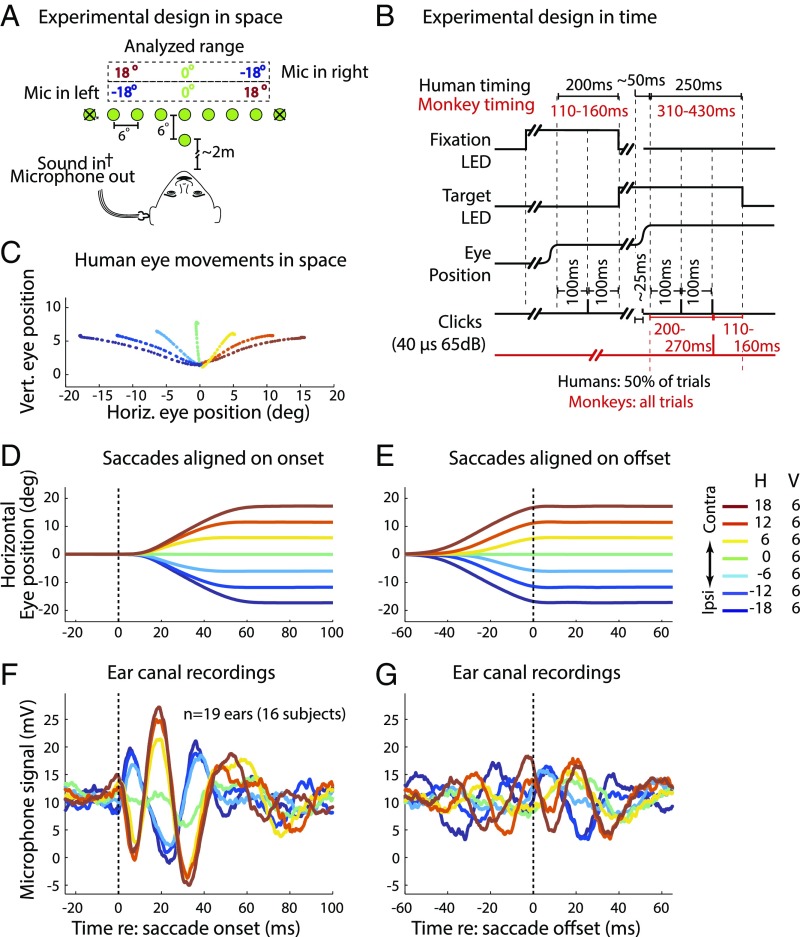
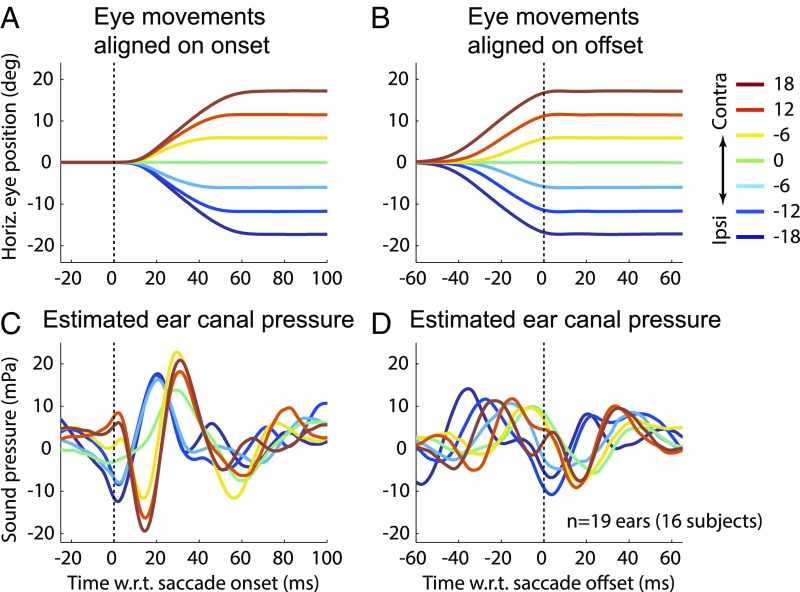
Interactions between sensory pathways such as the visual and auditory systems are known to occur in the brain, but where they first occur is uncertain. Here, we show a multimodal interaction evident at the eardrum. Ear canal microphone measurements in humans ( = 19 ears in 16 subjects) and monkeys ( = 5 ears in three subjects) performing a saccadic eye movement task to visual targets indicated that the eardrum moves in conjunction with the eye movement. The eardrum motion was oscillatory and began as early as 10 ms before saccade onset in humans or with saccade onset in monkeys. These eardrum movements, which we dub eye movement-related eardrum oscillations (EMREOs), occurred in the absence of a sound stimulus. The amplitude and phase of the EMREOs depended on the direction and horizontal amplitude of the saccade. They lasted throughout the saccade and well into subsequent periods of steady fixation. We discuss the possibility that the mechanisms underlying EMREOs create eye movement-related binaural cues that may aid the brain in evaluating the relationship between visual and auditory stimulus locations as the eyes move.
已知大脑中存在视觉和听觉等感觉通路之间的相互作用,但它们首先发生的位置尚不确定。在这里,我们展示了在鼓膜处明显存在的多模态相互作用。在执行扫视眼动任务以观察视觉目标的人类(= 16 名受试者中的 19 只耳朵)和猴子(= 3 名受试者中的 5 只耳朵)的耳道麦克风测量结果表明,鼓膜会随眼动一起移动。鼓膜运动呈振荡式,在人类中,早在扫视开始前 10 毫秒就开始,而在猴子中则与扫视开始时同步。这些我们称之为与眼动相关的鼓膜振动(EMREO)的鼓膜运动是在没有声音刺激的情况下发生的。EMREO 的幅度和相位取决于扫视的方向和水平幅度。它们在扫视过程中持续存在,并在随后的稳定注视期间持续存在。我们讨论了这样一种可能性,即 EMREO 背后的机制产生了与眼动相关的双耳线索,这可能有助于大脑在眼睛移动时评估视觉和听觉刺激位置之间的关系。