Key Laboratory of Public Health Safety of Ministry of Education, Collaborative Innovation Center of Social Risks Governance in Health, School of Public Health, Fudan University, Shanghai 200032, China.
Nutrients. 2018 Jan 24;10(2):114. doi: 10.3390/nu10020114.
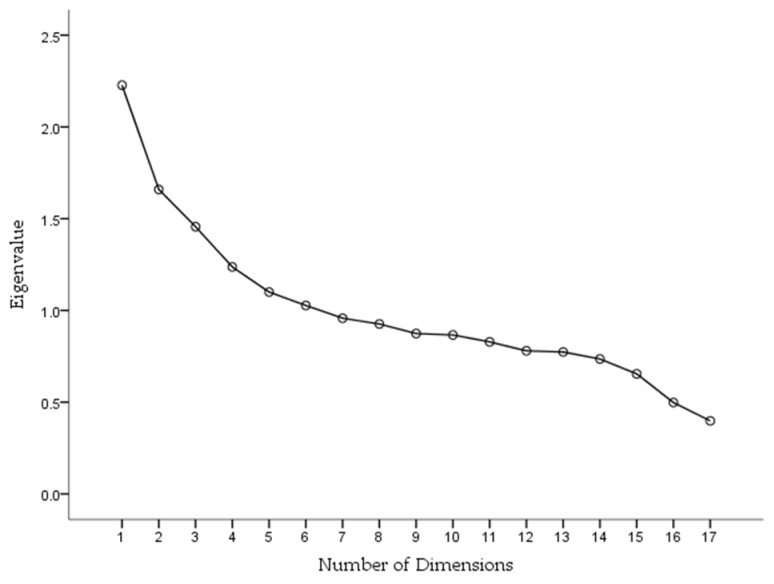
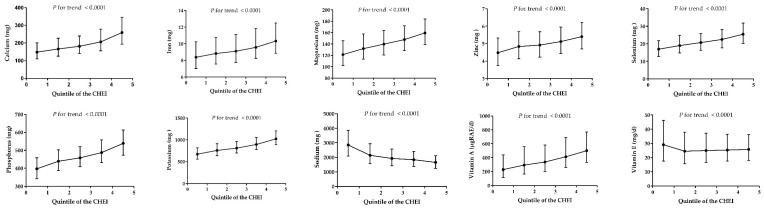
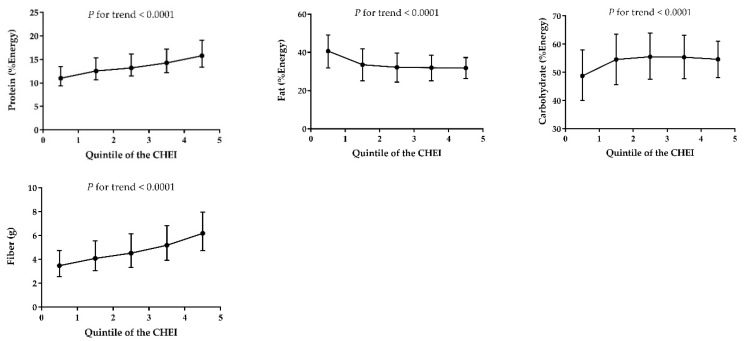
The Chinese Healthy Eating Index (CHEI) is a measuring instrument of diet quality in accordance with the Dietary Guidelines for Chinese (DGC)-2016. The objective of the study was to evaluate the validity and reliability of the CHEI. Data from 12,473 adults from the China Health and Nutrition Survey (CHNS)-2011, including 3-day-24-h dietary recalls were used in this study. The CHEI was assessed by four exemplary menus developed by the DGC-2016, the general linear models, the independent -test and the Mann-Whitney -test, the Spearman's correlation analysis, the principal components analysis (PCA), the Cronbach's coefficient, and the Pearson correlation with nutrient intakes. A higher CHEI score was linked with lower exposure to known risk factors of Chinese diets. The CHEI scored nearly perfect for exemplary menus for adult men (99.8), adult women (99.7), and the healthy elderly (99.1), but not for young children (91.2). The CHEI was able to distinguish the difference in diet quality between smokers and non-smokers ( < 0.0001), people with higher and lower education levels ( < 0.0001), and people living in urban and rural areas ( < 0.0001). Low correlations with energy intake for the CHEI total and component scores (|r| < 0.34, < 0.01) supported the index assessed diet quality independently of diet quantity. The PCA indicated that underlying multiple dimensions compose the CHEI, and Cronbach's coefficient α was 0.22. Components of dairy, fruits and cooking oils had the greatest impact on the total score. People with a higher CHEI score had not only a higher absolute intake of nutrients ( < 0.001), but also a more nutrient-dense diet ( < 0.001). Our findings support the validity and reliability of the CHEI when using the 3-day-24-h recalls.
中国健康饮食指数(CHEI)是一种根据《中国居民膳食指南(2016)》衡量饮食质量的工具。本研究旨在评估 CHEI 的有效性和可靠性。本研究使用了 2011 年中国健康与营养调查(CHNS)中的 12473 名成年人的 3 天 24 小时膳食回忆数据。使用《中国居民膳食指南(2016)》制定的四个典型菜单评估 CHEI,采用一般线性模型、独立检验和曼-惠特尼检验、Spearman 相关分析、主成分分析(PCA)、克朗巴赫系数和与营养素摄入量的 Pearson 相关分析。CHEI 得分越高,表明接触中国饮食已知危险因素的程度越低。CHEI 对成年男性(99.8)、成年女性(99.7)和健康老年人(99.1)的典型菜单评分近乎完美,但对幼儿(91.2)则不然。CHEI 能够区分吸烟者和不吸烟者(<0.0001)、受教育程度较高和较低的人群(<0.0001)以及城乡居民(<0.0001)之间饮食质量的差异。CHEI 总分和分量得分与能量摄入的相关性较低(|r| < 0.34,<0.01),表明该指数在评估饮食质量时独立于饮食量。PCA 表明 CHEI 由多个维度组成,Cronbach 系数 α 为 0.22。乳制品、水果和食用油的成分对总分的影响最大。CHEI 得分较高的人不仅营养素的绝对摄入量更高(<0.001),而且饮食更有营养密度(<0.001)。我们的研究结果支持使用 3 天 24 小时回忆法时 CHEI 的有效性和可靠性。