Key Laboratory of Public Health Safety of Ministry of Education, Collaborative Innovation Center of Social Risks Governance in Health, School of Public Health, Fudan University, Shanghai 200032, China.
Nutrients. 2017 Sep 5;9(9):977. doi: 10.3390/nu9090977.
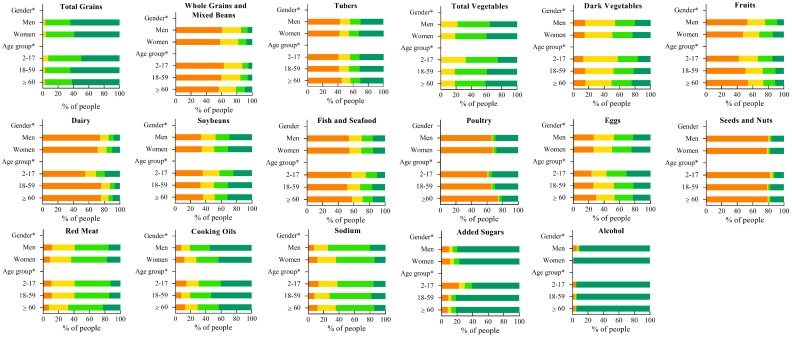
The objective of this study was to develop a Chinese Healthy Eating Index (CHEI) based on the updated Dietary Guidelines for Chinese (DGC-2016) and to apply it in the 2011 China Health and Nutrition Survey (CHNS-2011) to assess diet quality and its association with typical sociodemographic/economic factors. Data from 14,584 participants (≥2 years) from the CHNS-2011, including three 24-h dietary recalls and additional variables, were used to develop the CHEI. The standard portion size was applied to quantify food consumption. The CHEI was designed as a continuous scoring system, comprising 17 components; the maximum total score is 100. The mean, 1st and 99th percentiles of the CHEI score were 52.4, 27.6 and 78.3, respectively. Young and middle-aged adults scored better than the elderly. Diet insufficiency was chiefly manifested in fruits, dairy, whole grains and poultry; diet excess was mainly reflected in red meat, cooking oils and sodium. The CHEI was positively associated with education and urbanization levels; current smokers and unmarried people obtained relative low CHEI scores. Occupation and body mass index (BMI) were also related to the CHEI. Our findings indicate that the CHEI is capable of recognizing differences in diet quality among the Chinese, and it is sensitive to typical sociodemographic/economic factors.
本研究旨在基于《中国居民膳食指南(2016)》制定中国健康饮食指数(CHEI),并将其应用于 2011 年中国健康与营养调查(CHNS-2011)中,以评估饮食质量及其与典型社会人口经济学因素的关系。来自 CHNS-2011 的 14584 名(≥2 岁)参与者的数据,包括 3 次 24 小时膳食回顾和其他变量,用于开发 CHEI。采用标准份量来量化食物摄入。CHEI 设计为连续评分系统,包括 17 个组成部分;总分最高为 100 分。CHEI 得分的平均值、第 1 百分位数和第 99 百分位数分别为 52.4、27.6 和 78.3。年轻和中年成年人的得分优于老年人。饮食不足主要表现在水果、乳制品、全谷物和家禽;饮食过量主要反映在红肉、食用油和钠。CHEI 与教育和城市化水平呈正相关;吸烟者和未婚者的 CHEI 得分相对较低。职业和体重指数(BMI)也与 CHEI 有关。我们的研究结果表明,CHEI 能够识别中国人饮食质量的差异,并且对典型的社会人口经济学因素敏感。