Respiratory Unit, Ospedale San Paolo, Department of Health Science, Università degli Studi di Milano, Via A. di Rudinì, 8-20142, Milan, Italy.
Clinical Epidemiology and Medical Statistics Unit, Department of Biomedical Sciences, University of Sassari, Sassari, Italy.
Respir Res. 2018 Jan 24;19(1):18. doi: 10.1186/s12931-018-0721-3.
We carried out a systematic review and meta-analysis with the aim to evaluate the efficacy of longacting bronchodilators on exercise capacity in COPD patients.
The endpoints were the efficacy of long-acting bronchodilators (altogether, and by single classes) vs. placebo in modifying endurance time (ET), inspiratory capacity (IC) and dyspnea during exercise, taking into consideration the outcomes according to different patients’ inclusion criteria and exercise methodology.
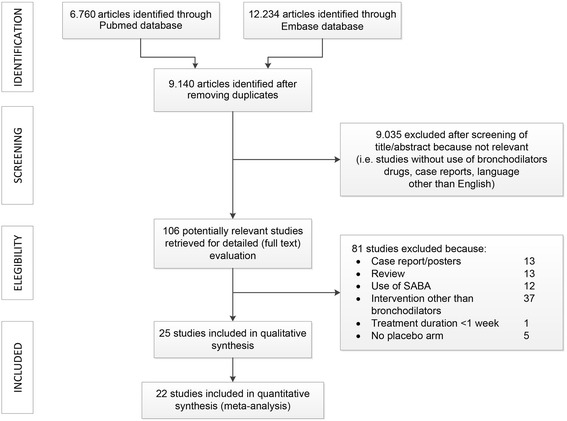
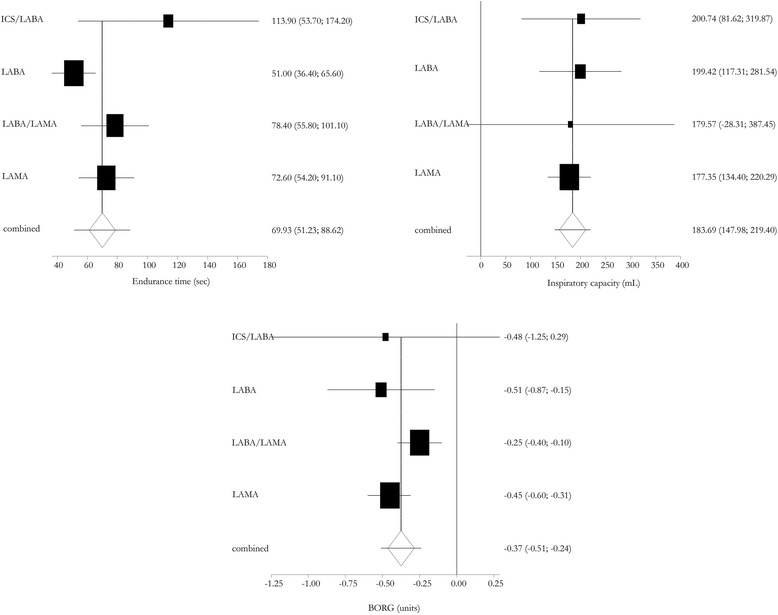
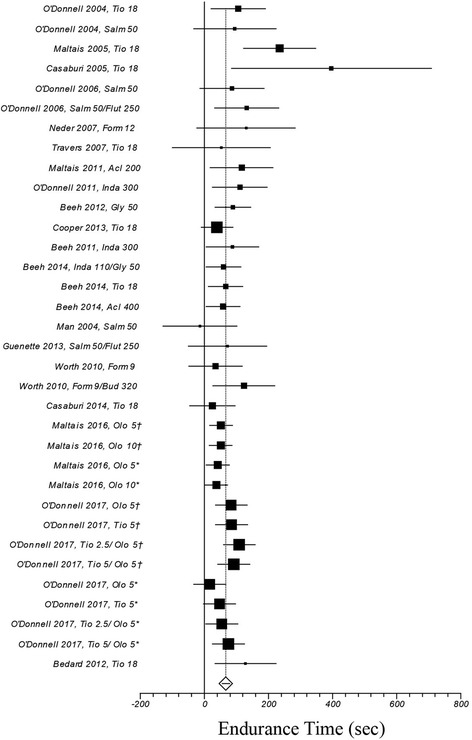
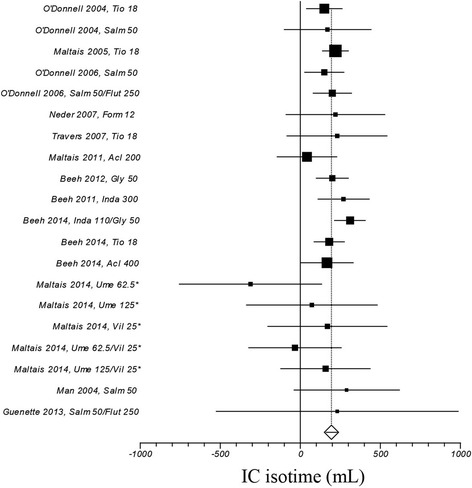
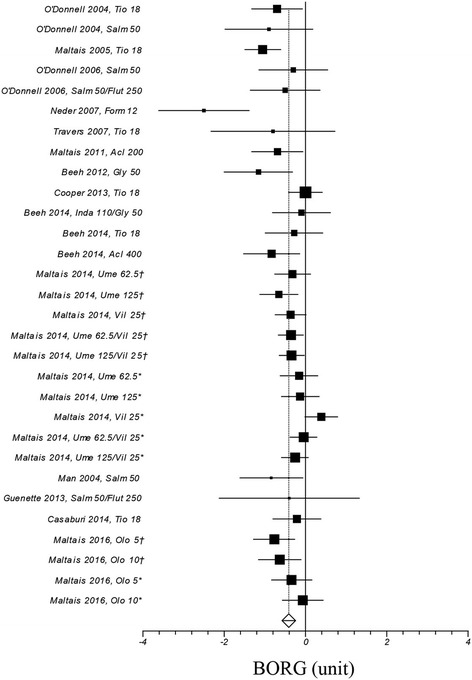
Twenty-two studies were deemed eligible for analysis. Weighted mean increase in ET resulted of 67 s (95% CI ranges from 55 to 79). For isotime IC and dyspnea during exercise, weighted improvements were 195 ml (162–229), and − 0.41 units (− 0.56 to − 0.27), respectively. The increase in trough IC was 157 ml (138–175). We found a trend in favour of LAMA compared to LABA in terms of ET. In the 11 studies which reported a value of functional residual capacity > 120% as inclusion criterion, weighted mean increase in endurance time was 94 s (65 to 123); however we did not find any significant correlation between ET and mean trough IC (P: 0.593). The improvement of ET in the 5 studies using walking as exercise methodology resulted of 58 s (− 4 to 121).
Long-acting bronchodilators improve exercise capacity in COPD. The main effect of long-acting bronchodilators seems to be a increase of basal IC rather than a modification of dynamic hyperinflation during exercise. The efficacy in terms of endurance time seems higher in studies which enrolled patients with hyperinflation, with a similar efficacy on walking or cycling.
我们进行了一项系统评价和荟萃分析,旨在评估长效支气管扩张剂在 COPD 患者运动能力方面的疗效。
终点是长效支气管扩张剂(总体和单一类别)与安慰剂相比,在改变耐力时间(ET)、吸气量(IC)和运动时呼吸困难方面的疗效,同时考虑根据不同患者纳入标准和运动方法学的结果。
有 22 项研究被认为符合分析条件。ET 的加权平均增加量为 67 秒(95%CI 范围为 55 至 79)。对于等时 IC 和运动时呼吸困难,加权改善量分别为 195 毫升(162-229)和-0.41 单位(-0.56 至-0.27)。潮气量 IC 增加了 157 毫升(138-175)。我们发现 LAMA 在 ET 方面比 LABA 更有优势。在 11 项报告功能残气量>120%作为纳入标准的研究中,耐力时间的加权平均增加量为 94 秒(65 至 123);然而,我们没有发现 ET 和平均潮气量 IC 之间存在任何显著相关性(P:0.593)。在使用步行作为运动方法的 5 项研究中,ET 的改善量为 58 秒(-4 至 121)。
长效支气管扩张剂可改善 COPD 患者的运动能力。长效支气管扩张剂的主要作用似乎是增加基础 IC,而不是改变运动时的动态过度充气。在纳入过度充气患者的研究中,在耐力时间方面的疗效似乎更高,在步行或骑自行车方面的疗效相似。