School of Mechanical, Aerospace and Civil Engineering, University of Manchester, Sackville Street, Manchester, M13 9PL, UK.
Department of Shoulder and Elbow Surgery, University Hospital of South Manchester, Southmoor Road, Wythenshawe, Manchester, M23 9LT, UK.
Biomed Eng Online. 2018 Jan 25;17(1):10. doi: 10.1186/s12938-018-0447-y.
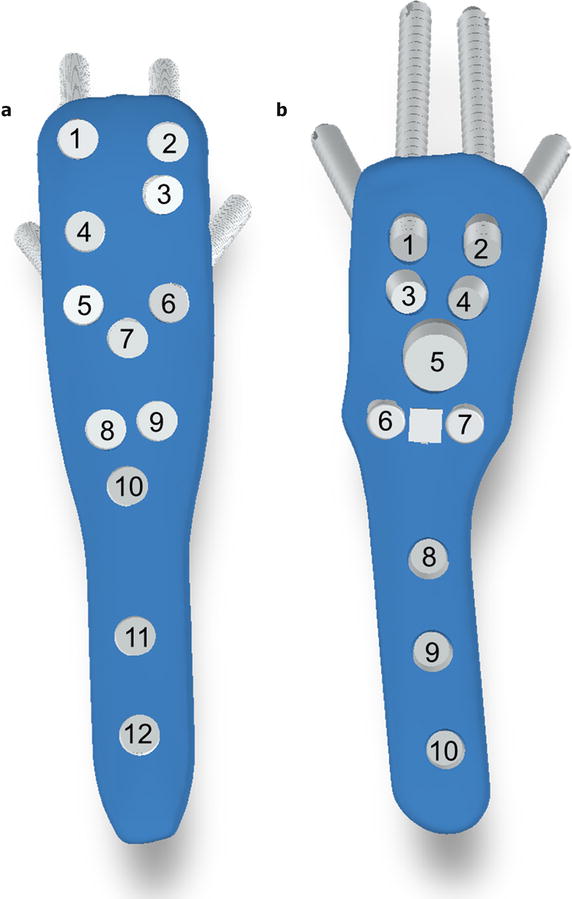
Open reduction and internal fixation of proximal humerus fractures can be difficult to achieve adequate, complication free results due to osteopenia of the proximal humerus and unstable fracture patterns. This study aimed to compare the biomechanical properties of a novel hybrid fixed angle blade plate (Fx plate) with an established fixed angle locking plate (PHILOS plate).
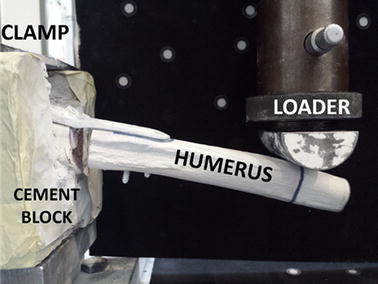
A two-part fracture was simulated in synthetic composite humeri by creating a transverse osteotomy and 10 mm fracture gap at the surgical neck. After treating the fractures with either an Fx plate or a PHILOS plate, humeral head was fixed and the shaft was displaced in a cantilever fashion. For elastic tests, loading was along the frontal and sagittal plane to achieve varus/valgus and extension/flexion, respectively. In plastic tests, loading was in a varus direction to determine the constructs' resistance to varus collapse.
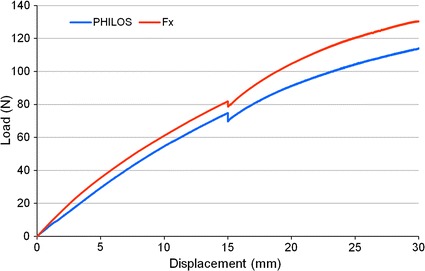
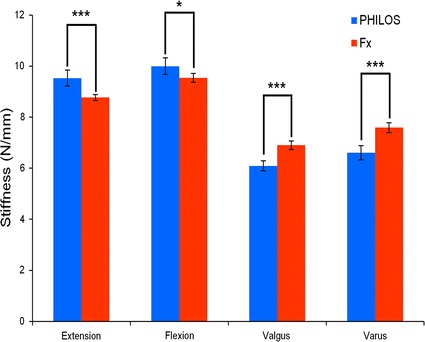
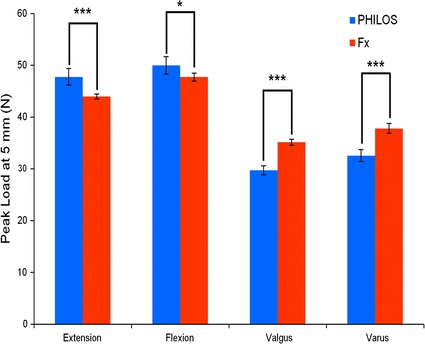
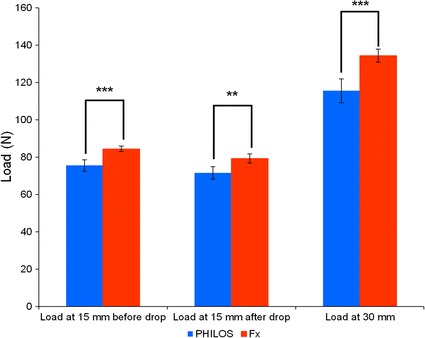
In elastic tests, both construct types had higher peak load and stiffness in extension/flexion than varus/valgus. Fx plate constructs were significantly stiffer than PHILOS constructs in varus/valgus (mean: 7.590/6.900 vs. 6.609/6.091 N/mm; p < 0.001 for both) but significantly less stiff in extension/flexion (8.770/9.541 vs. 9.533/9.997 N/mm; p < 0.001 for extension, p < 0.05 for flexion). In varus plastic tests, significantly higher peak loads were reported for Fx plate than PHILOS (134.391 vs. 115.531 N; p < 0.001).
In this fracture gap model, humeri implanted with a novel Fx plate provided higher varus/valgus stiffness but lower extension/flexion stiffness than a more traditional proximal humeral locking plate design (PHILOS).
由于肱骨头骨质疏松和不稳定的骨折模式,肱骨近端骨折的切开复位内固定术很难获得满意、无并发症的结果。本研究旨在比较新型混合固定角度刀片板(Fx 板)和已建立的固定角度锁定板(PHILOS 板)的生物力学特性。
通过在外科颈处创建横断骨切开术和 10mm 的骨折间隙,在合成复合材料肱骨中模拟两部分骨折。用 Fx 板或 PHILOS 板治疗骨折后,固定肱骨头并以悬臂方式移位骨干。对于弹性测试,加载方向沿额状面和矢状面,分别达到内翻/外翻和伸展/屈曲。在塑性测试中,加载方向为内翻,以确定结构对内翻塌陷的抵抗力。
在弹性测试中,两种结构类型在伸展/屈曲时的峰值载荷和刚度均高于内翻/外翻。在 Fx 板结构中,内翻/外翻的刚度明显高于 PHILOS 结构(平均:7.590/6.900 与 6.609/6.091N/mm;两者均 p<0.001),但在伸展/屈曲时的刚度明显较小(8.770/9.541 与 9.533/9.997N/mm;伸展时 p<0.001,屈曲时 p<0.05)。在内翻塑性测试中,Fx 板的峰值载荷明显高于 PHILOS(134.391 与 115.531N;p<0.001)。
在这个骨折间隙模型中,新型 Fx 板植入的肱骨在内外翻时具有更高的刚度,但在伸展/屈曲时的刚度低于更传统的肱骨近端锁定板设计(PHILOS)。